

What this worksheet helps children practise
Name ones and tens while working. Remind the child to subtract the lower digit from the top digit in each column. If only one digit is given, point to both boxes and read the stock left as a complete number.
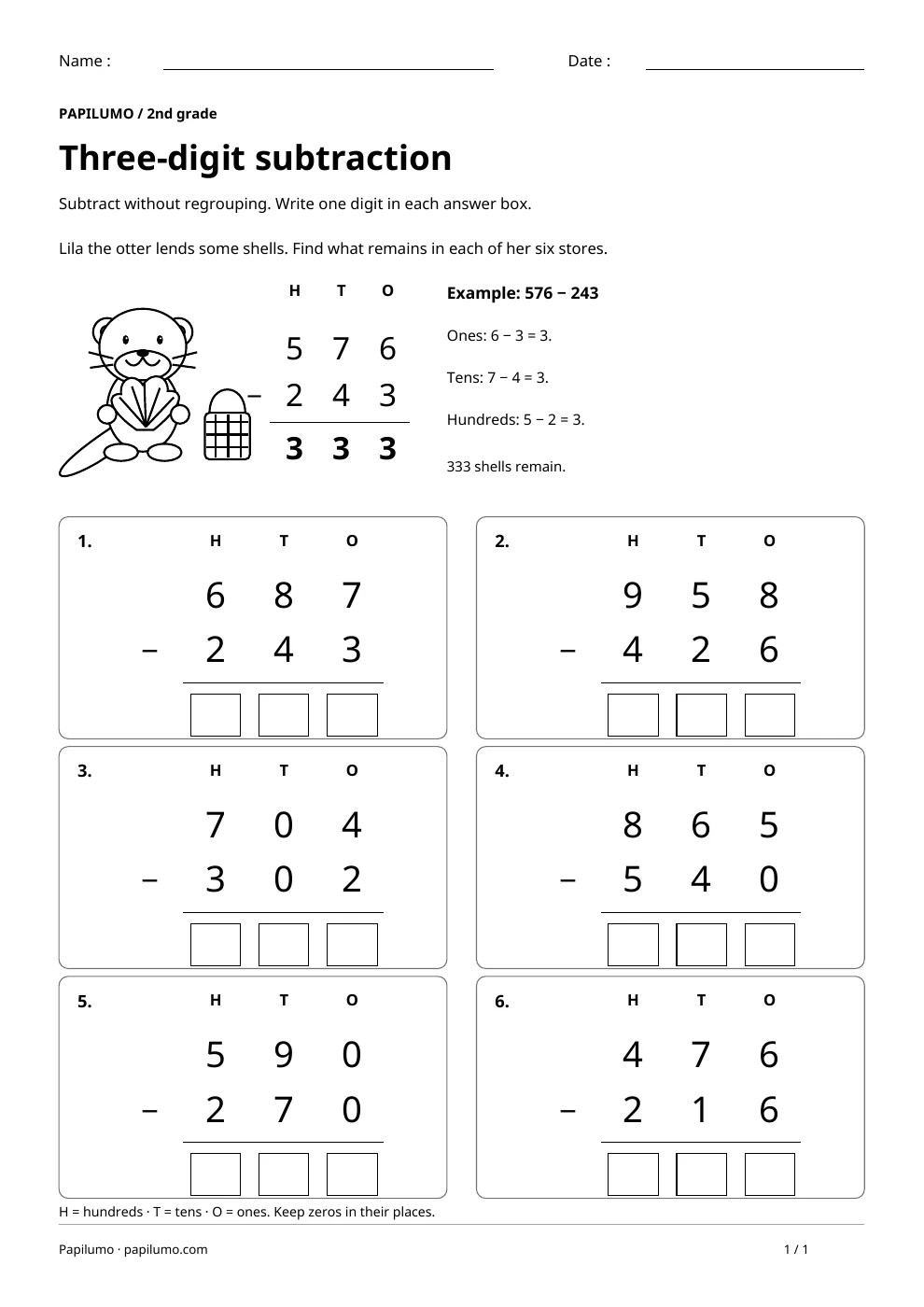
The aim is to subtract ones from ones and tens from tens while keeping each digit in its place. In every problem, each top digit is at least as large as the digit below it, so no ten needs to be exchanged. This guided early elementary activity suits children who understand tens and ones and know basic subtraction facts. The numbers are already aligned. For a related skill, use Three-digit subtraction without regrouping: Subtract without regrouping. Write one digit in each answer box.
Preparing a short session
Print at actual size and provide a pencil. Keep the key aside. Meet Luma and read the three row labels: At the start, Sold, and Left. Read both numbers before calculating. Point to ones on the right and tens on the left. The minus sign shows subtraction; the line separates both numbers from the answer. Each bottom box holds one digit in the column where that digit belongs.
A concrete example to get started
The model starts with 46 toys and takes away 23 sold. In the ones column, 6 - 3 = 3, so write 3 under the ones. In the tens column, 4 - 2 = 2: two tens remain, so write 2 on the left. Read the answer as 23, or two tens and three ones. In this model, the number sold and the number left happen to match, but they belong on different rows.
Supporting the activity
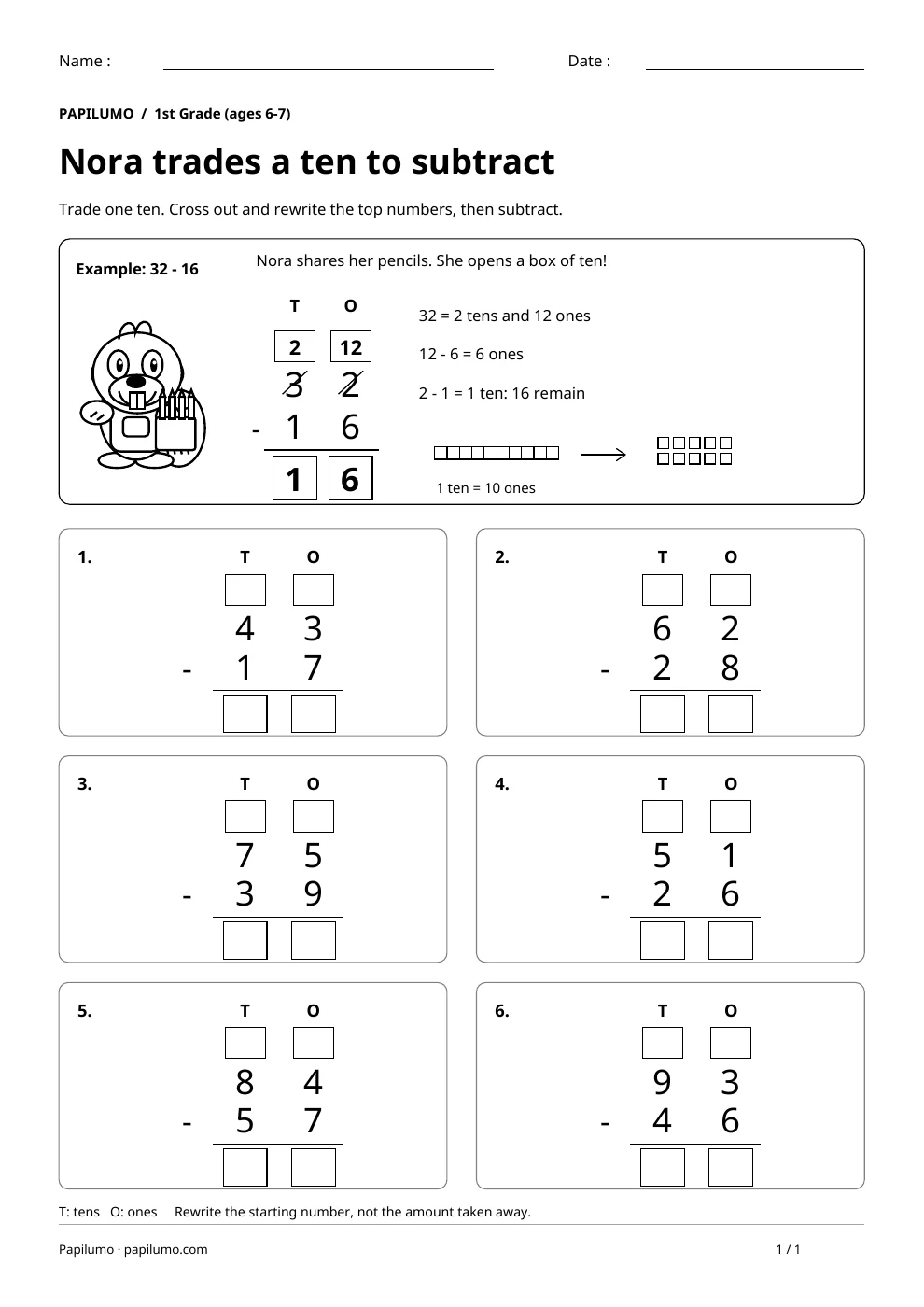
Begin with 47 - 23. Point to the ones, calculate 7 - 3, and write 4 on the right. Move to the tens: 4 - 2 gives 2 on the left. The child then reads 24 toys left. Use the same order in each frame. In 76 - 40, taking away zero ones leaves the six ones unchanged. In 86 - 36, taking away six ones from six leaves zero ones, so the right box needs 0. Read the complete answer after each sale. To vary the practice, try Two-digit subtraction with regrouping: Trade one ten. Cross out and rewrite the top numbers, then subtract.
What to notice and how to check
The six answers are 24, 33, 32, 36, 52, and 50 in problem order. Check both columns separately before comparing the whole number with the key. For 86 - 36, the 5 represents five tens and the 0 holds the ones place. An empty box does not show the same information as a written zero. If an answer is wrong, check whether the error is in a subtraction fact or a digit placed in the other column.
Making the task easier
Complete only 47 - 23 using tens and ones materials. Remove three ones and two tens, then compare what remains with the answer boxes. This representation helps explain the subtraction that is already arranged on the page.
Keep the learning aim, but reduce how much the child has to handle at once. Cover part of the page with another sheet and reveal one task at a time. Demonstrate a separate example, then leave a real opportunity to work something out. An answer reached with support is still a useful attempt; it does not yet show that the same task can be completed independently.
Taking the idea beyond the worksheet
Check one sale by adding toys left and toys sold: 24 + 23 gives 47 again. Ask the child why this check recovers Luma's starting stock. Keep the same numbers to connect subtraction with the related addition.
Use the follow-up to meet the same idea in a different setting. Offer it once the first task makes sense, without insisting that the whole page must be perfect. The child might explain a strategy, make an example or set a challenge for an adult. Return to the worksheet only when it helps connect the two situations. A short conversation or a practical activity can be enough to finish the session. To continue exploring, use Tens and Ones to 99: Count the tens rods and single squares. Complete each table.
Downloading and printing the PDF
This free PDF contains one worksheet designed for A4 paper. Download the file using the button on this page and open it in your PDF reader. Choose actual size or a 100% scale, check the orientation in the print preview and turn off any browser headers or footers. The illustrations use vector lines, so their outlines stay sharp when printed. Check the margins on one copy before preparing several sheets for a group. The level shown on the page is a guide, rather than a requirement to complete the activity at a particular age.