

What this worksheet helps children practise
After reaching 60, return to the left edge of the next row to read 61. The chart is not read in a zigzag. For above and below questions, stay in the same column: 74 is above 84, and 77 is below 67. If spatial vocabulary is unfamiliar, point to the two cells before discussing subtraction or addition. Treat unclear handwriting separately from a counting error, and let the child explain the number they intended.
The activity develops number order to 100 and navigation within a ten-column chart. Moving one box to the right adds one. Moving down one box in the same column adds ten. It suits first grade learners who can already read the numbers involved. Reciting a counting sequence is useful, but children also need to recognize the written numerals and notice where each new row starts. This is a practice chart, rather than a complete reference poster. For a related skill, use Before and after numbers to 99: Write the number just before and the number just after.
Preparing a short session
Print the student page at actual size and provide a pencil and eraser. Introduce Mila and her seed storage before discussing the chart. Its rows cover 51 to 60, 61 to 70, 71 to 80, 81 to 90, and 91 to 100. Printed numbers are clues and do not need to be copied. Keep the answer key out of sight during the first attempt. A full hundred chart can be offered as a temporary support if needed.
A concrete example to get started
The first row shows 51, an empty box, and 53. The missing number is 52. Farther along, 54 and 56 frame the space for 55. Ask the child to read those three consecutive numbers after writing an answer. A vertical check gives another clue: the box directly below 52 must contain 62. Checking in two directions helps children confirm a choice without restarting their count at one every time.
Supporting the activity
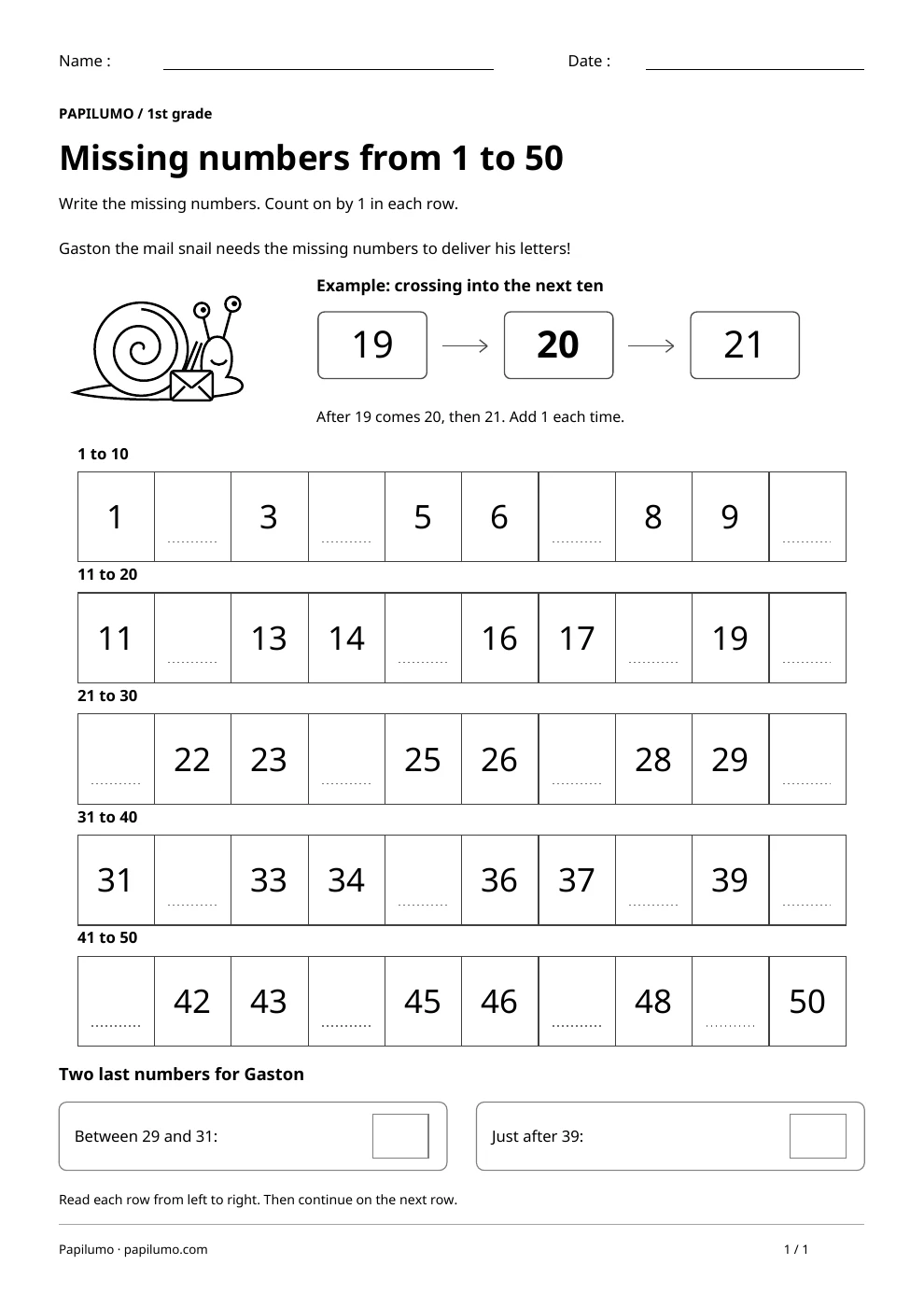
Work through one row together, asking the child to say a number before writing it. Continue with the remaining rows, pausing when attention fades. Each row has four gaps, but their positions vary. Two neighboring boxes are sometimes empty, so children must continue the sequence through more than one step. Once the chart is complete, try the three questions underneath. Children may point to numbers in the chart; these questions do not require answers from memory. To vary the practice, try Missing numbers 1 to 50: Gaston’s delivery numbers: Write the missing numbers. Count on by 1 in each row.
What to notice and how to check
The missing numbers by row are 52, 55, 57, 59; 62, 64, 67, 70; 73, 75, 78, 80; 82, 86, 88, 89; and 93, 95, 98, 100. The three quick-check answers are 60, 74, and 77. Added numbers are underlined in the key so adults can distinguish them from the printed clues. Pay particular attention to the transitions from 59 to 60, 69 to 70, and 99 to 100.
Making the task easier
Cover the last four rows and use only 51 to 60. Offer a number strip as a temporary model. Separate the task into saying the number, finding the right box, and writing it. If recognizing larger numerals is still difficult, begin with short sequences of familiar small numbers. An adult can also record a spoken answer when pencil control becomes tiring. Remove the reference for a later attempt rather than demanding immediate independence.
Keep the learning aim, but reduce how much the child has to handle at once. Cover part of the page with another sheet and reveal one task at a time. Demonstrate a separate example, then leave a real opportunity to work something out. An answer reached with support is still a useful attempt; it does not yet show that the same task can be completed independently.
Taking the idea beyond the worksheet
Choose an interior number and ask for its neighbors to the right, left, above, and below. Avoid edge cells for this first investigation. The child can then hide two numbers in another row and ask a partner to recover them. Encourage an explanation of one-step and ten-step moves. Finally, use a complete 1–100 chart to find the same organization over a wider range, keeping the counting task separate from writing number words.
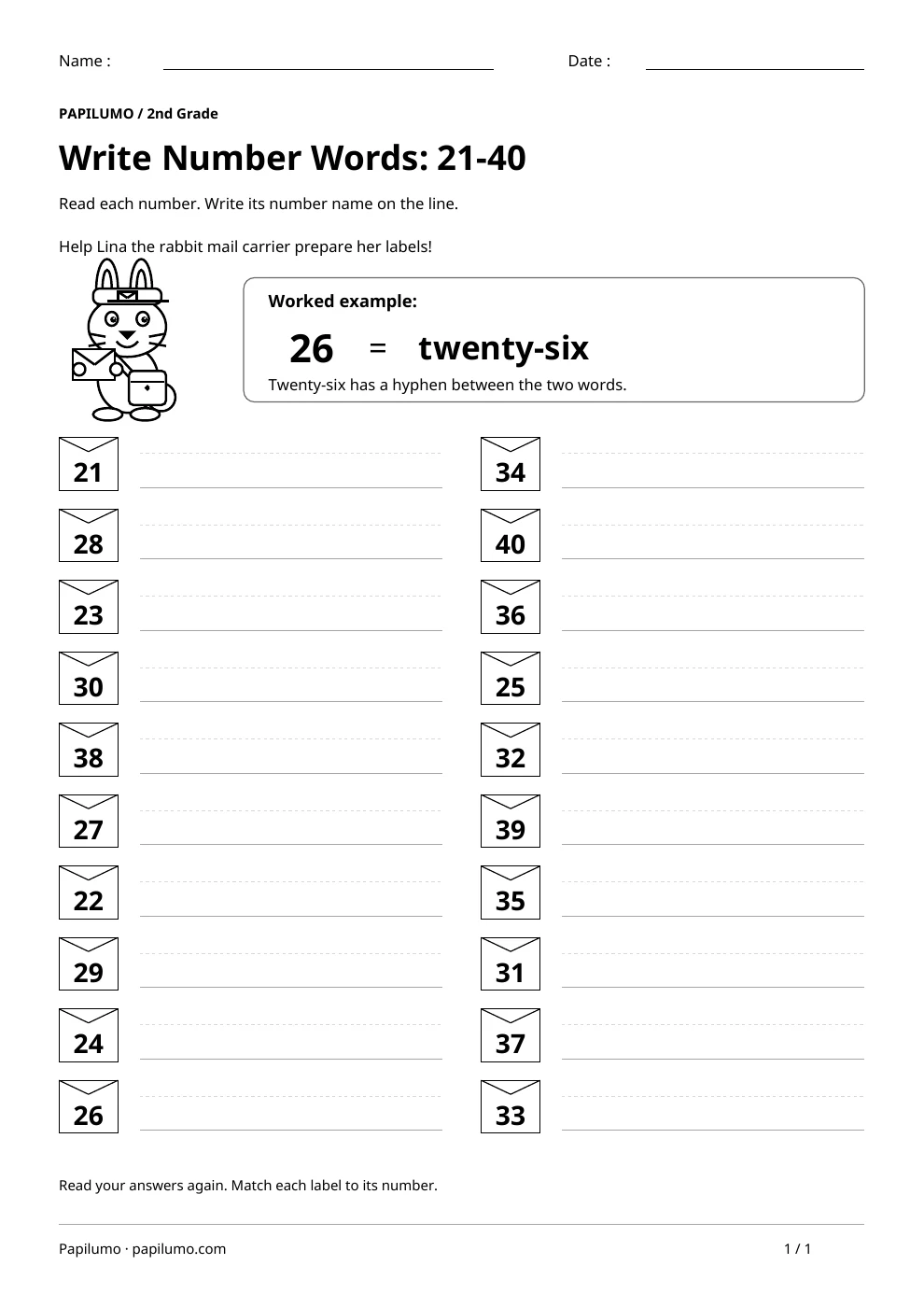
Use the follow-up to meet the same idea in a different setting. Offer it once the first task makes sense, without insisting that the whole page must be perfect. The child might explain a strategy, make an example or set a challenge for an adult. Return to the worksheet only when it helps connect the two situations. A short conversation or a practical activity can be enough to finish the session. To continue exploring, use Writing numbers 21 to 40 in words: Read each number. Write its number name on the line.
Downloading and printing the PDF
This free PDF contains one worksheet designed for A4 paper. Download the file using the button on this page and open it in your PDF reader. Choose actual size or a 100% scale, check the orientation in the print preview and turn off any browser headers or footers. The illustrations use vector lines, so their outlines stay sharp when printed. Check the margins on one copy before preparing several sheets for a group. The level shown on the page is a guide, rather than a requirement to complete the activity at a particular age.