
What this worksheet helps children practise
Say “one more” as a finger moves to the next box. Reading a whole row helps children notice a repeated or skipped number.
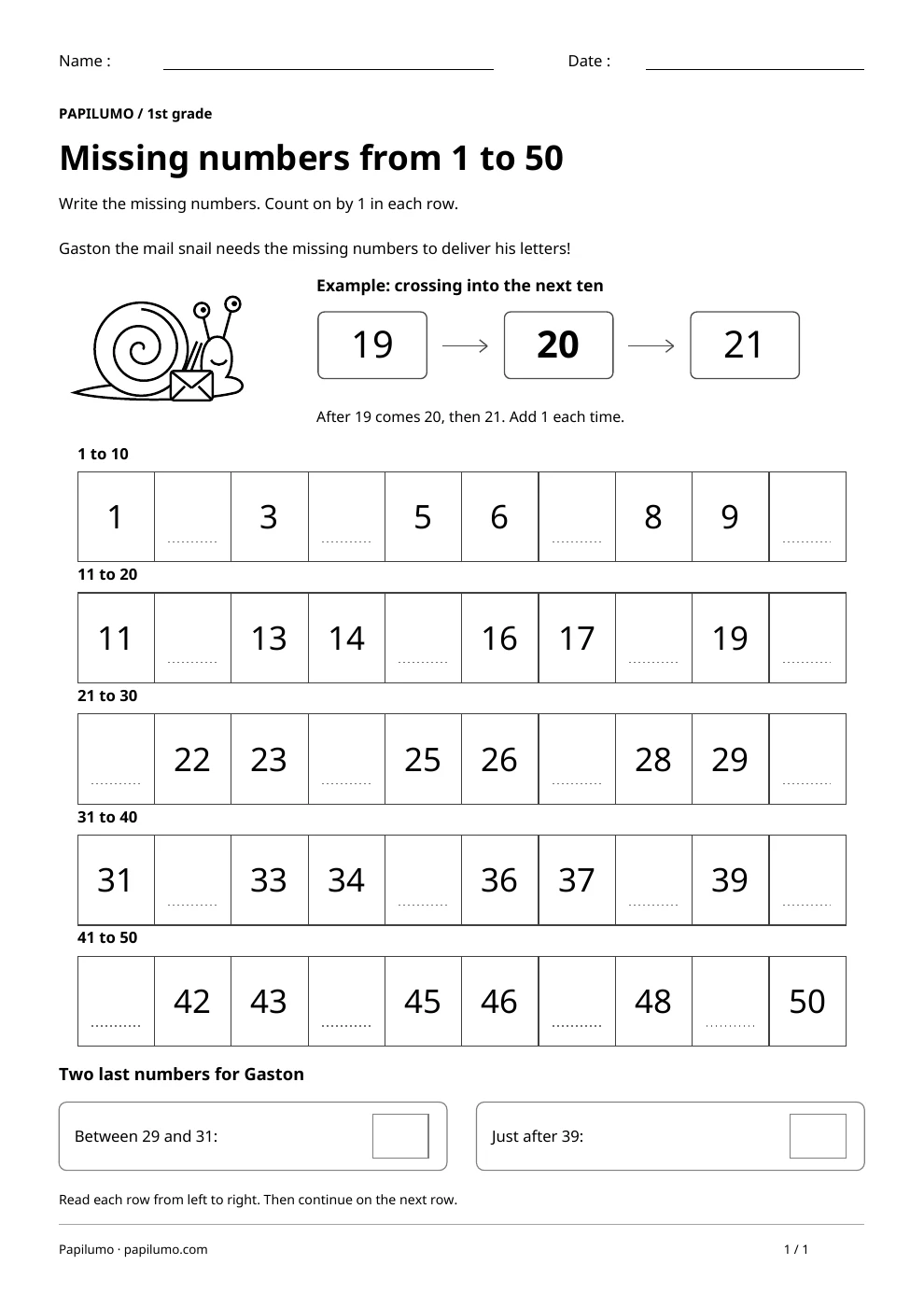
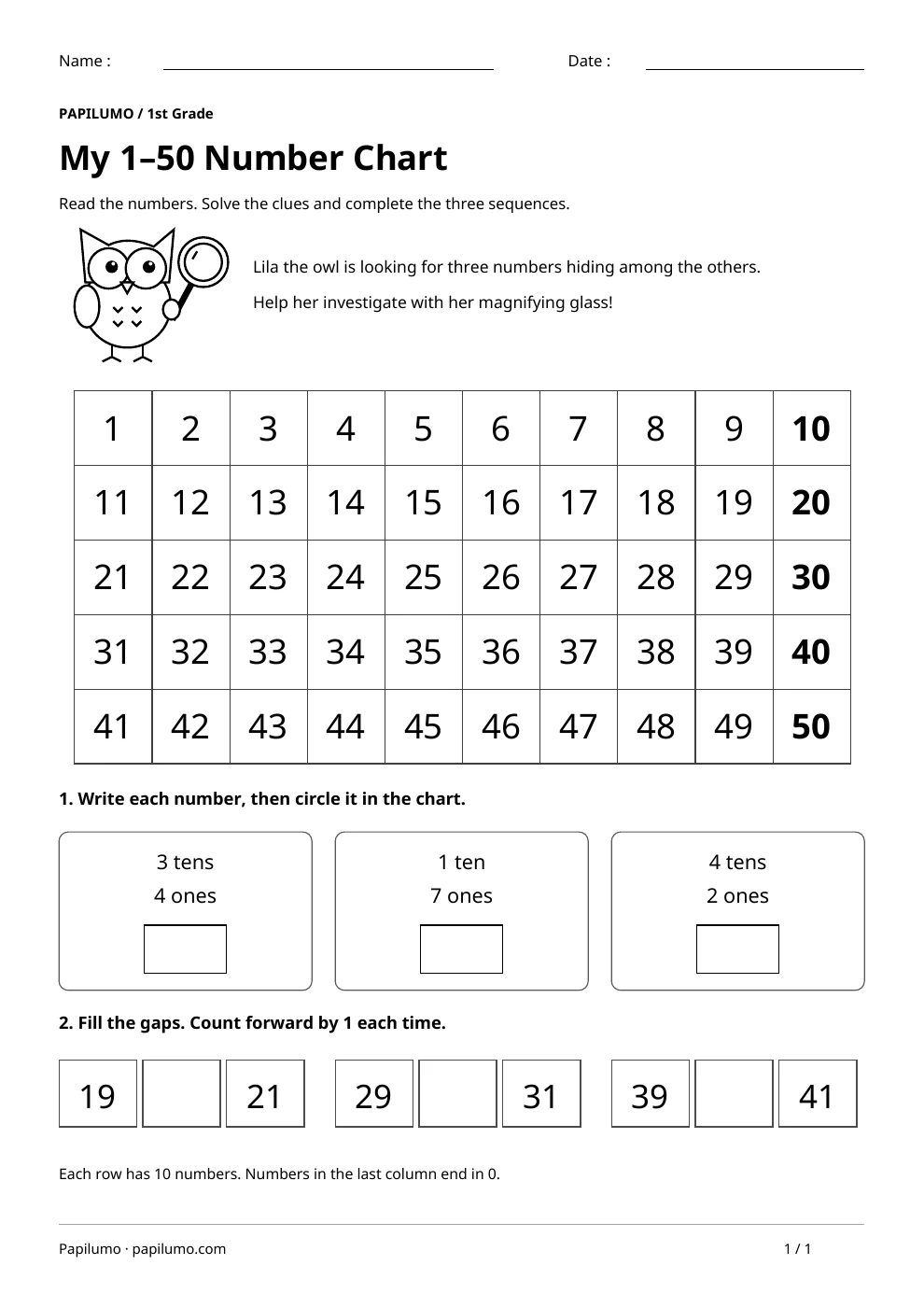
Children rebuild a number sequence by adding one at each step. They use the previous number and check against the next printed number. Gaps appear throughout the sequence, including 10, 20, 30 and 40 and the row starts 21 and 41. This first grade activity assumes that children recognize numbers to 50. A complete number chart can provide support initially and be covered when the child is ready. For a related skill, use Number Chart 1–50: Tens and Ones Detective: Read the numbers. Solve the clues and complete the three sequences.
Preparing a short session
Provide a pencil, eraser and a copy printed at actual size. Introduce Gaston and explain his delivery task: put the missing address numbers back in order. Read the first row from left to right together before filling a box. Show how the next row continues the count. Cover the remaining rows if seeing all fifty boxes feels overwhelming.
A concrete example to get started
The example shows 19, 20 and 21. After 19, the sequence continues with 20 rather than restarting at 1. Move a counter between the three numbers and say each one aloud. Use the same idea to find the number after 9 in the first row. Then ask which number begins the next row.
Supporting the activity
Complete the twenty empty boxes one row at a time. Read each finished row aloud, including both printed and newly written numbers. If a number is forgotten, count from a familiar starting point instead of supplying the answer. After all five rows, find the number between 29 and 31 and the number just after 39. Children can point to the matching boxes to explain their choices. To vary the practice, try Missing numbers 51 to 100: complete the chart: Write the missing numbers. Count on by 1 across each row.
What to notice and how to check
The missing numbers are 2, 4, 7, 10; 12, 15, 18, 20; 21, 24, 27, 30; 32, 35, 38, 40; and 41, 44, 47, 49. The final answers are 30 and 40. Check digit order, especially 12 and 21. The key fills every box and both final answers. If a child gets stuck at a new ten, read the numbers immediately before and after it together.
Making the task easier
Start with numbers 1 to 20 and keep a completed chart available. An adult can say the sequence while the child points to each box.
Keep the learning aim, but reduce how much the child has to handle at once. Cover part of the page with another sheet and reveal one task at a time. Demonstrate a separate example, then leave a real opportunity to work something out. An answer reached with support is still a useful attempt; it does not yet show that the same task can be completed independently.
Taking the idea beyond the worksheet
Cover a completed row and ask for three consecutive numbers around 30 or 40. Then extend the practice with missing numbers from 51 to 100.
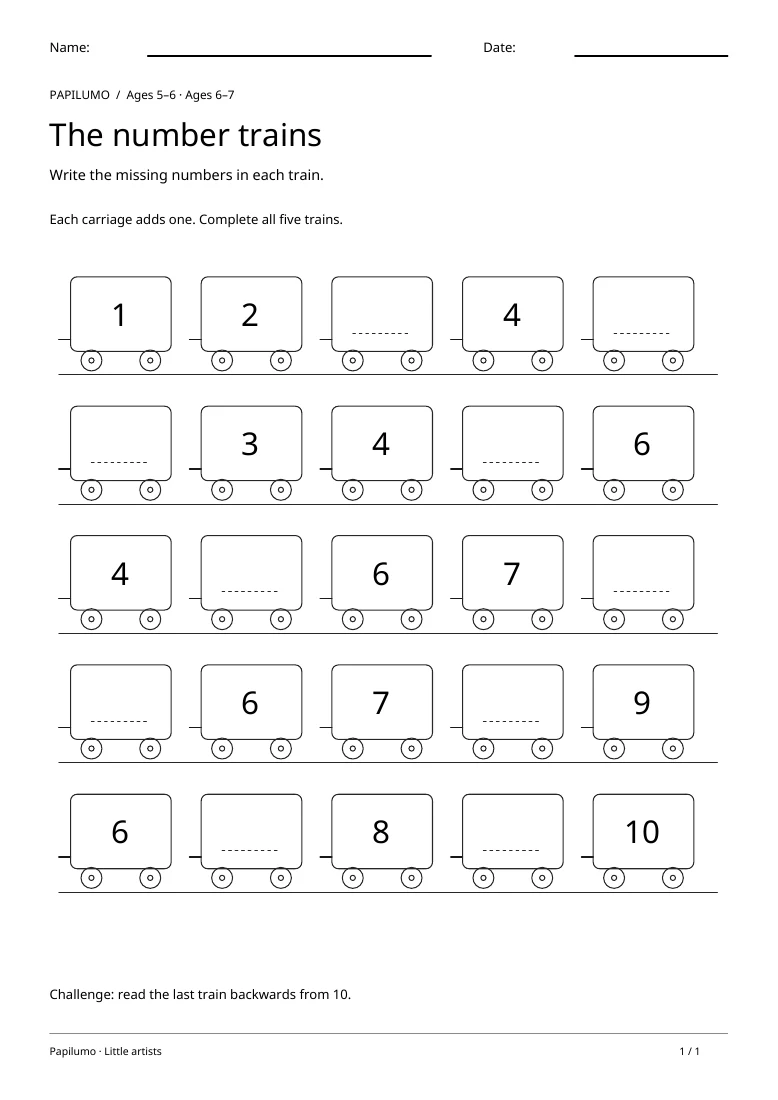
Use the follow-up to meet the same idea in a different setting. Offer it once the first task makes sense, without insisting that the whole page must be perfect. The child might explain a strategy, make an example or set a challenge for an adult. Return to the worksheet only when it helps connect the two situations. A short conversation or a practical activity can be enough to finish the session. To continue exploring, use Missing Numbers Worksheet for Early Number Sequences: Write the missing numbers in each train.
Downloading and printing the PDF
This free PDF contains one worksheet designed for A4 paper. Download the file using the button on this page and open it in your PDF reader. Choose actual size or a 100% scale, check the orientation in the print preview and turn off any browser headers or footers. The illustrations use vector lines, so their outlines stay sharp when printed. Check the margins on one copy before preparing several sheets for a group. The level shown on the page is a guide, rather than a requirement to complete the activity at a particular age.