
What this worksheet helps children practise
Have the child say the number before writing. Separate a tens-and-ones reversal from a spelling difficulty.
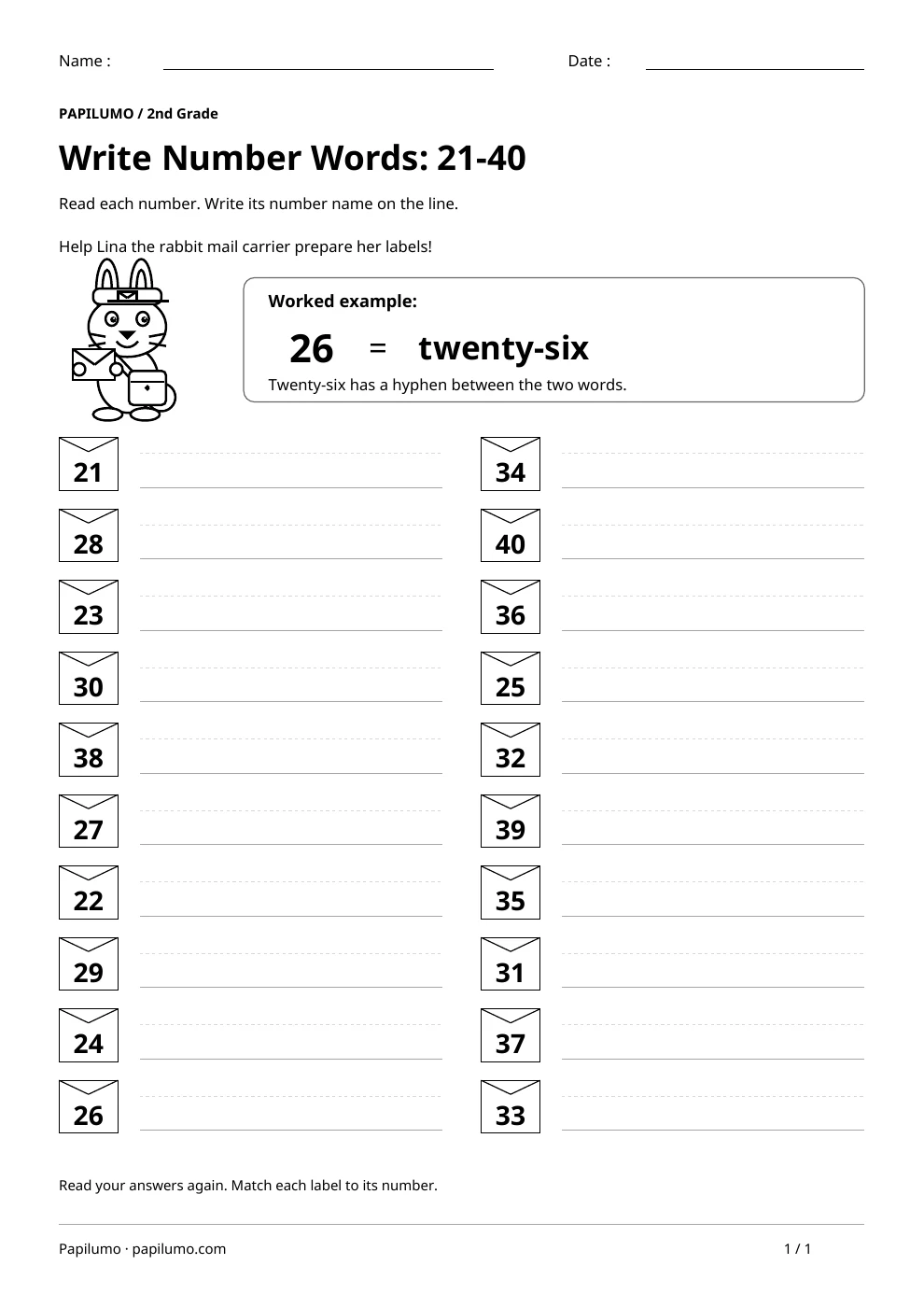
The worksheet connects two-digit numerals with written number names. It builds on reading numbers through twenty and recognizing tens and ones. Children name the number aloud and then record its spelling, rather than selecting from printed choices. All twenty numbers from 21 through 40 appear exactly once. Thirty and forty are included as whole tens. The grade label is a guide: use the task when the child can read the numerals and is ready to write their names. Accuracy and a readable response matter more than speed or finishing every item in one sitting. For a related skill, use Writing numbers 41 to 60 in words: Read each number. Write its number name on the line.
Preparing a short session
Print at actual size and provide a pencil, an eraser and scrap paper. Keep the answer key separate at first. Point out the numeral inside each small envelope and the writing line on its right. Work across each row from left to right. Four labels are enough for a short first session. If your purpose is careful copying, offer a small word reference. If you want to observe independent spelling, let the child make an attempt before showing the reference.
A concrete example to get started
In the example, 26 becomes twenty-six. Say the complete number, then notice twenty and six. Use a hyphen in compound names such as twenty-one, twenty-eight and thirty-nine. The whole tens thirty and forty are single words. Forty has no u, even though four does. For 31, write thirty-one; reversing the numeral to 13 would produce a different number. The model gives the procedure without supplying a word bank for all twenty answers.
Supporting the activity
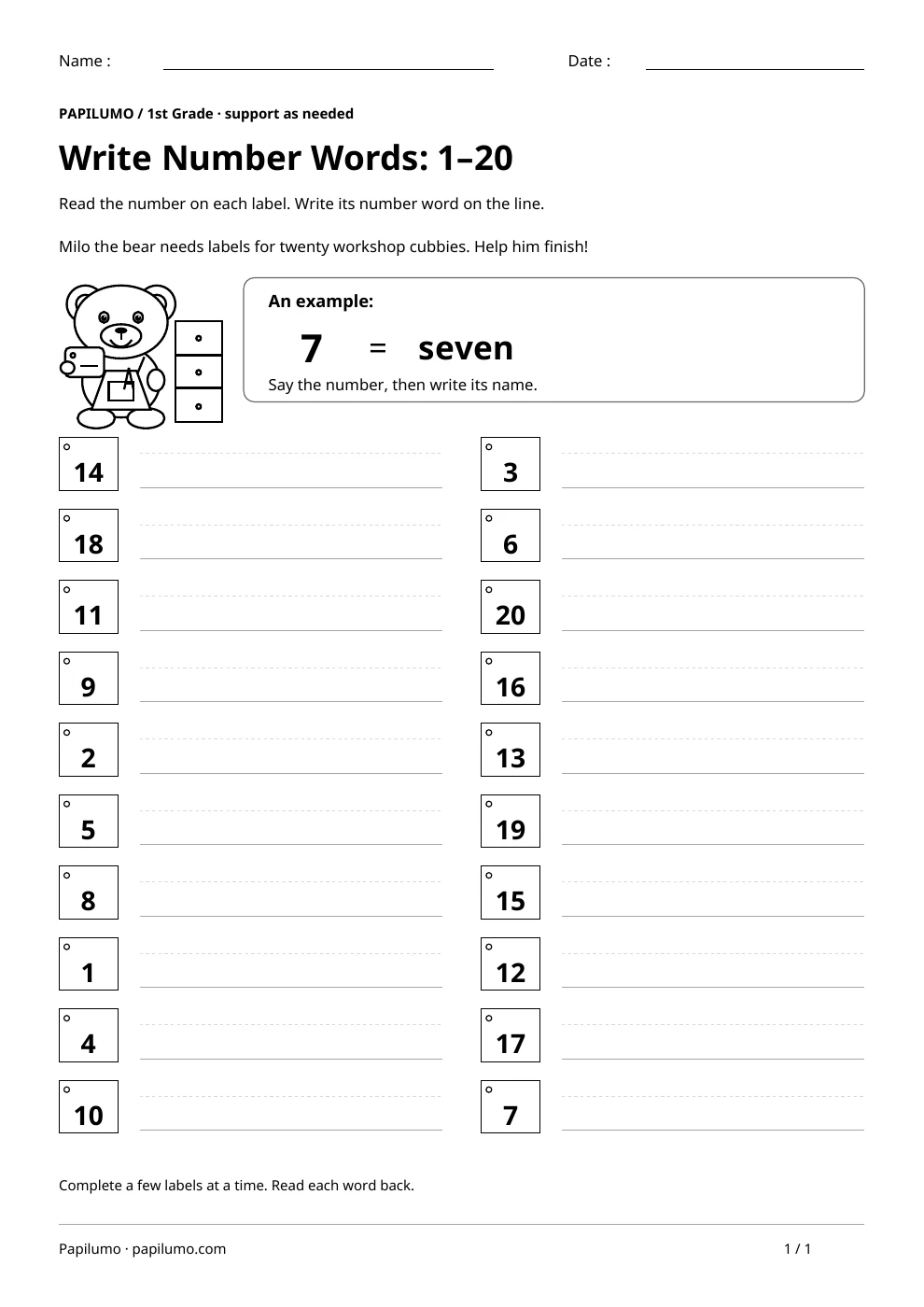
Ask the child to read an envelope number, say its name and then write it. If 23 is read as 32, return to tens and ones before discussing spelling. If the number is understood but one word is uncertain, provide a focused clue rather than the entire answer. Pause after two or four labels to compare the written words with the original numerals. Lina’s delivery task gives a simple purpose to the practice. The envelopes are part of the activity; nothing needs to be cut out. To vary the practice, try Writing numbers 1 to 20 in words with Milo: Read the number on each label. Write its number word on the line.
What to notice and how to check
Check each response against the same numeral on the answer key. Because the order is mixed, do not assume the next answer should be one greater. Review the number value, word spelling and hyphen separately. Pay particular attention to twenty, thirty and forty, as well as the unit word in each compound. A letter formation difficulty is different from misunderstanding the number. Ask the child to read back the intended response and correct one feature at a time. Keep a useful successful example visible for another attempt.
Making the task easier
Cover all but two rows and provide a short word reference. Later, repeat a few number names without looking at it.
Keep the learning aim, but reduce how much the child has to handle at once. Cover part of the page with another sheet and reveal one task at a time. Demonstrate a separate example, then leave a real opportunity to work something out. An answer reached with support is still a useful attempt; it does not yet show that the same task can be completed independently.
Taking the idea beyond the worksheet
Dictate three numbers between 21 and 40 on scrap paper. Ask for each numeral and its written name, then compare both forms.
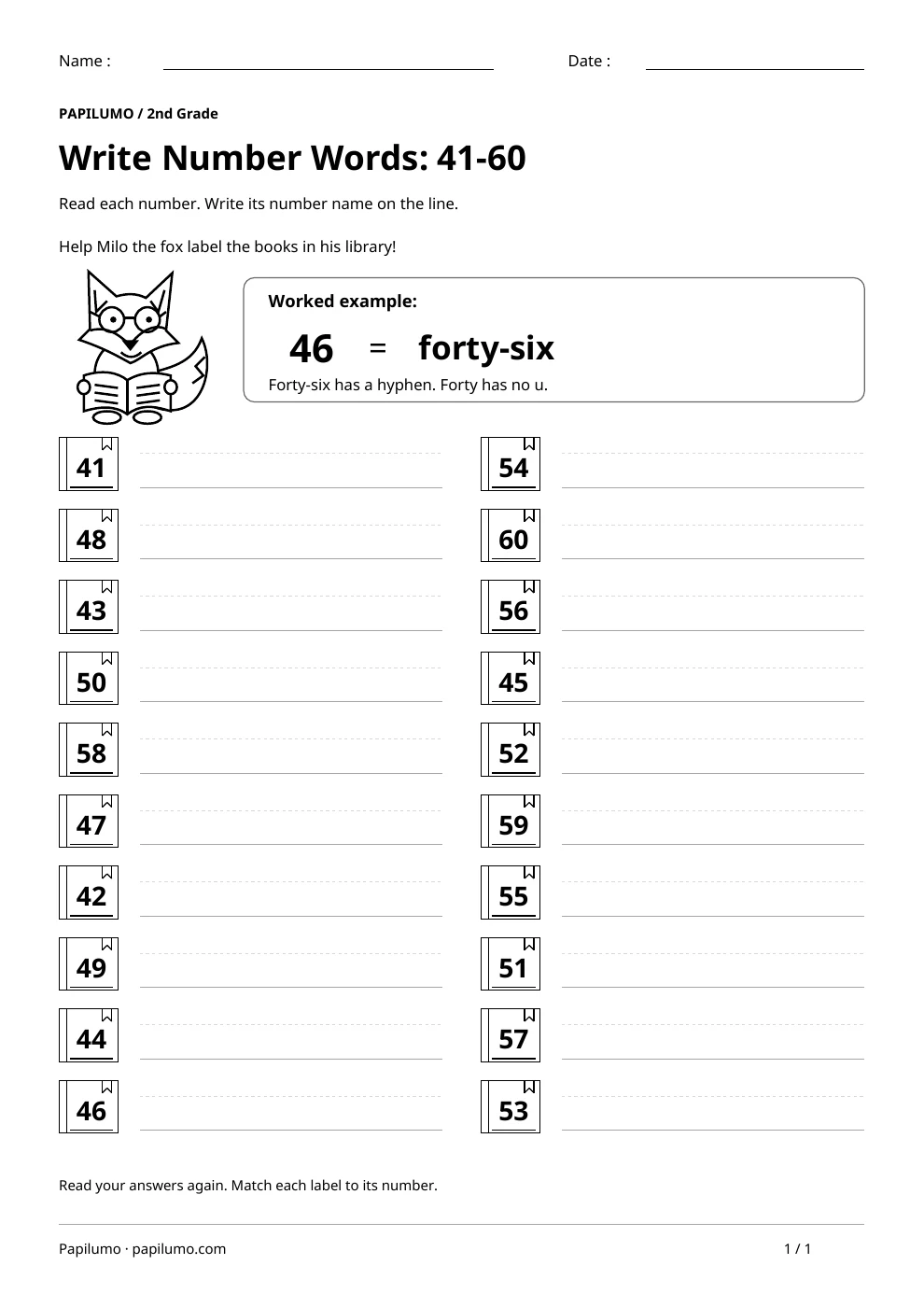
Use the follow-up to meet the same idea in a different setting. Offer it once the first task makes sense, without insisting that the whole page must be perfect. The child might explain a strategy, make an example or set a challenge for an adult. Return to the worksheet only when it helps connect the two situations. A short conversation or a practical activity can be enough to finish the session. To continue exploring, use Number Words 11–20: Read and Choose with Plume: Read each book's number. Circle the matching number word.
Downloading and printing the PDF
This free PDF contains one worksheet designed for A4 paper. Download the file using the button on this page and open it in your PDF reader. Choose actual size or a 100% scale, check the orientation in the print preview and turn off any browser headers or footers. The illustrations use vector lines, so their outlines stay sharp when printed. Check the margins on one copy before preparing several sheets for a group. The level shown on the page is a guide, rather than a requirement to complete the activity at a particular age.