
What this worksheet helps children practise
If a child writes 2, 5 or 10 in the first empty car, explain that this is the amount added, not a new starting point. After 20, 25, 30, the next number is 35. Model one jump on a number chart, then let the child try the next. An incorrect written number can reflect either a counting error or a misunderstood rule.
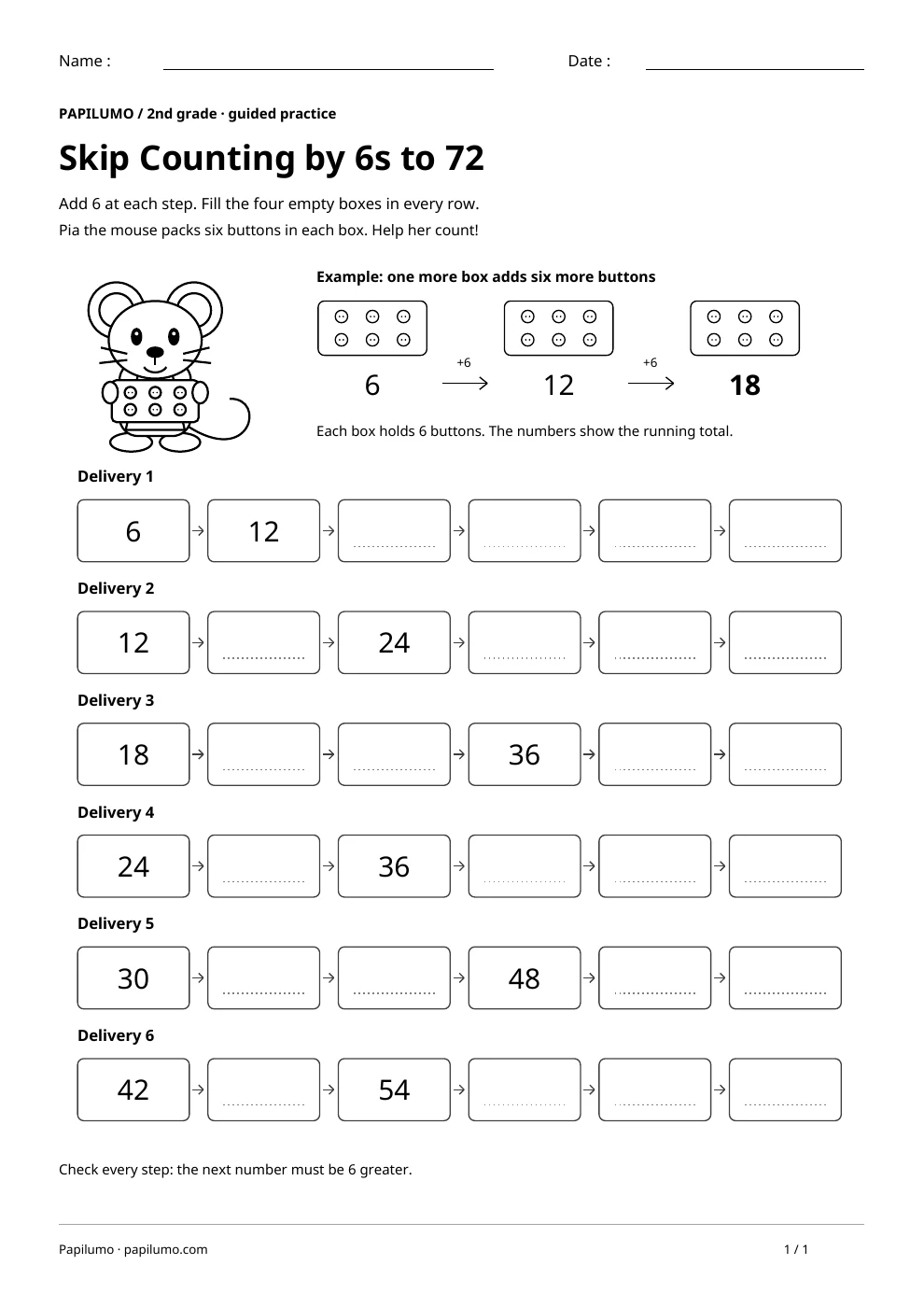
The main task is to identify a repeated increase before using it. Since the rules change between rows, children need to check each new train instead of carrying over the previous answer. All numbers are at most 90. Use this mixed practice after children have tried counting by twos, fives and tens separately and can read the starting numbers with support. For a related skill, use Skip Counting by 6s to 72 with Pia: Add 6 at each step. Fill the four empty boxes in every row.
Preparing a short session
Have a pencil and eraser ready. A number chart can help children who still need to count each jump. Point to the three choices above a train: only one is circled. The first three cars give the clues, and the last three are for writing. Lou’s friendly train picture introduces the task without creating extra counting or coloring requirements on the worksheet.
A concrete example to get started
The example begins 2, 4, 6. Moving from 2 to 4 adds 2; moving from 4 to 6 also adds 2. That confirms the +2 choice. The next number is 8, followed by 10 and 12 if the pattern continues. Ask the child to explain both given jumps before writing, rather than guessing a rule from just one familiar number.
Supporting the activity
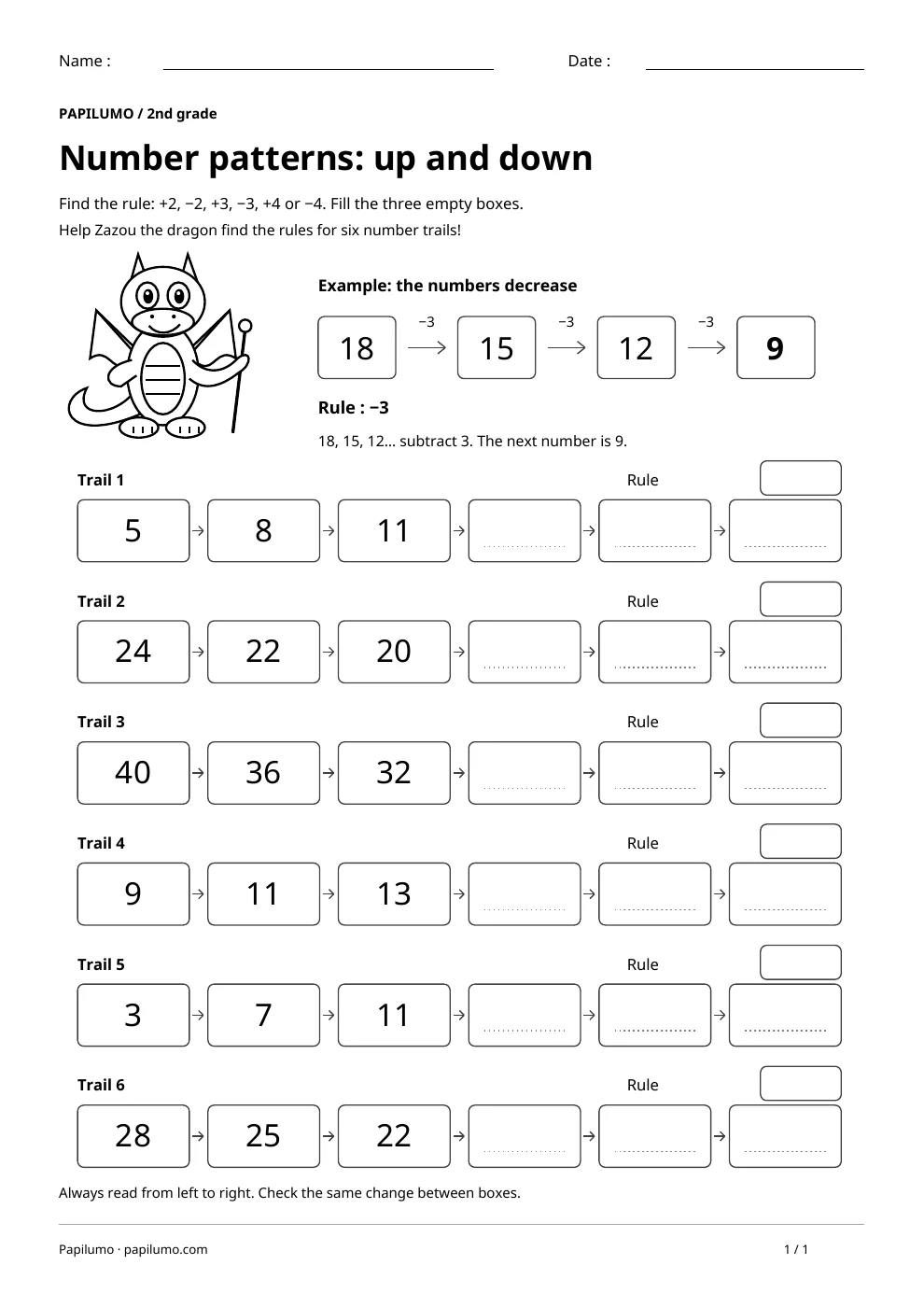
Work from left to right along one train. Have the child say the rule, circle it, and complete one car at a time. Check the increase after each answer. Before beginning another train, look at its printed clues again. The six rows can be split into two short sessions, especially when identifying a rule takes more effort than continuing a known counting sequence. To vary the practice, try Increasing and decreasing number patterns to 40: Find the rule: +2, −2, +3, −3, +4 or −4. Fill the three empty boxes.
What to notice and how to check
The six rules are +2, +5, +10, +5, +2 and +10. Missing numbers are 8, 10, 12; 20, 25, 30; 40, 50, 60; 35, 40, 45; 14, 16, 18; and 70, 80, 90. The answer key circles each correct rule as well as showing the missing numbers. Check both parts of the task, not just the final number.
Making the task easier
To make the activity easier, cover the other rows and discuss one train together. Say the rule after examining the clues, then ask for the missing numbers aloud before writing. Gradually remove this support when the child can explain the repeated increase. Writing neat numerals is separate from recognizing the pattern; an oral response can still show that the mathematical idea is understood.
Keep the learning aim, but reduce how much the child has to handle at once. Cover part of the page with another sheet and reveal one task at a time. Demonstrate a separate example, then leave a real opportunity to work something out. An answer reached with support is still a useful attempt; it does not yet show that the same task can be completed independently.
Taking the idea beyond the worksheet
For a follow-up, choose another starting number and keep one of the same three rules. The child writes three clues and asks an adult to continue. Compare 10, 15, 20 with 10, 20, 30: both start at 10, but their jumps differ. This makes the distinction between a starting number and a repeated step explicit without adding a new counting rule.
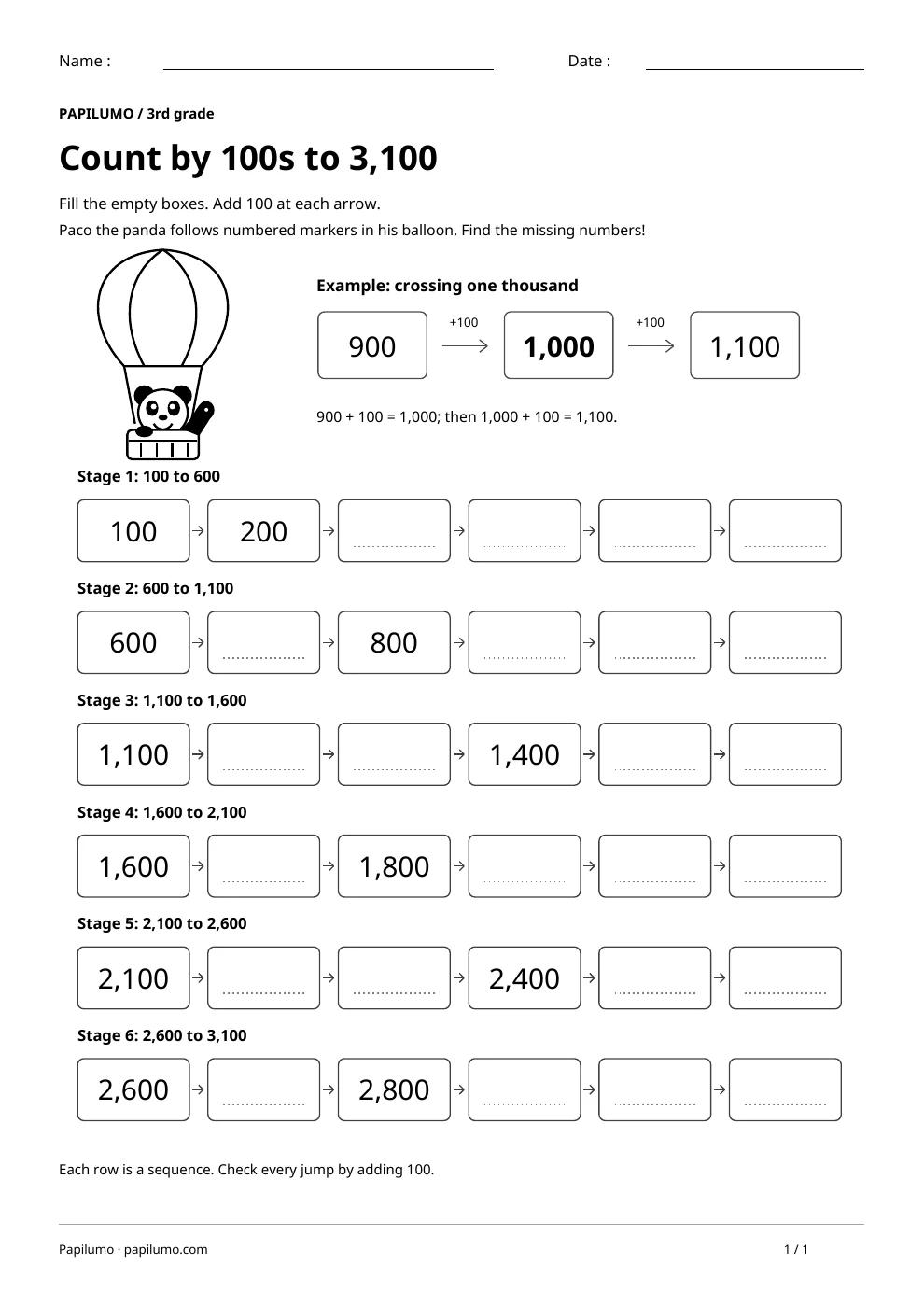
Use the follow-up to meet the same idea in a different setting. Offer it once the first task makes sense, without insisting that the whole page must be perfect. The child might explain a strategy, make an example or set a challenge for an adult. Return to the worksheet only when it helps connect the two situations. A short conversation or a practical activity can be enough to finish the session. To continue exploring, use Count by 100s to 3,100 with Paco: Fill the empty boxes. Add 100 at each arrow.
Downloading and printing the PDF
This free PDF contains one worksheet designed for A4 paper. Download the file using the button on this page and open it in your PDF reader. Choose actual size or a 100% scale, check the orientation in the print preview and turn off any browser headers or footers. The illustrations use vector lines, so their outlines stay sharp when printed. Check the margins on one copy before preparing several sheets for a group. The level shown on the page is a guide, rather than a requirement to complete the activity at a particular age.