

What this worksheet helps children practise
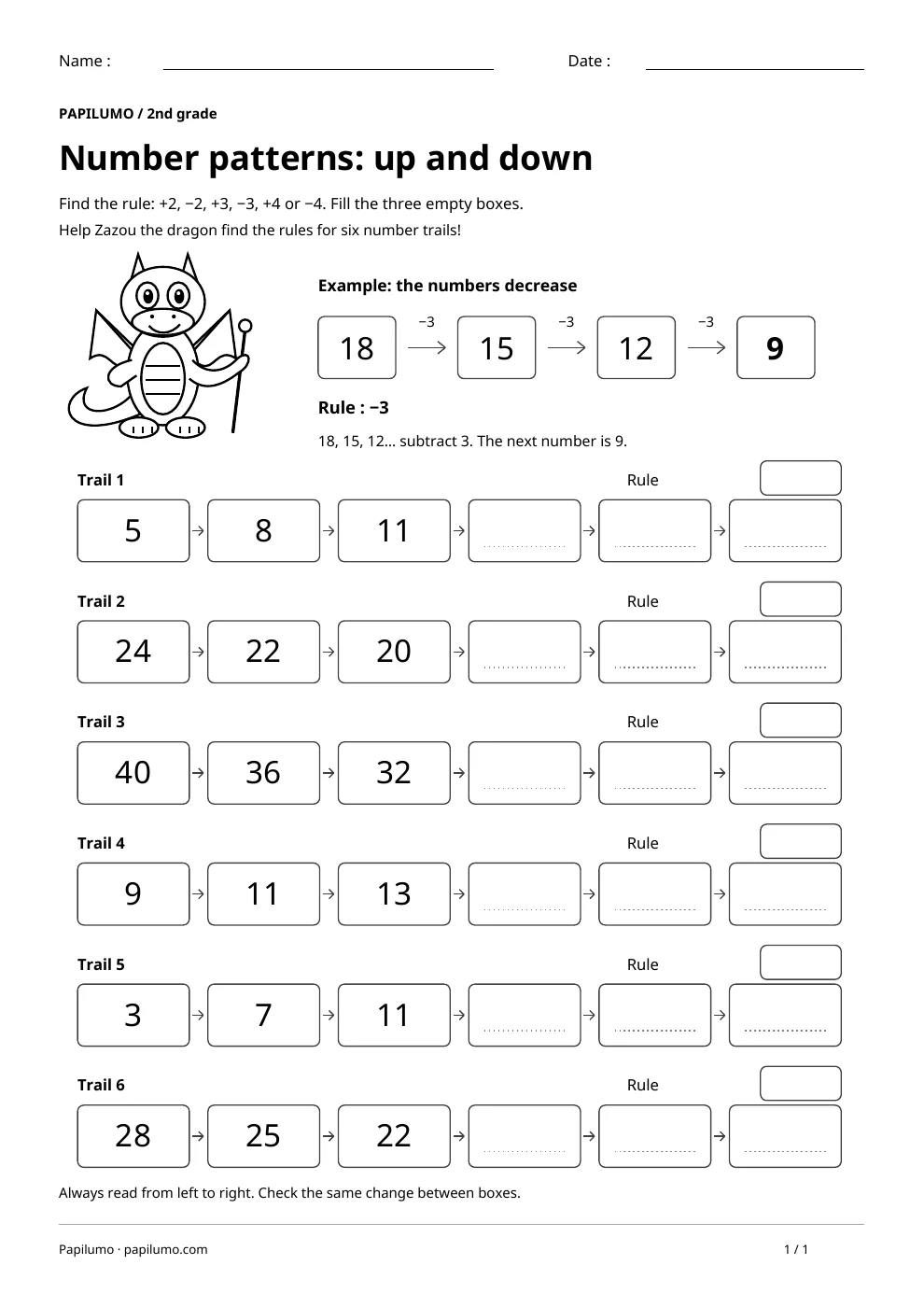
Separate the starting number from the repeated step. In 5, 8, 11, the rule is add three, not add five. Ask what changes between neighboring values rather than which number appears first.
The task combines two decisions: whether the values increase or decrease, and how much they change. Noticing that a sequence goes down is only the first step; children must also find the amount subtracted. Likewise, a difference of three needs the correct sign to express the whole rule. This links number comparison with addition and subtraction. Every sequence has a constant step, so the same operation applies throughout its row. For a related skill, use Skip counting: find the rule for 2s, 5s and 10s: Circle +2, +5 or +10. Fill in the three empty cars.
Preparing a short session
Have a pencil and eraser ready. Read the six possible rules, then explain Zazou’s missing markers. A rule of −4 means subtract four each time; it does not ask children to work with negative answers. Every value on this worksheet stays positive. Point out that all arrows lead right. They show reading direction, while the numbers may become smaller. Moving forward along the page is different from increasing in value.
A concrete example to get started
The example shows 18, 15, 12 and 9. Eighteen to fifteen is a decrease of three, and fifteen to twelve is another decrease of three. The rule is −3, so nine follows. Check both starting differences before looking at the final number. Two matching changes support the rule better than a guess from one pair. Children can describe the step in words before using the signed notation.
Supporting the activity
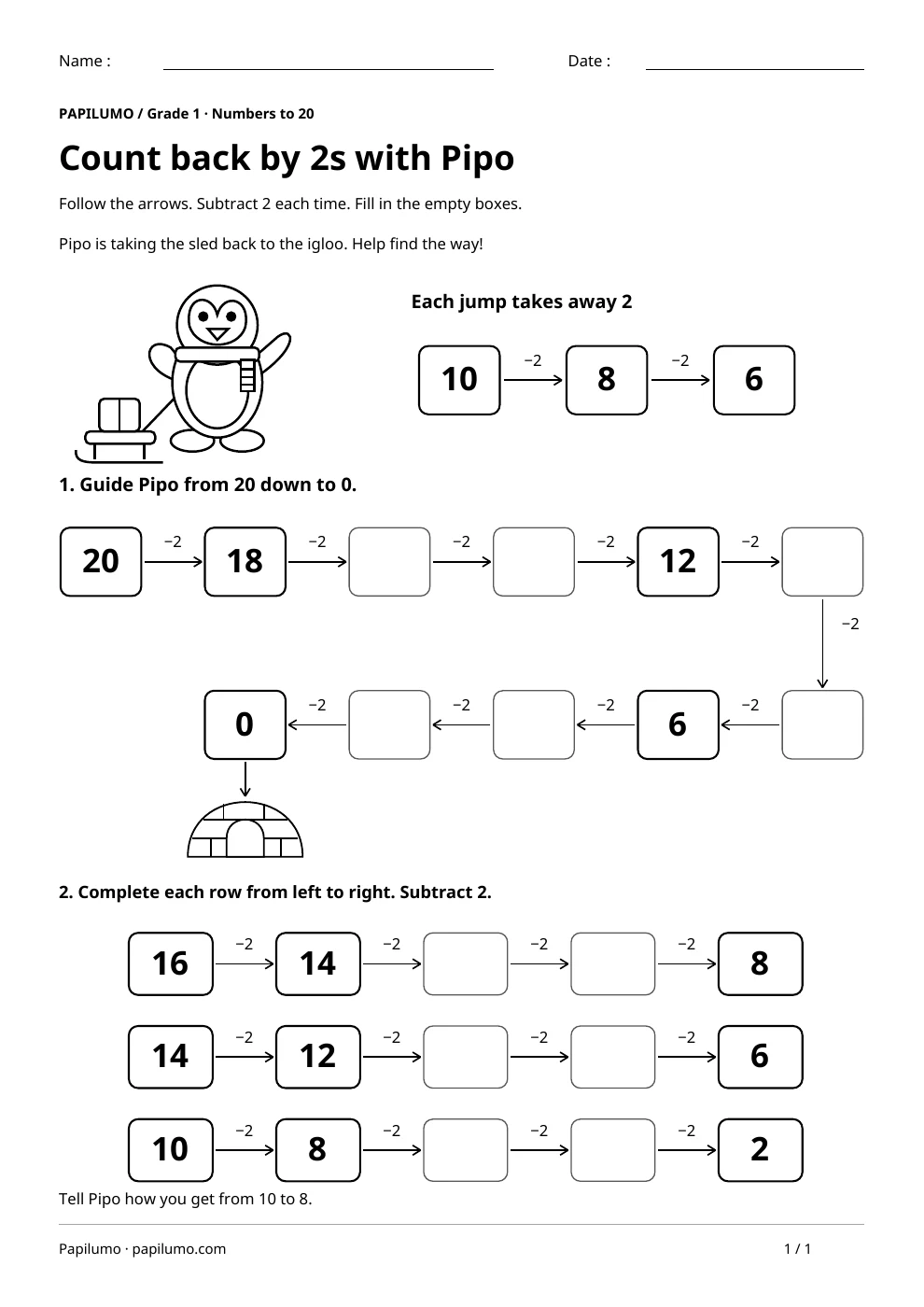
For each trail, read the three clues and decide whether they increase or decrease. Compare both gaps, write the sign and step in the Rule box, then fill the three missing numbers. Begin again with the next row’s clues: the direction and step may change. Trail numbers simply label the exercises. They do not tell children which operation to use. Read the finished row aloud and check every transition. To vary the practice, try Counting backward by 2 from 20 to 0: Follow the arrows. Subtract 2 each time. Fill in the empty boxes.
What to notice and how to check
The rules are +3, −2, −4, +2, +4 and −3. The missing groups are 14, 17, 20; 18, 16, 14; 28, 24, 20; 15, 17, 19; 15, 19, 23; and 19, 16, 13. If the answers are correct but the rule lacks its sign, ask for the complete notation. Check the link from the last clue to the first answer as well as the gaps between the new answers.
Making the task easier
Cover five trails and work on one rule together. Use a number strip to 40 and allow spoken answers before writing. Keep all three given numbers visible while checking both differences.
Keep the learning aim, but reduce how much the child has to handle at once. Cover part of the page with another sheet and reveal one task at a time. Demonstrate a separate example, then leave a real opportunity to work something out. An answer reached with support is still a useful attempt; it does not yet show that the same task can be completed independently.
Taking the idea beyond the worksheet
Invent a new sequence with the same rule and a different start, keeping all values positive. Then explain how moving to the right on the paper can still produce smaller numbers.
Use the follow-up to meet the same idea in a different setting. Offer it once the first task makes sense, without insisting that the whole page must be perfect. The child might explain a strategy, make an example or set a challenge for an adult. Return to the worksheet only when it helps connect the two situations. A short conversation or a practical activity can be enough to finish the session. To continue exploring, use Skip counting by 3 to 30 with Riko: Count groups of three stars, then complete the number path and the sequences up to 30.
Downloading and printing the PDF
This free PDF contains one worksheet designed for A4 paper. Download the file using the button on this page and open it in your PDF reader. Choose actual size or a 100% scale, check the orientation in the print preview and turn off any browser headers or footers. The illustrations use vector lines, so their outlines stay sharp when printed. Check the margins on one copy before preparing several sheets for a group. The level shown on the page is a guide, rather than a requirement to complete the activity at a particular age.