

What this worksheet helps children practise
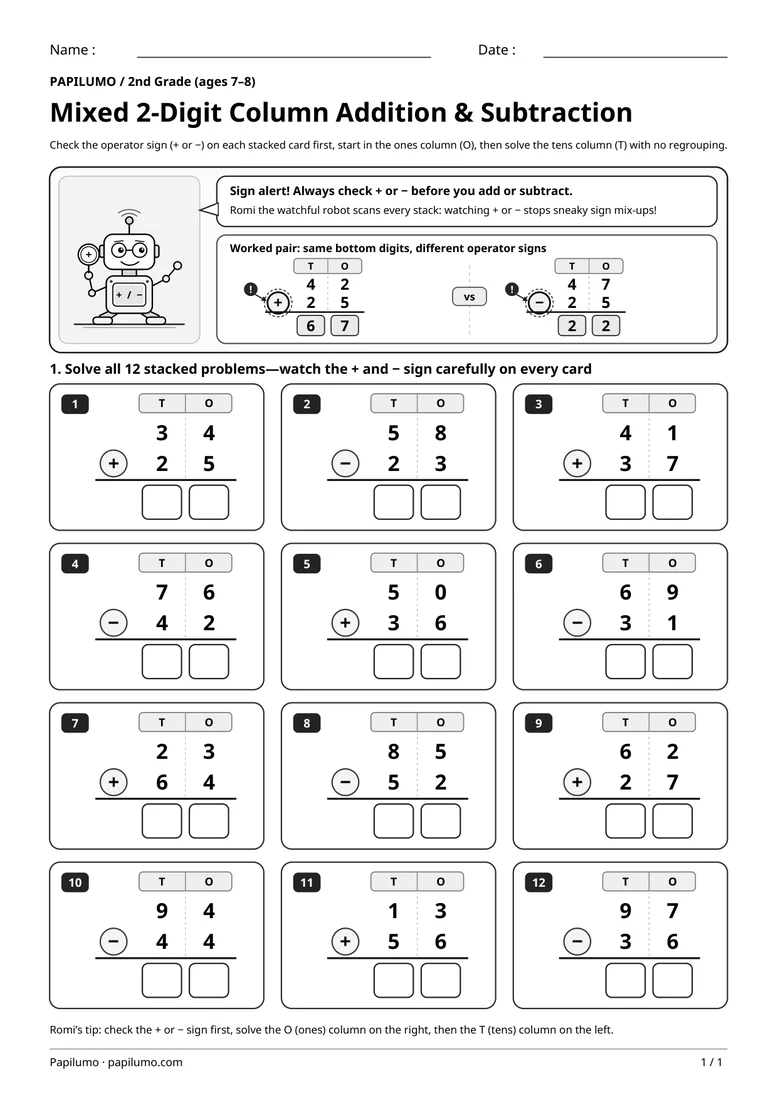
Point to the + or − sign before writing a digit, then always add or subtract the ones column first!
Switching between vertical addition and subtraction builds an essential 2nd Grade habit: slowing down to read the operator symbol instead of running on autopilot down a whole worksheet. Because none of these twelve stacks require carrying or borrowing, learners can focus squarely on two core skills—deciding whether to combine or take away, and working cleanly from the ones column to the tens column. This careful sign check prevents one of the most common column-math errors in elementary classrooms. For a related skill, use Count and Graph: Build a Bar Graph with Ari: Count each kind of badge. Color one box per badge, starting at the bottom.
Preparing a short session
Print the student worksheet at actual size (100%) on plain white letter or A4 paper without shrinking the margins, and provide a sharpened pencil and eraser. Before your child starts solving, examine Romi’s top banner together, trace the circled + and − signs in the worked comparison, and review what the T (tens) and O (ones) column headers mean. Keep the separate one-page answer key PDF out of reach during independent practice so students rely on their own sign checks.
A concrete example to get started
In the worked comparison box beside Romi the watchful robot, two closely matched vertical stacks sit side by side: 42 + 25 = 67 and 47 − 25 = 22. Both operator symbols carry a crisp circled sign alert beneath clear T and O headers. On the left, 2 + 5 = 7 ones and 4 + 2 = 6 tens give 67; on the right, 7 − 5 = 2 ones and 4 − 2 = 2 tens give 22, showing immediately how one sign flips the final answer.
Supporting the activity
The twelve numbered cards alternate strictly between + and − across every row and down every column: 34 + 25 = 59, 58 − 23 = 35, 41 + 37 = 78, 76 − 42 = 34, 50 + 36 = 86, 69 − 31 = 38, 23 + 64 = 87, 85 − 52 = 33, 62 + 27 = 89, 94 − 44 = 50, 13 + 56 = 69, and 97 − 36 = 61. Cards 5 and 10 spotlight zero placeholders cleanly: 0 + 6 = 6 in the ones place and 4 − 4 = 0 to hold 50. To vary the practice, try Skip counting: find the rule for 2s, 5s and 10s: Circle +2, +5 or +10. Fill in the three empty cars.
What to notice and how to check
When checking finished work with the separate answer key PDF, scan first for sign slip-ups—such as writing 81 instead of 35 on 58 − 23 or 11 instead of 59 on 34 + 25. Next verify that each digit sits neatly inside its T or O answer box, paying special attention to 50 + 36 = 86 and 94 − 44 = 50 so the zero in the ones column is written clearly rather than left blank. A clean sheet shows strong readiness for regrouping lessons later in 2nd Grade.
Making the task easier
Circle the + or − sign lightly with your pencil before each problem and say “add” or “subtract” out loud.
Keep the learning aim, but reduce how much the child has to handle at once. Cover part of the page with another sheet and reveal one task at a time. Demonstrate a separate example, then leave a real opportunity to work something out. An answer reached with support is still a useful attempt; it does not yet show that the same task can be completed independently.
Taking the idea beyond the worksheet
Pick any answer on the sheet and build two new 2-digit vertical problems—one addition and one subtraction—that equal it.
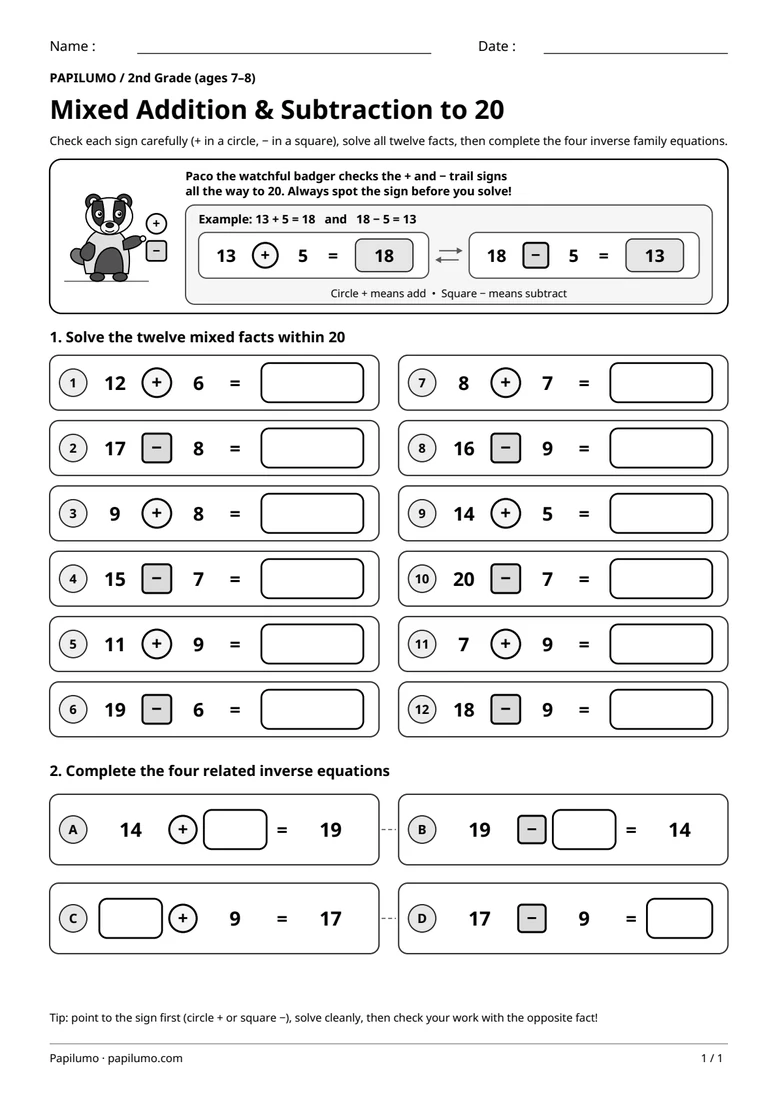
Use the follow-up to meet the same idea in a different setting. Offer it once the first task makes sense, without insisting that the whole page must be perfect. The child might explain a strategy, make an example or set a challenge for an adult. Return to the worksheet only when it helps connect the two situations. A short conversation or a practical activity can be enough to finish the session. To continue exploring, use Mixed Addition and Subtraction to 20 with Paco the Badger: Check each sign carefully (+ in a circle, − in a square), solve all twelve facts, then complete the four inverse family equations.
Downloading and printing the PDF
This free PDF contains one worksheet designed for A4 paper. Download the file using the button on this page and open it in your PDF reader. Choose actual size or a 100% scale, check the orientation in the print preview and turn off any browser headers or footers. The illustrations use vector lines, so their outlines stay sharp when printed. Check the margins on one copy before preparing several sheets for a group. The level shown on the page is a guide, rather than a requirement to complete the activity at a particular age.