


What this worksheet helps children practise
If the child loses count, try one kind again and keep the same route through all three rows. Say the amount before coloring. To compare, point to the tops of bars that begin at the same level. The tallest shows the most badges and the shortest shows the fewest.
The activity connects counting with an organized representation. Eighteen badges are arranged in three rows of six, with all four kinds mixed together. Each graph column belongs to just one kind of badge. Its six boxes are equal in size, and the scale runs from 1 to 6. One box always stands for one badge. The height of the completed bars makes quantities easy to compare, regardless of how large the badge pictures look. For a related skill, use Reading tally marks to 20: Count the tally marks in each record. Write the number in the box.
Preparing a short session
Print at actual size and provide a pencil. Keep the key aside. Introduce Ari and identify all four designs together. Find their order under the graph: stars, hearts, moons, suns. Point to the bottom box of each column, followed by the boxes directly above it. A regular pencil is enough to fill the graph. Read the directions aloud if the written words are still difficult to recognize.
A concrete example to get started
The small model uses two plain circles without giving away any badge category's total. Two circles match two colored boxes, stacked from the bottom. Show the one-to-one link: the first circle gives the bottom box and the second gives the next box above it. There is no empty box between the two filled boxes in the model.
Supporting the activity
Start with the stars. Look through the collection from left to right, row by row, pointing only to badges of that kind. Count each one once, then color the same number of boxes in the stars column. Repeat for hearts, moons, and suns. Keep each bar continuous from the bottom and stop at the counted amount. When all four bars are ready, circle the badge Ari has the most of and then the badge he has the least of. Finally, write the number of suns in the answer box. To vary the practice, try How many more or fewer? Compare groups within 10: Compare the stars. Write the subtraction sentence in the boxes.
What to notice and how to check
The key shows 5 boxes for stars, 3 for hearts, 6 for moons, and 4 for suns. The question answers are moons, hearts, and 4. Check the counted amount first, followed by each column's height. A bar that begins too high can look larger even if the right number of boxes is colored. Check that each bar starts at the bottom and contains no empty boxes below its top colored box.
Making the task easier
Complete only the hearts column together. Point to each heart, count aloud, and fill its column from the bottom. Then return to a second kind. A break between columns can keep the task manageable while preserving the original counts.
Keep the learning aim, but reduce how much the child has to handle at once. Cover part of the page with another sheet and reveal one task at a time. Demonstrate a separate example, then leave a real opportunity to work something out. An answer reached with support is still a useful attempt; it does not yet show that the same task can be completed independently.
Taking the idea beyond the worksheet
Cover the collection and ask the child to find all four amounts using only the finished graph. Ask which column helps answer a question and why. Uncover the badges afterward to check that the graph still represents the information in Ari's collection.
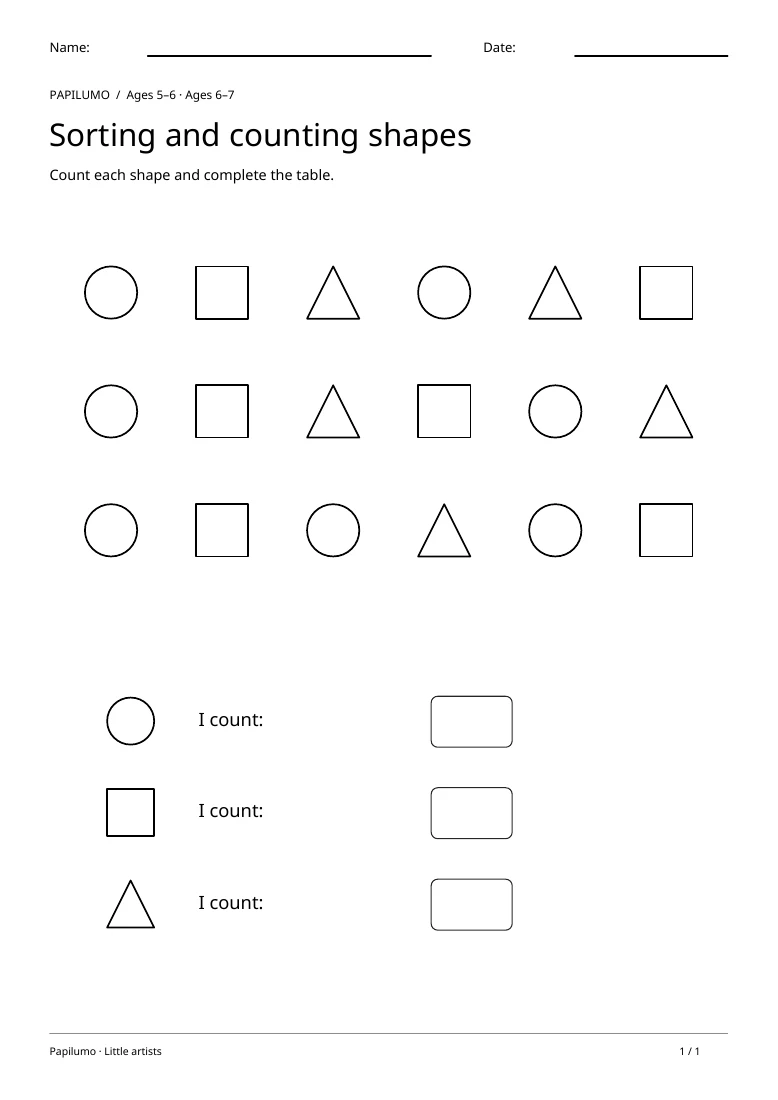
Use the follow-up to meet the same idea in a different setting. Offer it once the first task makes sense, without insisting that the whole page must be perfect. The child might explain a strategy, make an example or set a challenge for an adult. Return to the worksheet only when it helps connect the two situations. A short conversation or a practical activity can be enough to finish the session. To continue exploring, use Count and Sort Shapes Worksheet: Count each shape and complete the table.
Downloading and printing the PDF
This free PDF contains one worksheet designed for A4 paper. Download the file using the button on this page and open it in your PDF reader. Choose actual size or a 100% scale, check the orientation in the print preview and turn off any browser headers or footers. The illustrations use vector lines, so their outlines stay sharp when printed. Check the margins on one copy before preparing several sheets for a group. The level shown on the page is a guide, rather than a requirement to complete the activity at a particular age.