What this worksheet helps children practise
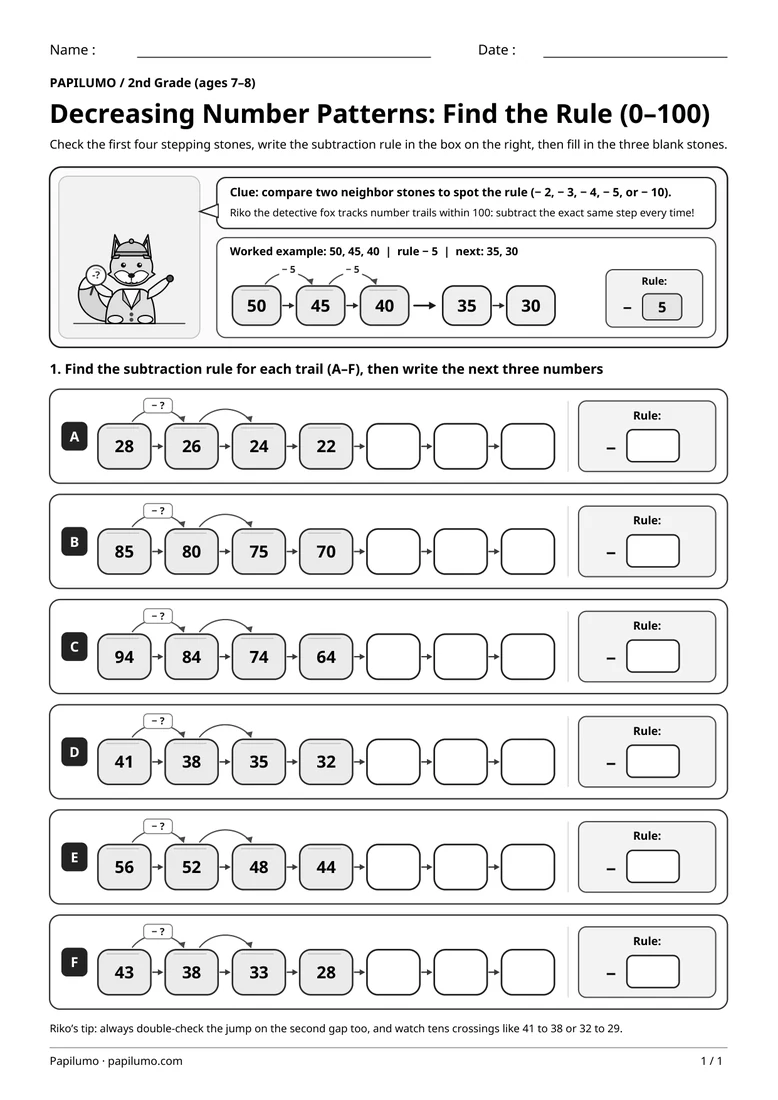
Find how much is taken away between the first two stones, confirm it on the next stone, and keep subtracting!
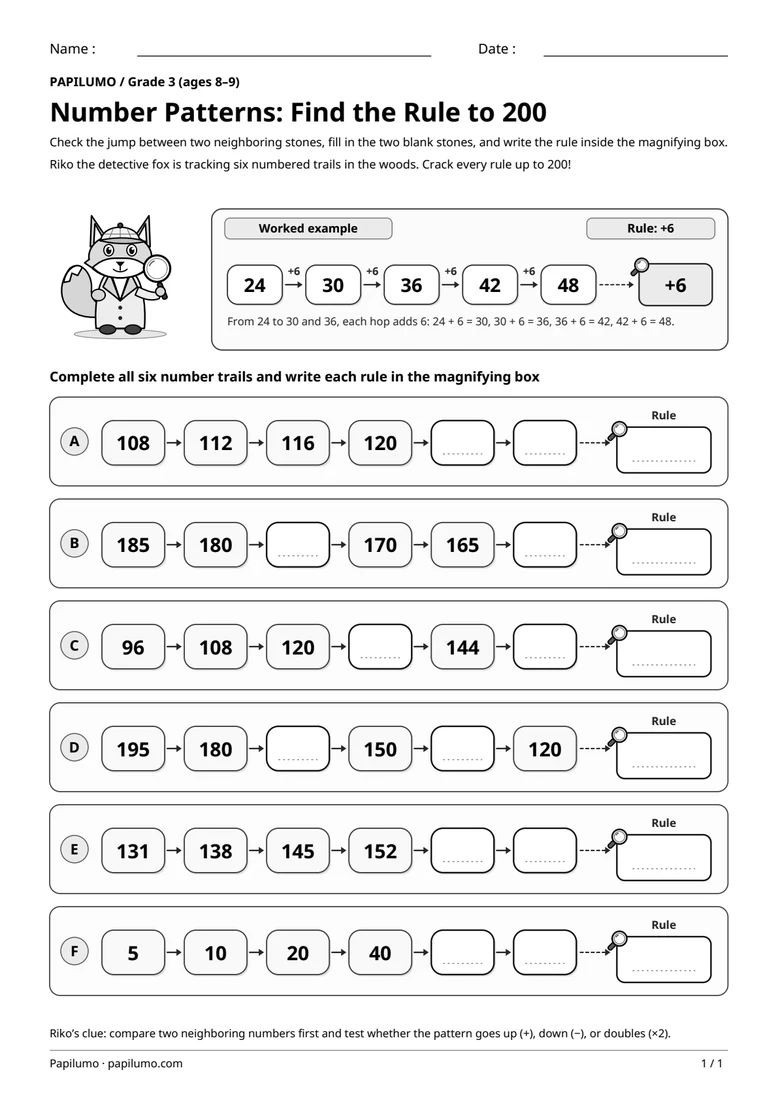
Finding the rule of a decreasing number pattern means measuring the exact difference between two neighboring terms and applying that same subtraction step consistently along the whole row. In 2nd Grade, this foundational algebraic thinking strengthens mental subtraction fluency, number-sense flexibility, and bridging backward across tens—such as stepping from 32 down to 29 when subtracting 3, or from 44 to 40 and 36 when subtracting 4. Mixing − 2, − 5, and − 10 with − 3, − 4, and an off-five − 5 trail encourages careful checking instead of guessing. For a related skill, use Number Patterns: Find the Rule to 200 with Riko the Detective Fox: Check the jump between two neighboring stones, fill in the two blank stones, and write the rule inside the magnifying box.
Preparing a short session
Print the student worksheet at actual size (100%) on plain white letter or A4 paper without shrinking the margins, and provide a sharpened pencil and eraser. Before tackling row A, examine Riko’s top banner together, read the worked example aloud, and ask your student to explain why the jump between 50 and 45 matches the jump from 45 to 40. Keep the separate one-page answer key PDF out of sight while your child solves all six trails independently.
A concrete example to get started
Inside the worked example box beside Riko the detective fox, three shaded stones display 50, 45, and 40 linked by − 5 subtraction hops. A clean arrow leads to the next two solved stones, 35 and 30, while the detective rule card on the right highlights − 5. This clear model teaches an essential two-step habit: test the difference between the first pair of numbers, verify that the same subtraction holds on the next gap, and only then write the missing terms.
Supporting the activity
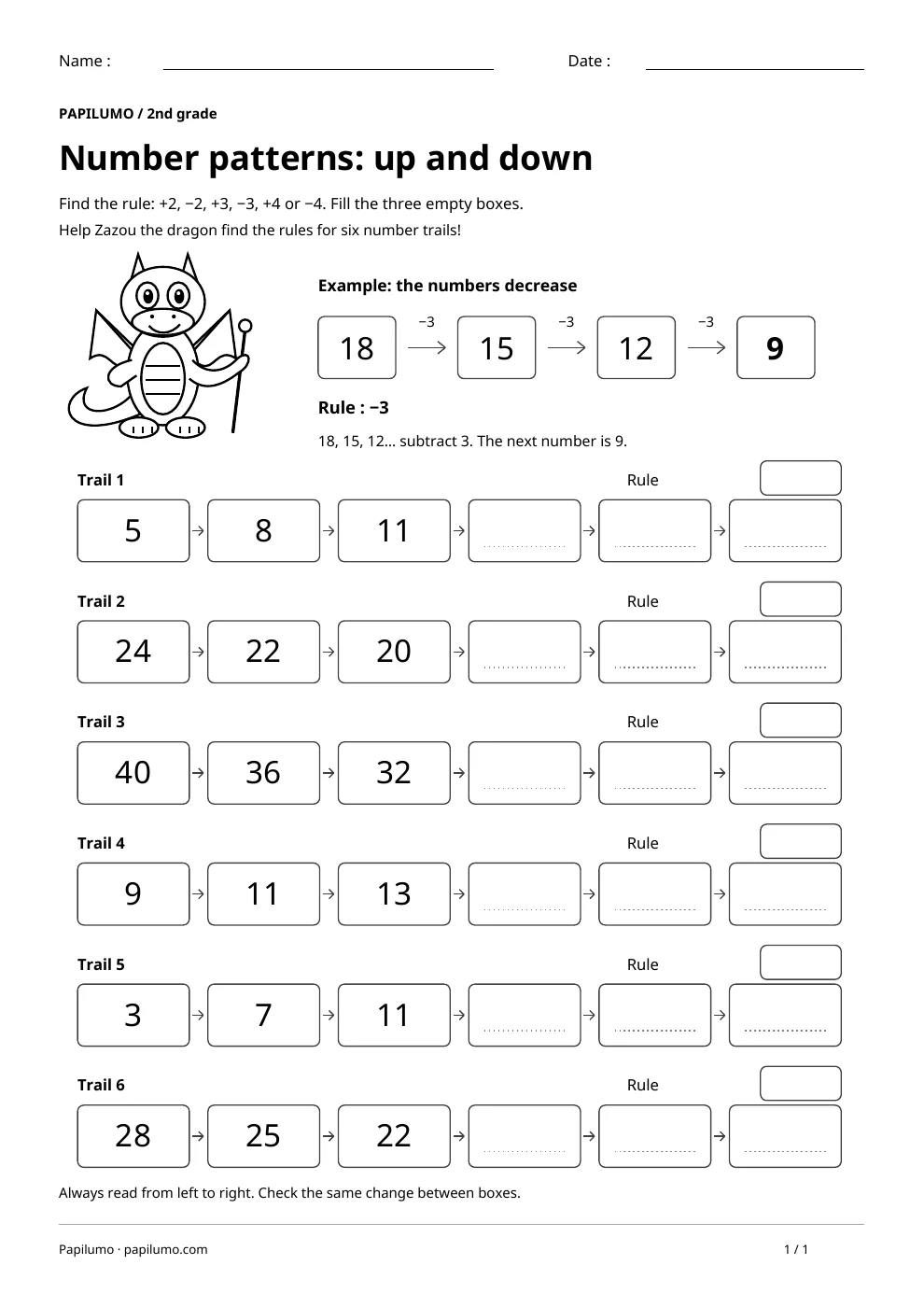
Trails A through F offer a thoughtful progression strictly within 0 to 100: row A counts back by 2 (28, 26, 24, 22, then 20, 18, 16); row B subtracts 5 from 85 (85, 80, 75, 70, then 65, 60, 55); row C subtracts 10 while keeping the ones digit at 4 (94, 84, 74, 64, then 54, 44, 34). Next, row D practices − 3 (41, 38, 35, 32, then 29, 26, 23), row E applies − 4 (56, 52, 48, 44, then 40, 36, 32), and row F spots − 5 off multiples of five (43, 38, 33, 28, then 23, 18, 13). To vary the practice, try Increasing and decreasing number patterns to 40: Find the rule: +2, −2, +3, −3, +4 or −4. Fill the three empty boxes.
What to notice and how to check
When reviewing the completed sheet against the separate answer key PDF, check each row’s Rule box first to confirm that the student identified − 2, − 5, − 10, − 3, − 4, and − 5 accurately before filling the stones. Pay special attention to backward tens crossings—such as 32 to 29 in row D and 44 to 40 to 36 in row E—and verify the alternating 3 and 8 ones digits throughout trail F (23, 18, 13).
Making the task easier
Start with trails A (− 2), B (− 5), and C (− 10) using the 50, 45, 40 model, and count back carefully across tens.
Keep the learning aim, but reduce how much the child has to handle at once. Cover part of the page with another sheet and reveal one task at a time. Demonstrate a separate example, then leave a real opportunity to work something out. An answer reached with support is still a useful attempt; it does not yet show that the same task can be completed independently.
Taking the idea beyond the worksheet
Create your own secret 7-number decreasing trail between 90 and 20 using the rule − 4, and challenge a partner to crack it.
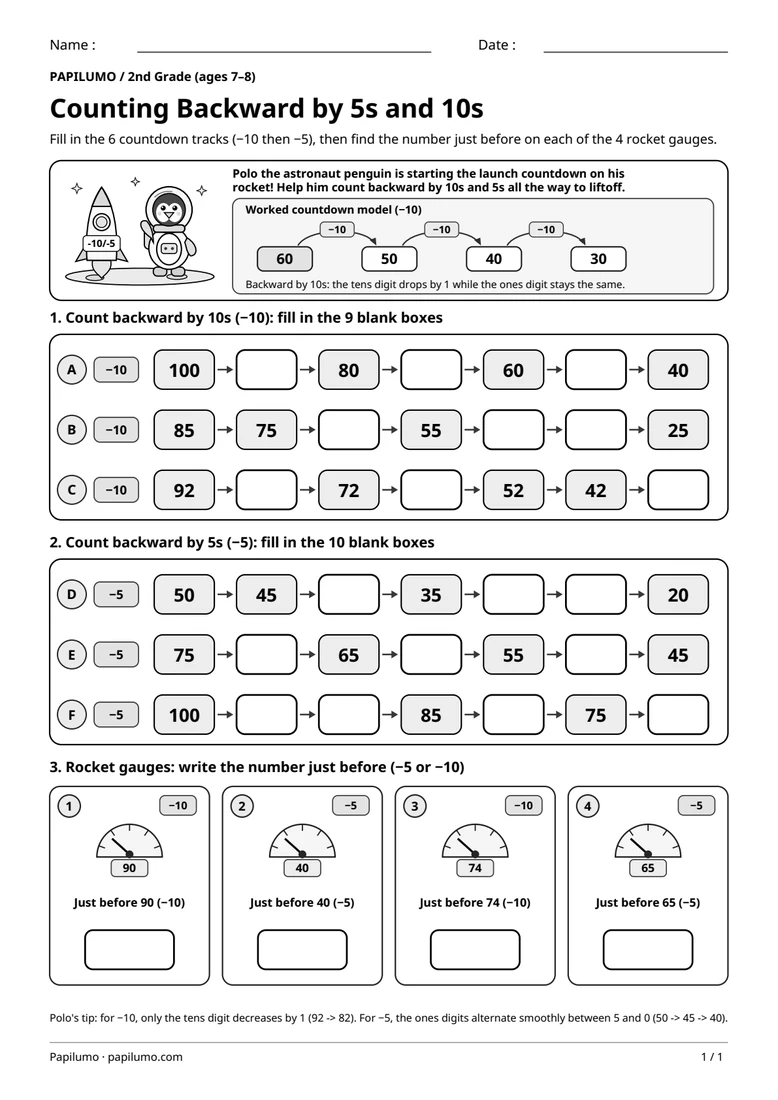
Use the follow-up to meet the same idea in a different setting. Offer it once the first task makes sense, without insisting that the whole page must be perfect. The child might explain a strategy, make an example or set a challenge for an adult. Return to the worksheet only when it helps connect the two situations. A short conversation or a practical activity can be enough to finish the session. To continue exploring, use Counting Backward by 5s and 10s with Polo the Astronaut Penguin: Fill in the 6 countdown tracks (−10 then −5), then find the number just before on each of the 4 rocket gauges.
Downloading and printing the PDF
This free PDF contains one worksheet designed for A4 paper. Download the file using the button on this page and open it in your PDF reader. Choose actual size or a 100% scale, check the orientation in the print preview and turn off any browser headers or footers. The illustrations use vector lines, so their outlines stay sharp when printed. Check the margins on one copy before preparing several sheets for a group. The level shown on the page is a guide, rather than a requirement to complete the activity at a particular age.