

What this worksheet helps children practise
Always glance ahead to the next printed stone on the track to confirm your countdown lands cleanly!
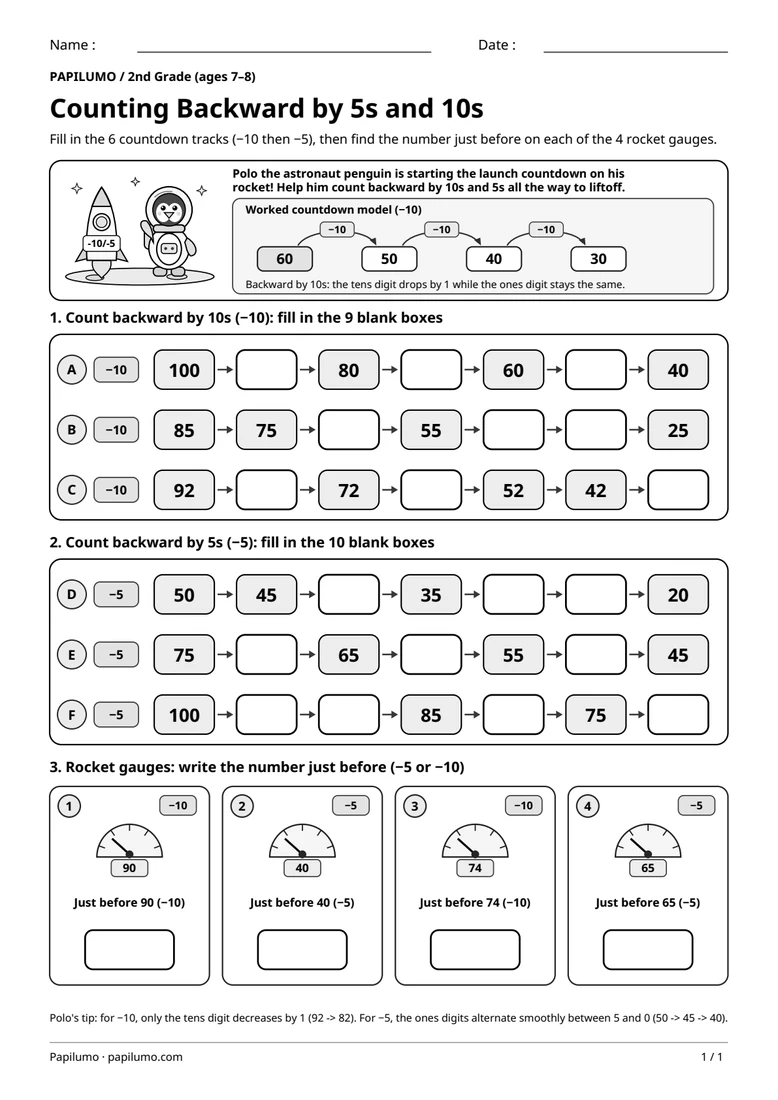
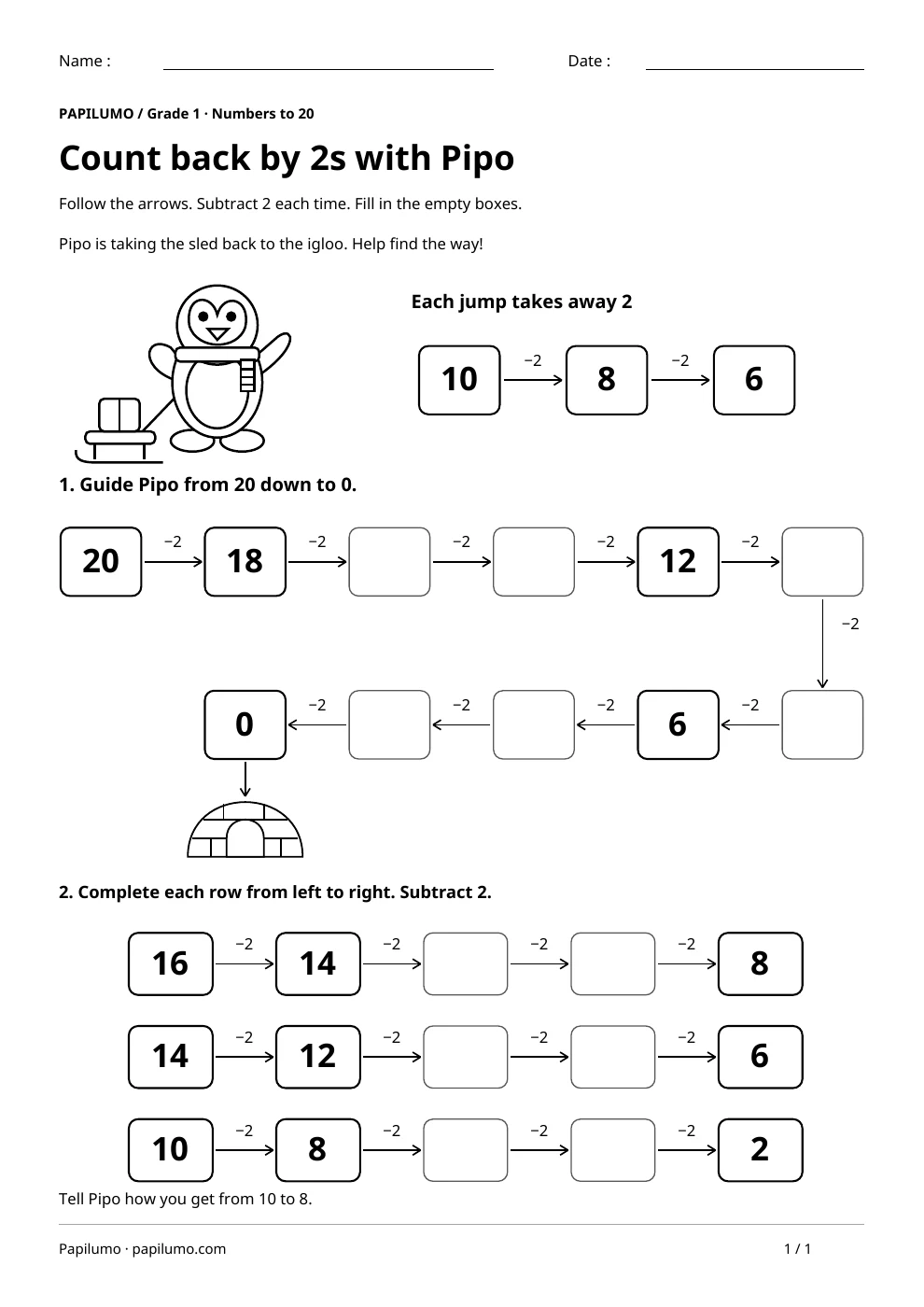
Counting backward by 10s and 5s in second grade builds strong place-value fluency, mental subtraction speed, and flexible navigation across the hundreds chart. Stepping down by 10 not only from multiples like 100 but also from off-ten numbers like 85 and 92 reveals that the tens digit drops by one while the ones digit remains unchanged. Counting down by 5 trains the alternating 0-and-5 ones rhythm and directly supports reading analog clocks in five-minute steps and making change. For a related skill, use Counting backward by 2 from 20 to 0: Follow the arrows. Subtract 2 each time. Fill in the empty boxes.
Preparing a short session
Print the student page at actual size (100%) on plain white A4 or letter paper without shrinking margins, and hand your learner a sharp pencil and soft eraser. Keep the separate one-page answer key out of sight until every box is filled. Before starting Part 1, inspect Polo the astronaut penguin and his −10 / −5 rocket at the top, and trace the three worked −10 hops aloud together (60 -> 50 -> 40 -> 30) so the downward rhythm feels natural.
A concrete example to get started
Inside the top example panel, three curved −10 jump arcs guide students cleanly from 60 down to 50, then 40, and finally 30. That visual pattern proves at a glance that subtracting ten reduces the left-hand tens digit by one step (6, 5, 4, 3) without altering the ones column. Beneath the arcs, the short rule highlights how that exact move works on off-ten paths like 85 or 92, while −5 hops step cleanly between 0 and 5 endings.
Supporting the activity
In Part 1 (−10 across three seven-stone tracks), students complete nine clean blank boxes: Track A from 100 to 40 with 100, [90], 80, [70], 60, [50], 40; Track B from 85 to 25 with 85, 75, [65], 55, [45], [35], 25; and Track C from 92 to 32 with 92, [82], 72, [62], 52, 42, [32]. In Part 2 (−5 across three tracks), learners fill ten blank boxes: Track D from 50 to 20 with 50, 45, [40], 35, [30], [25], 20; Track E from 75 to 45 with 75, [70], 65, [60], 55, [50], 45; and Track F from 100 to 70 with 100, [95], [90], 85, [80], 75, [70]. Part 3 checks four rocket gauges: before 90 (−10) = 80, before 40 (−5) = 35, before 74 (−10) = 64, and before 65 (−5) = 60. To vary the practice, try 10 More, 10 Less, 1 More, 1 Less Crosses with Zia the Mole: Fill in the six 100-chart cross cutouts around each center, then solve the two reverse challenges starting from the shaded tile.
What to notice and how to check
When reviewing with the separate PDF answer key, check the nine Part 1 blanks first, then the ten Part 2 blanks, and finally the four bottom rocket gauges (80, 35, 64, and 60). Pay special attention to backward tens crossings such as 40 − 5 = 35 and 90 − 5 = 85, where young learners sometimes keep the higher ten by mistake. If any stone slips off pattern, step back to the previous printed stone and count backward aloud until reaching the next printed milestone.
Making the task easier
For −10 jumps, cover the ones digit with a finger so you only drop the tens digit by 1, then uncover the matching ones digit.
Keep the learning aim, but reduce how much the child has to handle at once. Cover part of the page with another sheet and reveal one task at a time. Demonstrate a separate example, then leave a real opportunity to work something out. An answer reached with support is still a useful attempt; it does not yet show that the same task can be completed independently.
Taking the idea beyond the worksheet
Continue Track C backward by 10s down to 2 (32 -> 22 -> 12 -> 2) on scrap paper, and invent two extra −5 rocket gauges for a partner.
Use the follow-up to meet the same idea in a different setting. Offer it once the first task makes sense, without insisting that the whole page must be perfect. The child might explain a strategy, make an example or set a challenge for an adult. Return to the worksheet only when it helps connect the two situations. A short conversation or a practical activity can be enough to finish the session. To continue exploring, use Ordering Numbers to 99 from Least to Greatest with Leo: Write the five numbers in each row in order from least to greatest.
Downloading and printing the PDF
This free PDF contains one worksheet designed for A4 paper. Download the file using the button on this page and open it in your PDF reader. Choose actual size or a 100% scale, check the orientation in the print preview and turn off any browser headers or footers. The illustrations use vector lines, so their outlines stay sharp when printed. Check the margins on one copy before preparing several sheets for a group. The level shown on the page is a guide, rather than a requirement to complete the activity at a particular age.