


What this worksheet helps children practise
Have children lightly check off each number as they write it, comparing the tens digits first and the ones digits only when the tens match.
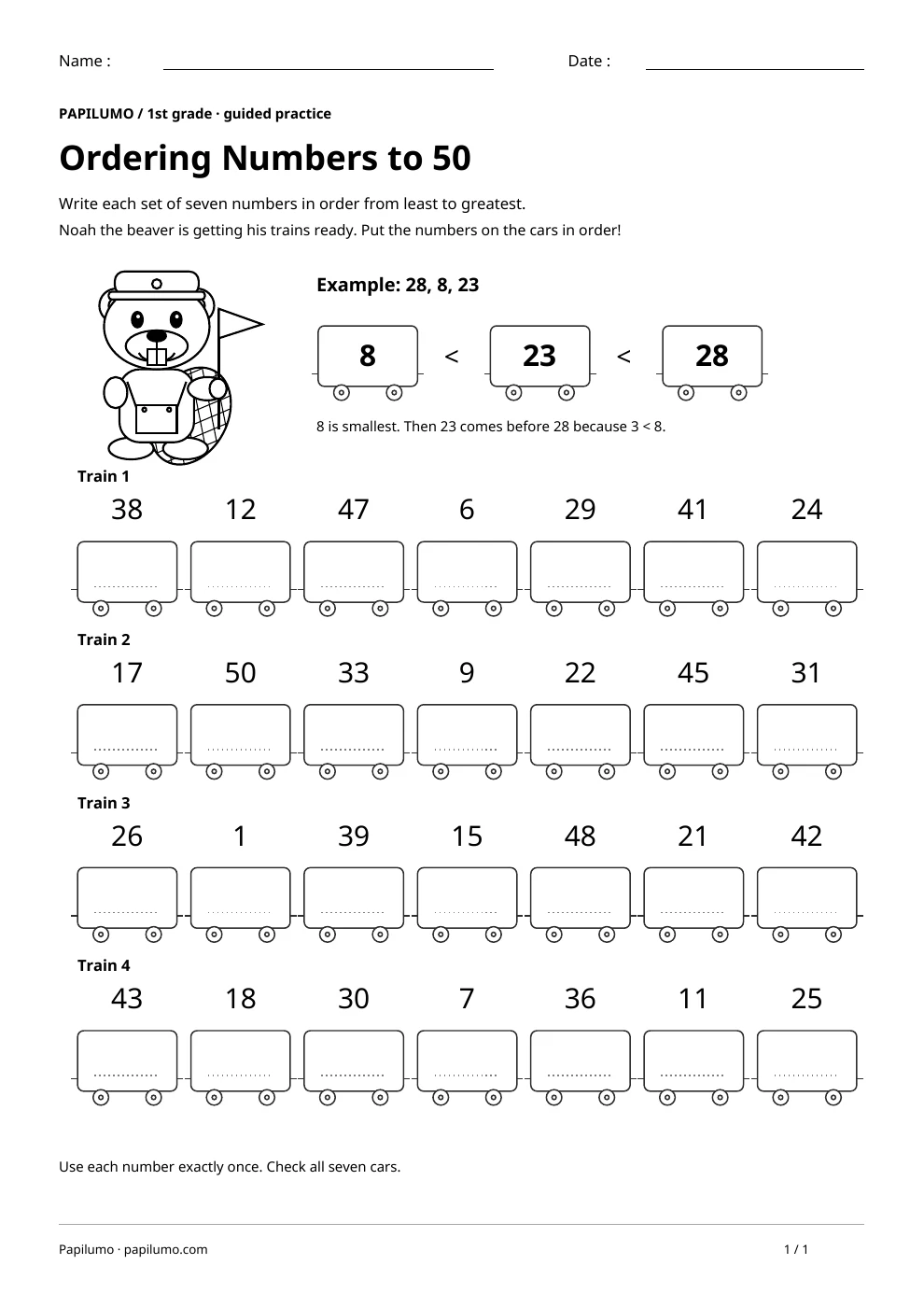
Ordering five numbers up to 99 builds both place-value fluency and systematic working habits. When students compare just two numbers, they only make a single decision; when sorting a group of five mixed values such as 84, 39, 81, 16, and 57, they must scan the entire list, select the smallest available number, record it, and repeat the search among the remaining values. Every row on this worksheet intentionally includes one pair of numbers with the same tens digit (68 and 63 in Row 1, 84 and 81 in Row 2, 75 and 72 in Row 3, 54 and 59 in Row 4, 96 and 91 in Row 5). This design prevents children from looking only at the leading digit and reinforces the two-step comparison rule: compare tens first, then compare ones whenever the tens are equal. For a related skill, use Ordering Numbers to 50 with Noah: Write each set of seven numbers in order from least to greatest.
Preparing a short session
Print the student worksheet at 100% scale on standard paper and provide a sharp pencil and an eraser. Before writing anything in Row 1, introduce Leo the lemur and read the worked example together. Ask the child to explain why 29 comes first, why 58 is second, and how we know 71 belongs before 74 when both numbers start with 7 tens. Teach a simple tracking habit right away: as soon as a number is written inside a lantern, lightly check it off or cross it out in the printed list above. Marking used numbers keeps the remaining choices clear, prevents accidental skips or duplicates, and eliminates the need for cutting and pasting.
A concrete example to get started
The top model shows the four numbers 74, 29, 71, and 58. Looking at the tens digits first gives 7 tens, 2 tens, 7 tens, and 5 tens. Since 2 tens is the smallest, 29 goes into the first lantern, followed by 58 (5 tens) in the second lantern. That leaves 74 and 71, which both have 7 tens; comparing their ones digits shows that 1 one is less than 4 ones, so 71 comes before 74, completing the sequence 29 < 58 < 71 < 74. In Row 1 (68, 25, 63, 14, 49), the student spots 1 ten (14) first, then 2 tens (25), then 4 tens (49), and finally compares 63 and 68 by their ones (3 < 8) to write 14, 25, 49, 63, 68.
Supporting the activity
Students work through five rows from top to bottom and left to right, writing 25 answers in all. Row 1 (68, 25, 63, 14, 49) and Row 2 (84, 39, 81, 16, 57) establish the routine of scanning for the lowest tens digit and resolving a same-ten pair (63/68 and 81/84). Row 3 (75, 42, 93, 28, 72) extends the range into the nineties while contrasting 72 and 75. Row 4 (54, 8, 86, 59, 31) includes a single-digit number (8, which has 0 tens) to make sure learners do not confuse 8 ones with 8 tens (86). Finally, Row 5 (96, 47, 62, 91, 35) provides a confident finish near 100 as students order 35, 47, 62, 91, and 96. To vary the practice, try Descending Order to 100: Greatest to Least with Polo: Write each set of five numbers in descending order from greatest to least down the steps.
What to notice and how to check
When all five rows are complete, run a two-part check before comparing with the separate answer key PDF. First, verify that all five printed numbers in a row appear once in the lanterns, with no miscopied digits (such as writing 73 instead of 72). Second, read the completed row from left to right and confirm that each number is greater than the one before it. If a same-ten pair is reversed (for instance, 84 written before 81), cover the tens digits briefly with a finger so the child focuses on comparing 4 ones and 1 one. If 8 is placed near 86 in Row 4, remind the learner that a one-digit number has zero tens and therefore comes first.
Making the task easier
Circle the smallest number and underline the greatest number in the row first, then sort the three middle numbers.
Keep the learning aim, but reduce how much the child has to handle at once. Cover part of the page with another sheet and reveal one task at a time. Demonstrate a separate example, then leave a real opportunity to work something out. An answer reached with support is still a useful attempt; it does not yet show that the same task can be completed independently.
Taking the idea beyond the worksheet
Pick any finished row and read the five lanterns from right to left to practice ordering from greatest to least.
Use the follow-up to meet the same idea in a different setting. Offer it once the first task makes sense, without insisting that the whole page must be perfect. The child might explain a strategy, make an example or set a challenge for an adult. Return to the worksheet only when it helps connect the two situations. A short conversation or a practical activity can be enough to finish the session. To continue exploring, use Ordering 3-Digit Numbers to 999 with Noe: Compare hundreds first, then tens and ones, and write each set in the blank boxes following the < or > signs.
Downloading and printing the PDF
This free PDF contains one worksheet designed for A4 paper. Download the file using the button on this page and open it in your PDF reader. Choose actual size or a 100% scale, check the orientation in the print preview and turn off any browser headers or footers. The illustrations use vector lines, so their outlines stay sharp when printed. Check the margins on one copy before preparing several sheets for a group. The level shown on the page is a guide, rather than a requirement to complete the activity at a particular age.