
What this worksheet helps children practise
Point across the bottom row for the shape, then check the top row to see what changed in the right column!
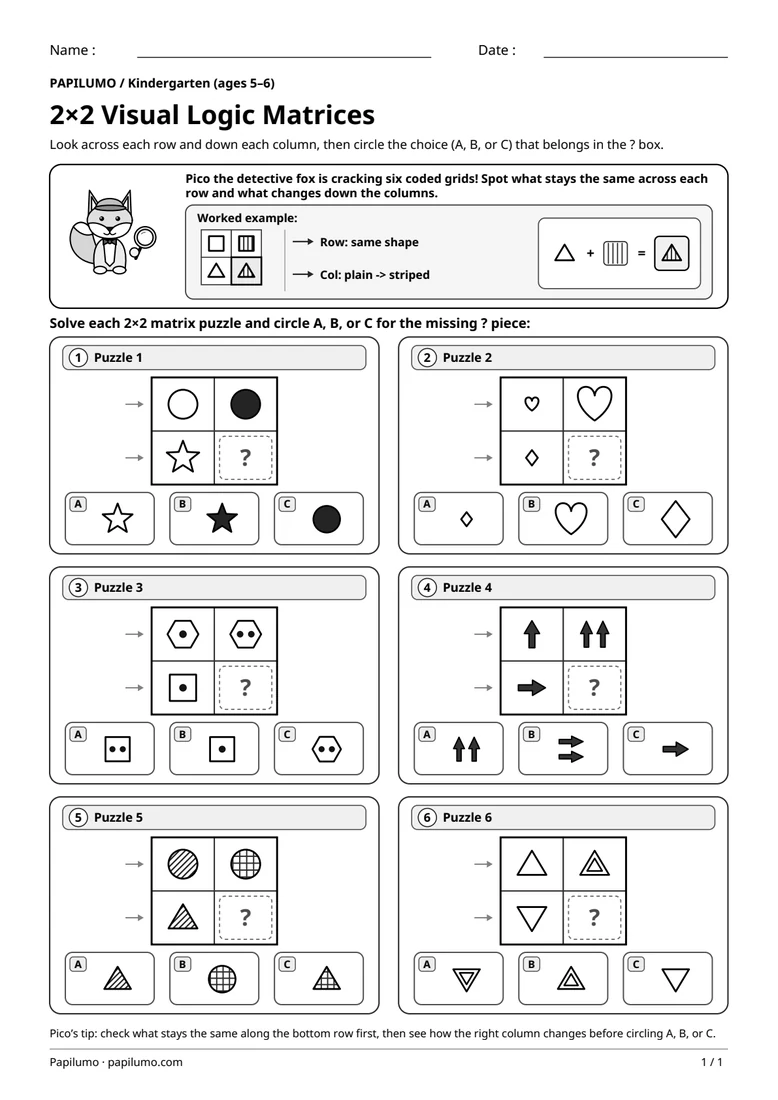
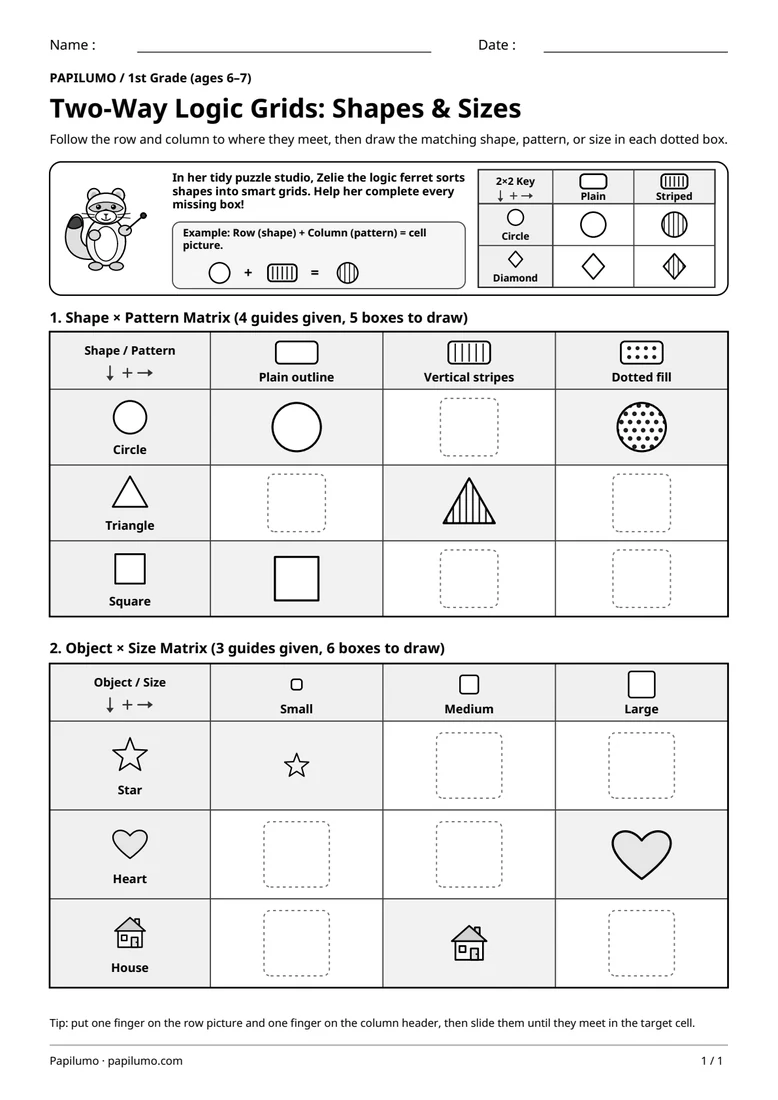
Solving 2×2 visual logic matrices in Kindergarten strengthens early deductive reasoning by asking children to combine two independent visual clues at the same time. Instead of grabbing the first familiar shape, young detectives observe what remains constant along the bottom row and compare what transforms from the left column to the right column—such as solid fill, size jump, dot count, arrow quantity, line pattern, or orientation and nesting. This word-free practice sharpens visual discrimination, working memory, and early algebraic pattern thinking. For a related skill, use Two-Way Shape Logic Grid with Zelie the Logic Ferret: Follow the row and column to where they meet, then draw the matching shape, pattern, or size in each dotted box.
Preparing a short session
Print the student page at actual size (100%) on plain white letter or A4 paper without cropping margins, and hand your child a sharpened pencil and soft eraser. Keep the separate PDF answer key tucked away during independent work. Sit comfortably together beside Pico’s banner at the top and talk aloud through the solved 2×2 example before starting, asking two guiding questions: what stays identical across each row, and what changes from left to right?
A concrete example to get started
Inside the top example box, the 2×2 grid displays a white square and a vertically striped square on the top row, followed by a white triangle and a completed vertically striped triangle on the bottom row. Pico’s clue notes make both rules unmistakable: every row keeps the same shape (squares on top, triangles below), while the left column stays plain white and the right column adds vertical stripes. Putting triangle and striped fill together immediately reveals why the striped triangle belongs in the bottom-right spot.
Supporting the activity
The six puzzles build gently in variety. Puzzle 1 pairs circle and star rows with plain-to-solid black columns: choice B (solid black star) wins. Puzzle 2 pairs heart and diamond rows with small-to-large size: choice C (large diamond) fits. Puzzle 3 links hexagon and square rows with one versus two inner dots: choice A (square with two dots) matches. Puzzle 4 crosses arrow direction (up vs. right) with arrow count (one vs. two): choice B (two right-pointing arrows) completes it. Puzzle 5 combines circle and triangle rows with diagonal stripes versus grid squares: choice C (grid triangle) fits. Puzzle 6 pairs upright and upside-down triangles with single versus double nested outlines: choice A (upside-down double triangle) solves it. To vary the practice, try Picture Shape Analogies with Zelie the Ferret: Look at how the first shape changes into the second, then circle choice (1), (2), or (3) that follows the exact same rule.
What to notice and how to check
When reviewing with the separate answer key, which circles and checks every correct letter while drawing the missing figure directly in each ? cell, check all six puzzles in order: 1-B, 2-C, 3-A, 4-B, 5-C, and 6-A. If a child picked a distractor that matches only the shape or only the pattern, cover the bottom row with one finger and look at the top row again to trace how the left box turns into the right box.
Making the task easier
Slide a blank sheet of paper over the lower puzzles so your child focuses on one 2×2 grid and its three choices at a time.
Keep the learning aim, but reduce how much the child has to handle at once. Cover part of the page with another sheet and reveal one task at a time. Demonstrate a separate example, then leave a real opportunity to work something out. An answer reached with support is still a useful attempt; it does not yet show that the same task can be completed independently.
Taking the idea beyond the worksheet
Challenge your child to draw an original 2×2 puzzle on the back using two shapes and two simple patterns for you to solve.
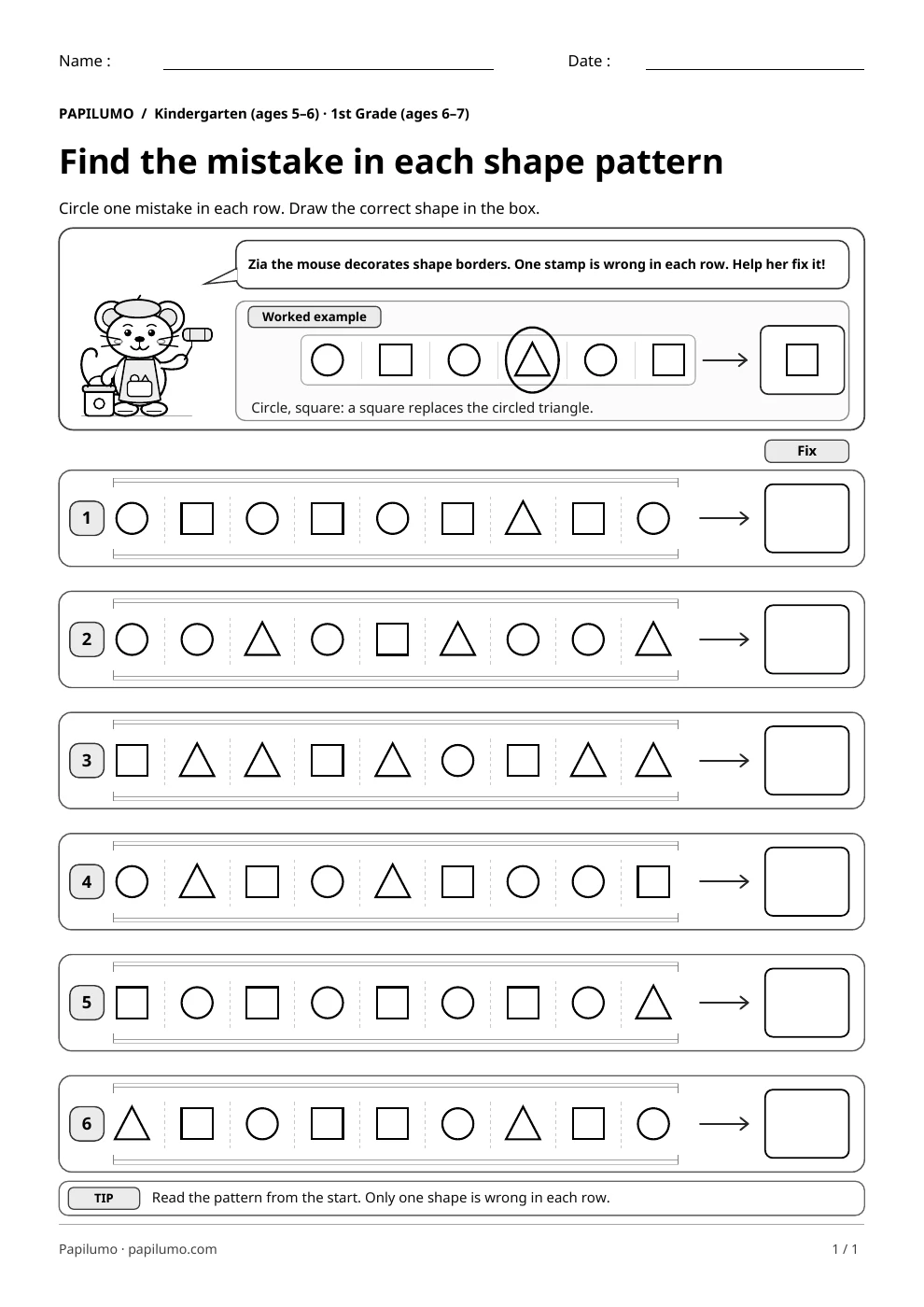
Use the follow-up to meet the same idea in a different setting. Offer it once the first task makes sense, without insisting that the whole page must be perfect. The child might explain a strategy, make an example or set a challenge for an adult. Return to the worksheet only when it helps connect the two situations. A short conversation or a practical activity can be enough to finish the session. To continue exploring, use Find the mistake in each shape pattern with Zia: Circle one mistake in each row. Draw the correct shape in the box.
Downloading and printing the PDF
This free PDF contains one worksheet designed for A4 paper. Download the file using the button on this page and open it in your PDF reader. Choose actual size or a 100% scale, check the orientation in the print preview and turn off any browser headers or footers. The illustrations use vector lines, so their outlines stay sharp when printed. Check the margins on one copy before preparing several sheets for a group. The level shown on the page is a guide, rather than a requirement to complete the activity at a particular age.