

What this worksheet helps children practise
Say the repeating unit aloud. If a child circles a shape just because it looks different, ask which shape should occupy that position.
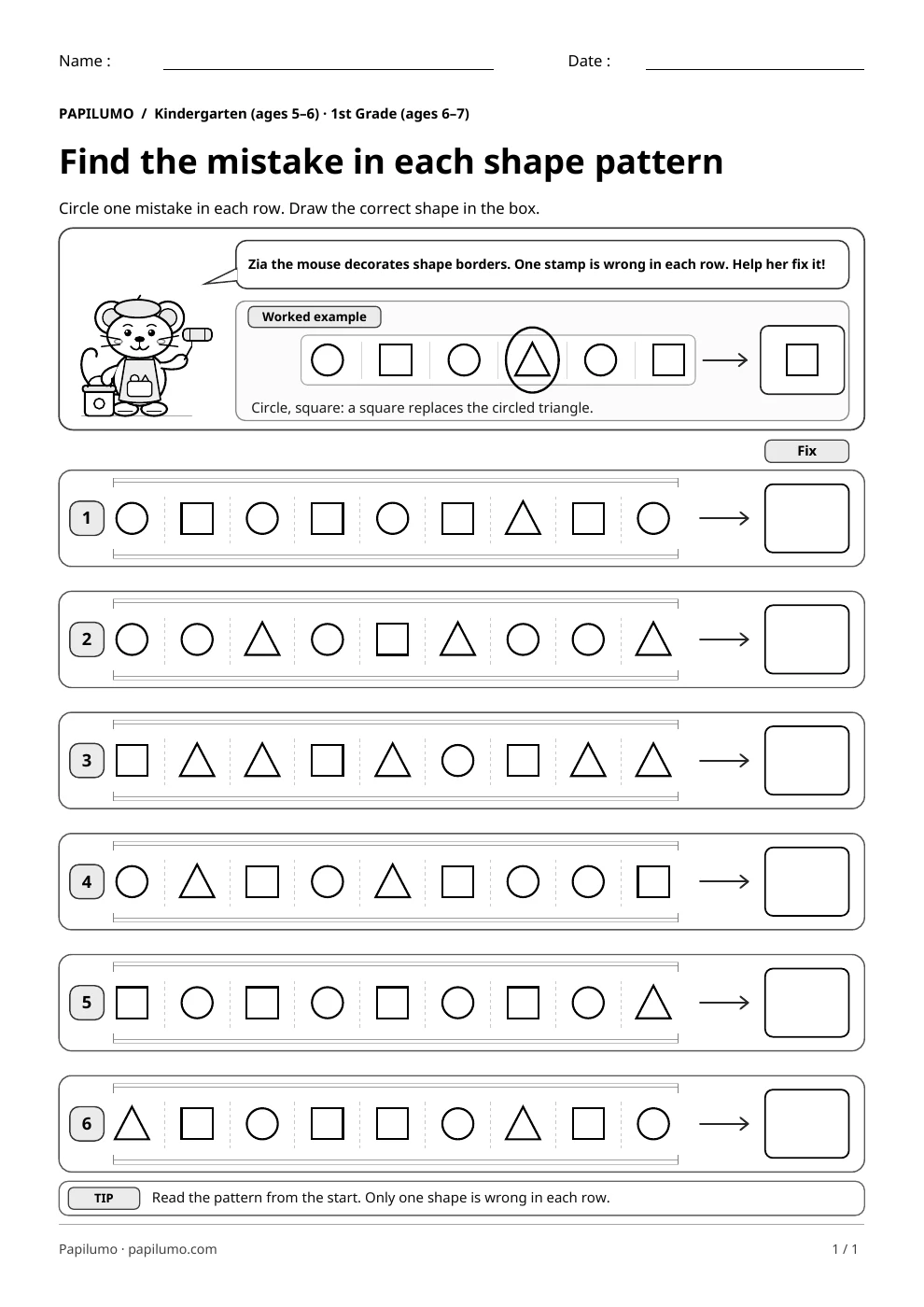
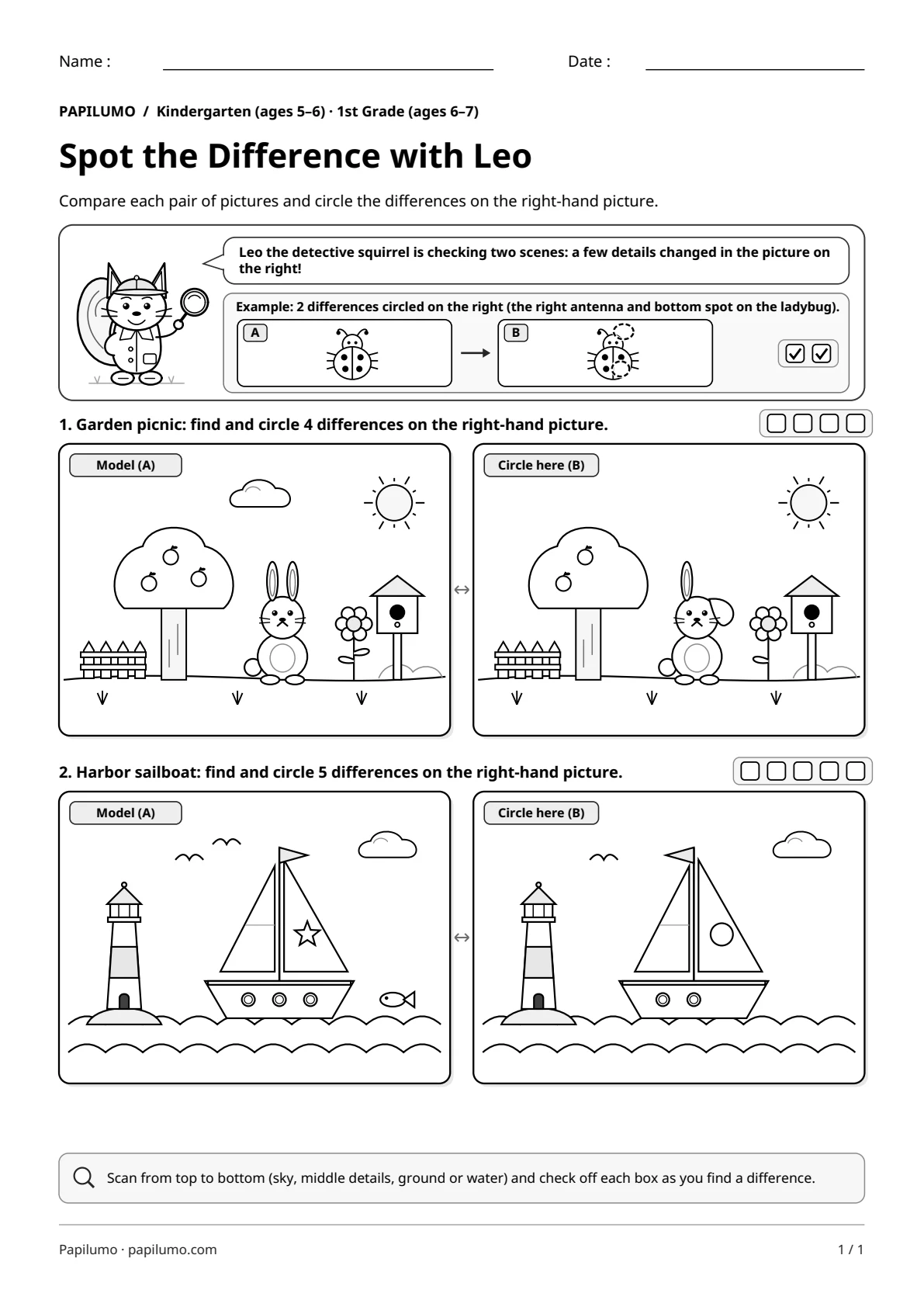
Children identify a repeating unit, continue it mentally and check a whole sequence. The rows include two-shape alternations and three-part units, both with repeated shapes and with three different shapes. A shape can appear elsewhere in a row and still be wrong in a particular position. Children therefore need to use the order rule rather than simply choose a shape that looks different. This kind of search supports visual attention, prediction and explaining a regular pattern aloud. For a related skill, use Spot the Difference: Look and Circle with Leo: Compare each pair of pictures and circle the differences on the right-hand picture.
Preparing a short session
Print at actual size and provide a pencil and eraser. No coloring or cutting is required. Name the circle, square and triangle, then look at Zia with her decorating roller and pot. Read the instruction and begin with the worked example. An adult can say the shape names while the child follows them with a finger. Reveal one row at a time when helpful and keep the answer key out of sight during the activity.
A concrete example to get started
The model shows circle, square, circle, triangle, circle, square. Its rule should alternate a circle and a square. A square is expected in the fourth position, so the triangle is the mistake. It is circled in the example, and a square is drawn in the box on the right. Read the sequence again while saying square instead of triangle. The final two shapes help confirm that the alternation continues. The circle marks the error, while the answer box shows the replacement.
Supporting the activity
The six rows use these repeating units in order: circle–square; circle–circle–triangle; square–triangle–triangle; circle–triangle–square; square–circle; and triangle–square–circle. Ask children to find the small group that repeats before looking for the mistake. They should circle just one shape in each row and draw its correction in the box on the right. There are six small drawings to complete altogether. Saying the shape names with a steady rhythm can help. The error occurs in a different position in each row. To vary the practice, try Missing shapes in repeating patterns: Look at each pattern. Draw the missing shapes in the empty boxes.
What to notice and how to check
The key circles position seven in row 1 and gives a circle; position five in row 2 and a circle; position six in row 3 and a triangle; position eight in row 4 and a triangle; position nine in row 5 and a square; and position four in row 6 and a triangle. Count positions from left to right. Then read the whole row using the corrected shape, so the answer is checked against the pattern rule rather than copied only from the key.
Making the task easier
Start with rows 1 and 5, which alternate two shapes. Say the pattern together before the child finds and draws the correction.
Keep the learning aim, but reduce how much the child has to handle at once. Cover part of the page with another sheet and reveal one task at a time. Demonstrate a separate example, then leave a real opportunity to work something out. An answer reached with support is still a useful attempt; it does not yet show that the same task can be completed independently.
Taking the idea beyond the worksheet
Make a nine-shape pattern on a whiteboard and deliberately replace one shape. Let the child and adult take turns finding each other's mistake.
Use the follow-up to meet the same idea in a different setting. Offer it once the first task makes sense, without insisting that the whole page must be perfect. The child might explain a strategy, make an example or set a challenge for an adult. Return to the worksheet only when it helps connect the two situations. A short conversation or a practical activity can be enough to finish the session. To continue exploring, use Picture Shape Analogies with Zelie the Ferret: Look at how the first shape changes into the second, then circle choice (1), (2), or (3) that follows the exact same rule.
Downloading and printing the PDF
This free PDF contains one worksheet designed for A4 paper. Download the file using the button on this page and open it in your PDF reader. Choose actual size or a 100% scale, check the orientation in the print preview and turn off any browser headers or footers. The illustrations use vector lines, so their outlines stay sharp when printed. Check the margins on one copy before preparing several sheets for a group. The level shown on the page is a guide, rather than a requirement to complete the activity at a particular age.