
What this worksheet helps children practise
Cover the answer on the right with a finger, work out the left side first, then check if both values match!
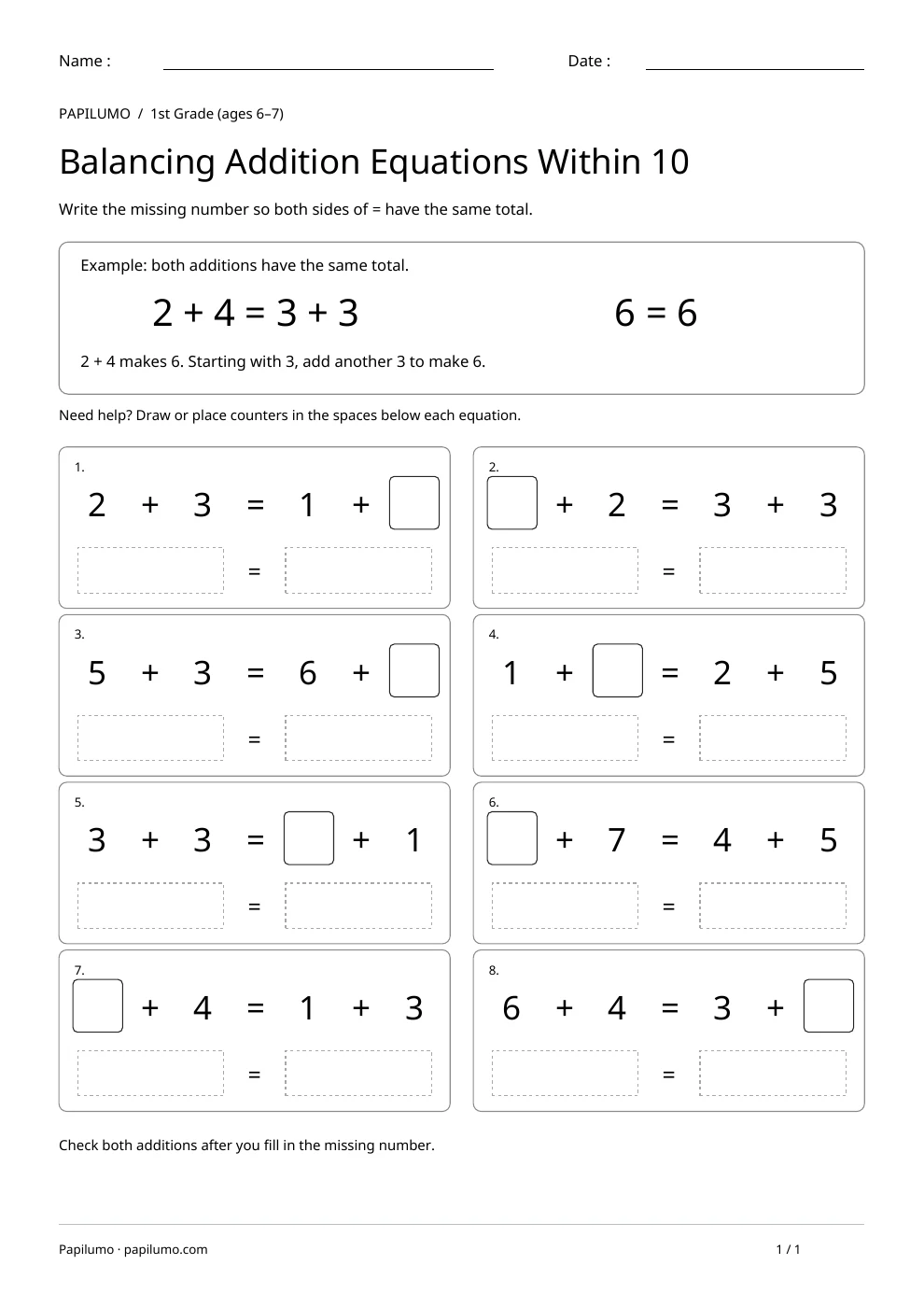
Deciding whether an equation is true or false turns passive fact recall into active mathematical reasoning and deepens understanding of the equals sign. Many first graders assume any written equation on a page is automatically correct, so judging both sides encourages self-checking rather than guessing. Practicing mixed addition and subtraction facts within 20 also strengthens make-ten strategies, doubles such as 7 + 7, and bridging across ten while training students to spot off-by-one errors before committing to an answer. For a related skill, use Balancing Addition Equations Within 10: Write the missing number so both sides of = have the same total.
Preparing a short session
Print the student worksheet at actual size (100%) on plain white letter or A4 paper without shrinking the margins, and set out a sharpened pencil, an eraser, and an optional 0-to-20 number line or small counters if needed. Before beginning the cards, read Pico the judge fox’s speech bubble together and talk through how 9 + 4 equals 13 in the top banner. Keep the separate answer key PDF tucked out of sight while your child checks and rules on all ten cards independently.
A concrete example to get started
Inside the top framed banner, Pico the judge fox points to the worked example 9 + 4 = 13. By counting on four from 9 or making ten (9 + 1 = 10, then 10 + 3 = 13), students confirm that the equation balances cleanly. Beside it, an arrow leads to the two rounded verdict badges with vector check and cross icons: the True badge is circled with a bold oval loop, modeling the exact pencil action pupils will repeat on every card below.
Supporting the activity
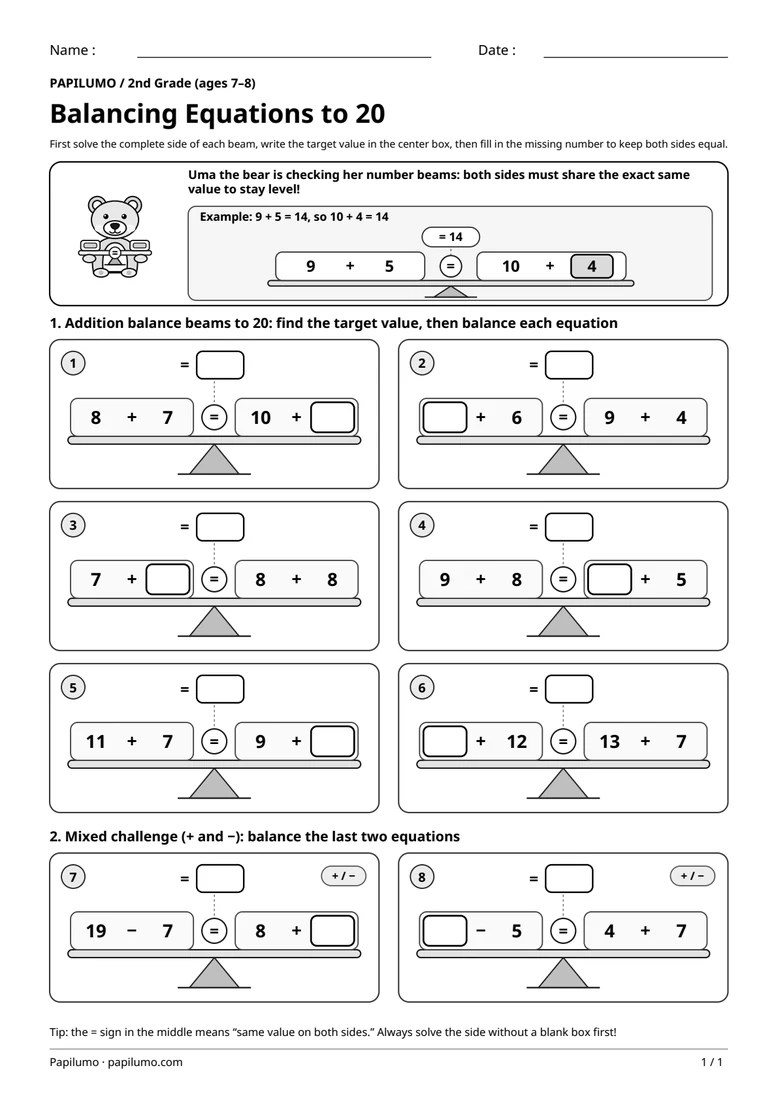
The ten shadowed cards labeled A through J alternate addition and subtraction within 20 across two tidy columns. Five equations are true: A (8 + 5 = 13), D (16 − 7 = 9), E (7 + 7 = 14), H (15 − 8 = 7), and I (11 + 6 = 17). Five equations are false by exactly one: B (9 + 6 = 14 instead of 15), C (14 − 5 = 8 instead of 9), F (8 + 9 = 16 instead of 17), G (18 − 9 = 8 instead of 9), and J (6 + 7 = 14 instead of 13). Pupils evaluate each left-hand expression and circle True or False. To vary the practice, try Balancing Addition Equations to 20 with Uma the Bear: First solve the complete side of each beam, write the target value in the center box, then fill in the missing number to keep both sides equal.
What to notice and how to check
When checking completed work against the separate answer key PDF, verify first that exactly five True badges and five False badges are circled across cards A through J. For every false equation (B, C, F, G, and J), the answer sheet displays the real corrected equation in soft gray directly beneath the problem, such as 9 + 6 = 15 and 18 − 9 = 9. Ask your child to read each corrected equation aloud so off-by-one slips become memorable number facts within 20.
Making the task easier
Start with friendly facts such as E (7 + 7 = 14) and I (11 + 6 = 17), using a 0–20 number line or counters when bridging ten.
Keep the learning aim, but reduce how much the child has to handle at once. Cover part of the page with another sheet and reveal one task at a time. Demonstrate a separate example, then leave a real opportunity to work something out. An answer reached with support is still a useful attempt; it does not yet show that the same task can be completed independently.
Taking the idea beyond the worksheet
On the back of the sheet, rewrite all five False equations so they become True, then create two new tricky equations for a partner.
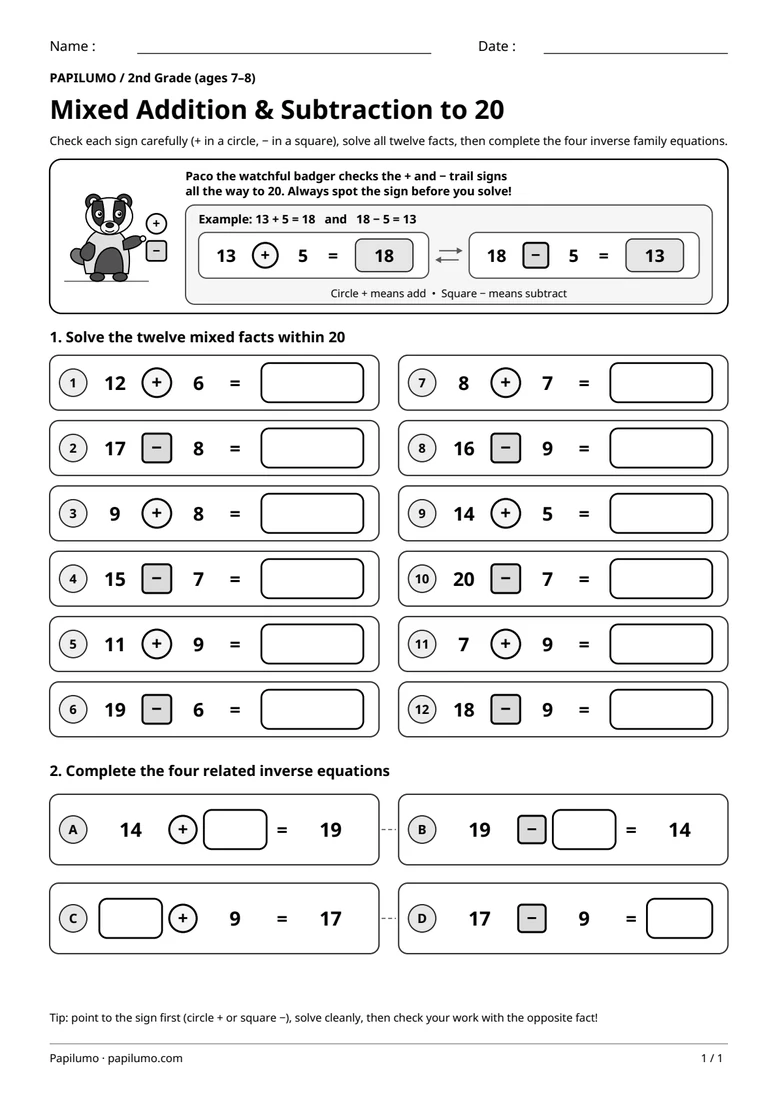
Use the follow-up to meet the same idea in a different setting. Offer it once the first task makes sense, without insisting that the whole page must be perfect. The child might explain a strategy, make an example or set a challenge for an adult. Return to the worksheet only when it helps connect the two situations. A short conversation or a practical activity can be enough to finish the session. To continue exploring, use Mixed Addition and Subtraction to 20 with Paco the Badger: Check each sign carefully (+ in a circle, − in a square), solve all twelve facts, then complete the four inverse family equations.
Downloading and printing the PDF
This free PDF contains one worksheet designed for A4 paper. Download the file using the button on this page and open it in your PDF reader. Choose actual size or a 100% scale, check the orientation in the print preview and turn off any browser headers or footers. The illustrations use vector lines, so their outlines stay sharp when printed. Check the margins on one copy before preparing several sheets for a group. The level shown on the page is a guide, rather than a requirement to complete the activity at a particular age.