
What this worksheet helps children practise
Always start with the side that has both numbers: write its total in the center box, then match it on the other side!
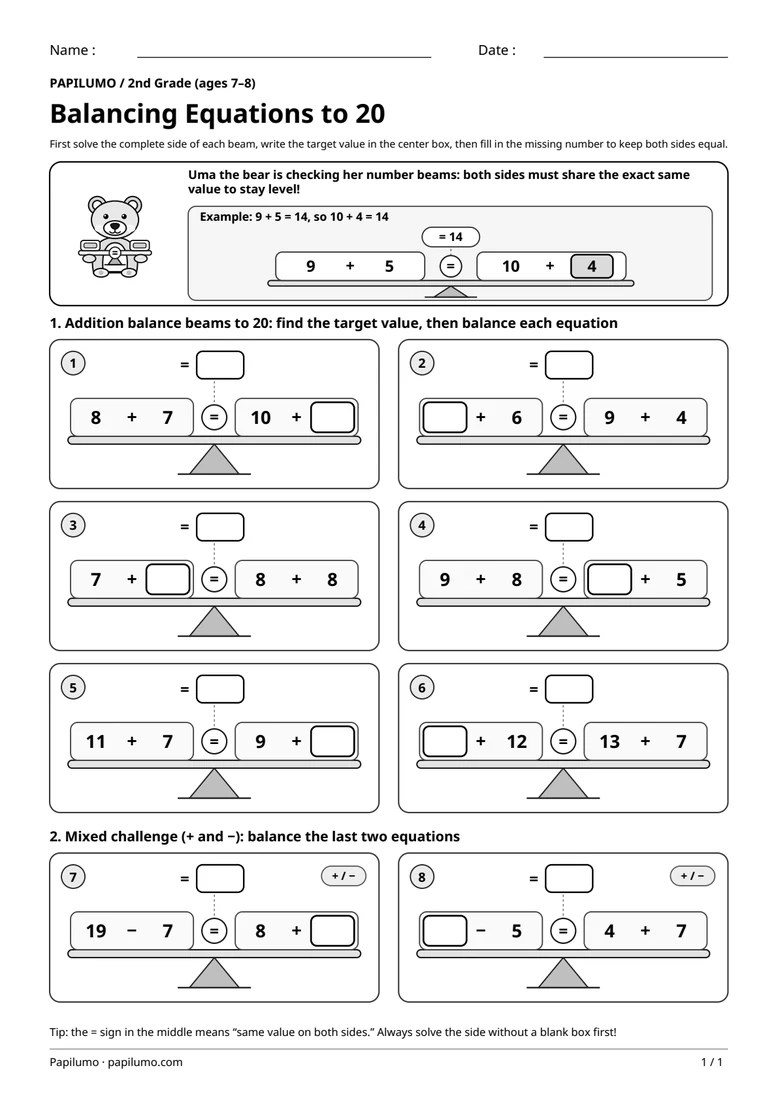
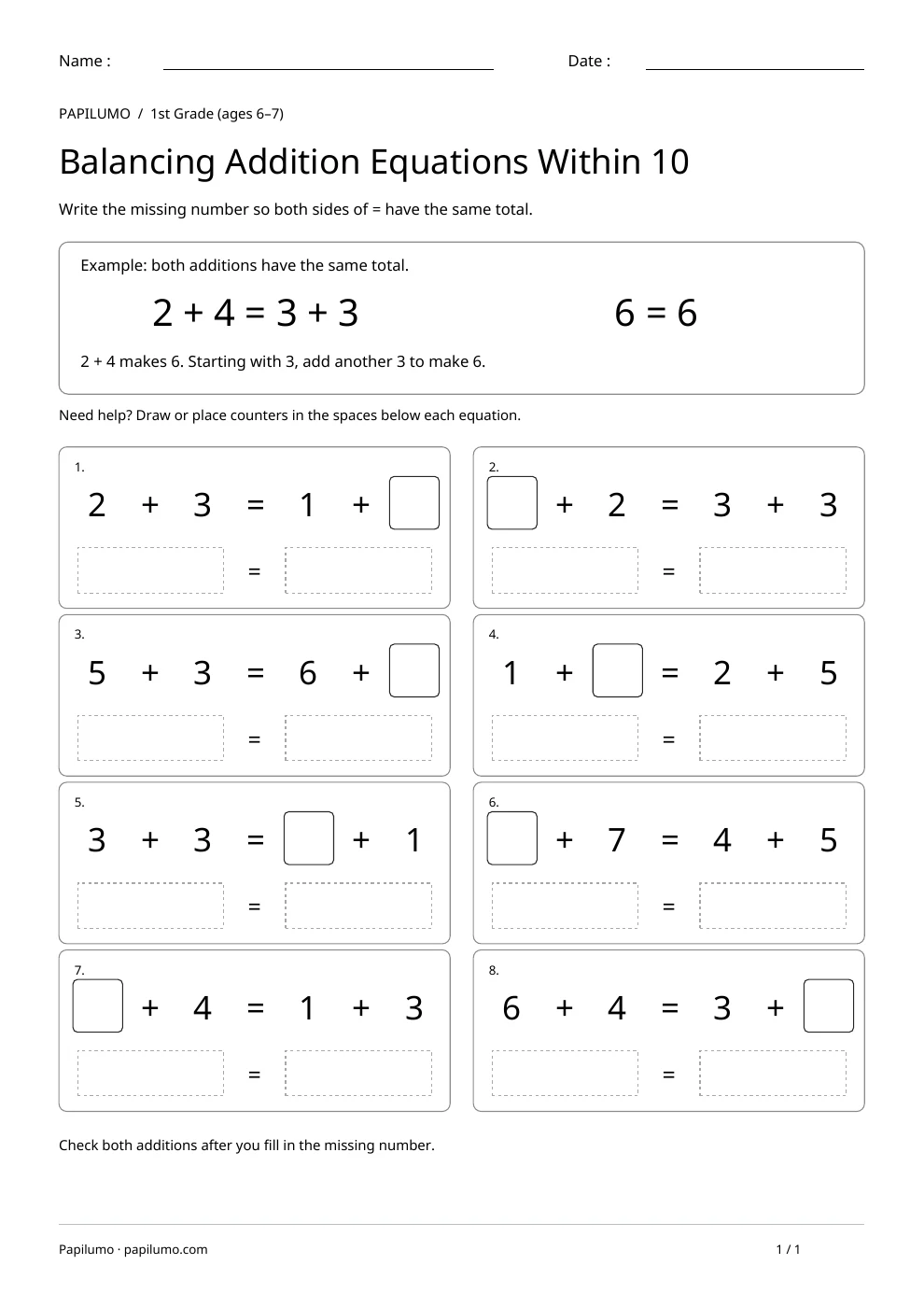
Understanding that the equals sign means “the same value on both sides” rather than “put the answer next” is one of the biggest algebra readiness milestones in 2nd grade math. When students balance equations such as 8 + 7 = 10 + 5 or solve left-missing equations like 7 + 6 = 9 + 4, they build flexible number sense, making-ten strategies, and strong fact fluency within 20. The final two mixed beams pairing addition with subtraction (19 − 7 and 16 − 5) deepen relational thinking across inverse operations. For a related skill, use Balancing Addition Equations Within 10: Write the missing number so both sides of = have the same total.
Preparing a short session
Print the student worksheet at actual size (100%) on plain white A4 or letter paper without scaling down the margins, and set out a sharpened pencil and eraser. Keep the separate one-page PDF answer key tucked aside during independent work. Before starting card 1, walk through the worked example beside Uma the bear together and ask your child which side of the beam already shows both numbers so they see why finding the center target value comes first.
A concrete example to get started
In the top banner next to Uma the bear, the worked balance shows 9 + 5 on the left tray and 10 + [4] on the right tray. A learner first evaluates the complete side (9 + 5 = 14) and notes 14 in the small center bubble above the equals pivot, then asks what number added to 10 also makes 14—filling 4 into the box on the right. Having both the target bubble and the missing-number slot keeps the two-step strategy clear.
Supporting the activity
Part 1 features six addition balance beams with missing addends alternating on both left and right sides: 1) 8 + 7 = 10 + 5 (target 15); 2) 7 + 6 = 9 + 4 (target 13); 3) 7 + 9 = 8 + 8 (target 16); 4) 9 + 8 = 12 + 5 (target 17); 5) 11 + 7 = 9 + 9 (target 18); and 6) 8 + 12 = 13 + 7 (target 20). Part 2 closes with two mixed +/− balances: 7) 19 − 7 = 8 + 4 (target 12) and 8) 16 − 5 = 4 + 7 (target 11), creating sixteen crisp response boxes. To vary the practice, try True or False Equations Within 20 with Pico the Fox: Solve the left side of each equation in your head, check the stated answer, and circle either the True or False badge.
What to notice and how to check
When checking work against the separate one-page answer key, review each card’s center target value first and the missing equation number second. Pay special attention to beams 2, 3, 6, and 8 where the blank box sits on the left side of the equals pivot, and to beam 8 (16 − 5 = 4 + 7) where students work backward from 11 to find the starting number before minus 5. If any beam tips off balance, ask your child to evaluate each tray separately to spot the mismatch.
Making the task easier
Cover the side with the empty box first, add or subtract the two given numbers to get the center target, then count up or back.
Keep the learning aim, but reduce how much the child has to handle at once. Cover part of the page with another sheet and reveal one task at a time. Demonstrate a separate example, then leave a real opportunity to work something out. An answer reached with support is still a useful attempt; it does not yet show that the same task can be completed independently.
Taking the idea beyond the worksheet
Write two new balanced equations to 20 on the back of the sheet, including at least one with a minus sign.
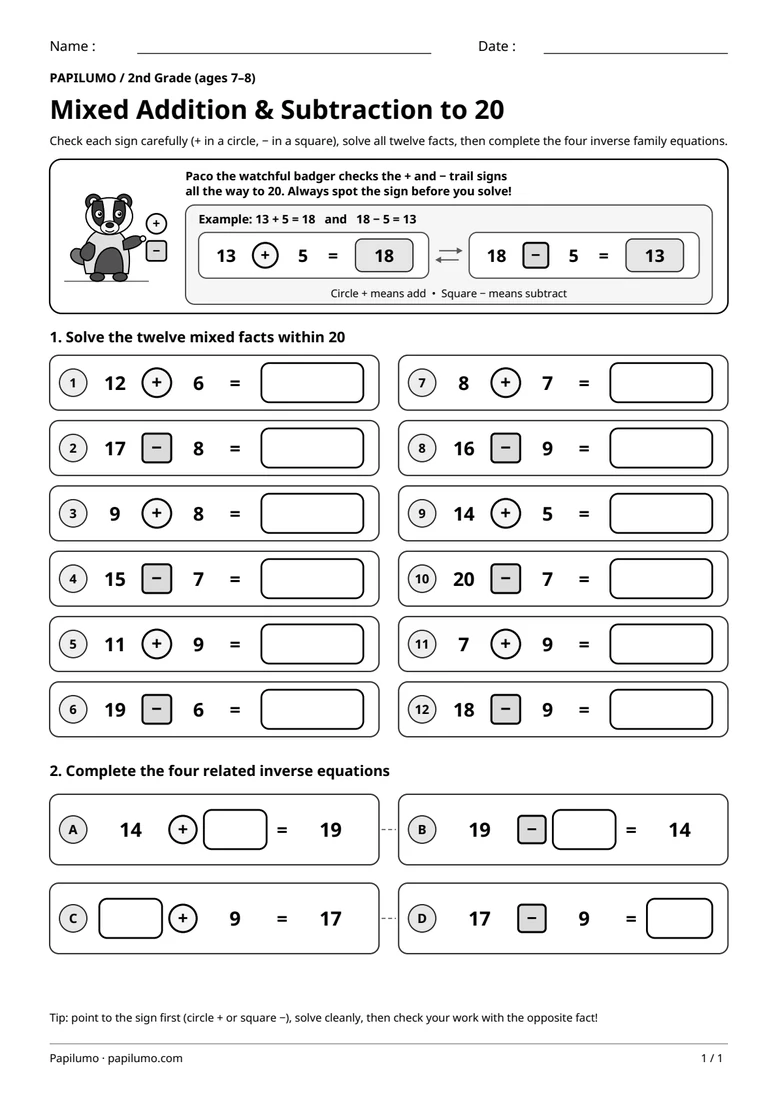
Use the follow-up to meet the same idea in a different setting. Offer it once the first task makes sense, without insisting that the whole page must be perfect. The child might explain a strategy, make an example or set a challenge for an adult. Return to the worksheet only when it helps connect the two situations. A short conversation or a practical activity can be enough to finish the session. To continue exploring, use Mixed Addition and Subtraction to 20 with Paco the Badger: Check each sign carefully (+ in a circle, − in a square), solve all twelve facts, then complete the four inverse family equations.
Downloading and printing the PDF
This free PDF contains one worksheet designed for A4 paper. Download the file using the button on this page and open it in your PDF reader. Choose actual size or a 100% scale, check the orientation in the print preview and turn off any browser headers or footers. The illustrations use vector lines, so their outlines stay sharp when printed. Check the margins on one copy before preparing several sheets for a group. The level shown on the page is a guide, rather than a requirement to complete the activity at a particular age.