What this worksheet helps children practise
Subtract the tens digits first, then copy the ones digit straight into your answer without changing it!
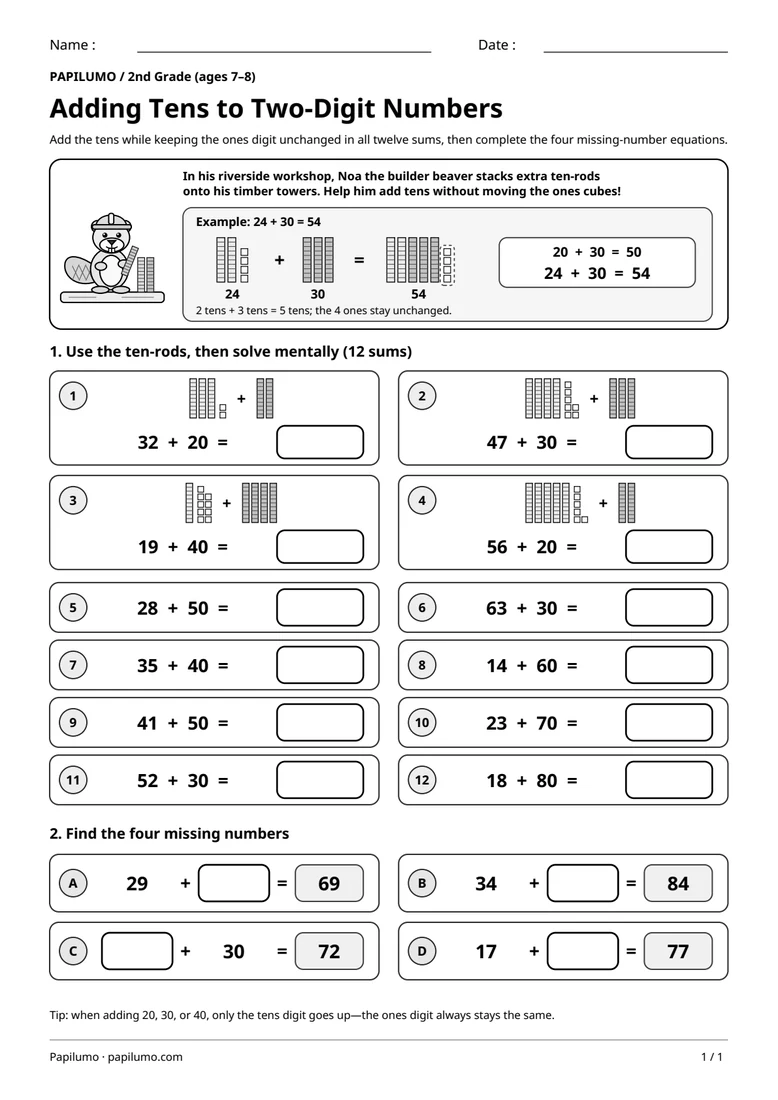
Subtracting multiples of ten from two-digit numbers in 2nd grade strengthens core place-value fluency and serves as the direct inverse of adding tens. Students discover through visual proof that subtracting 20, 30, 40, 50, or 60 reduces only the tens digit while leaving the ones digit completely fixed. Mastering this dependable structure eliminates slow counting backward by ones on fingers, builds accuracy on zero-ones cases such as 70 − 50 = 20, and prepares learners smoothly for full two-digit subtraction without or with regrouping. For a related skill, use Adding Tens to Two-Digit Numbers with Noa the Beaver: Add the tens while keeping the ones digit unchanged in all twelve sums, then complete the four missing-number equations.
Preparing a short session
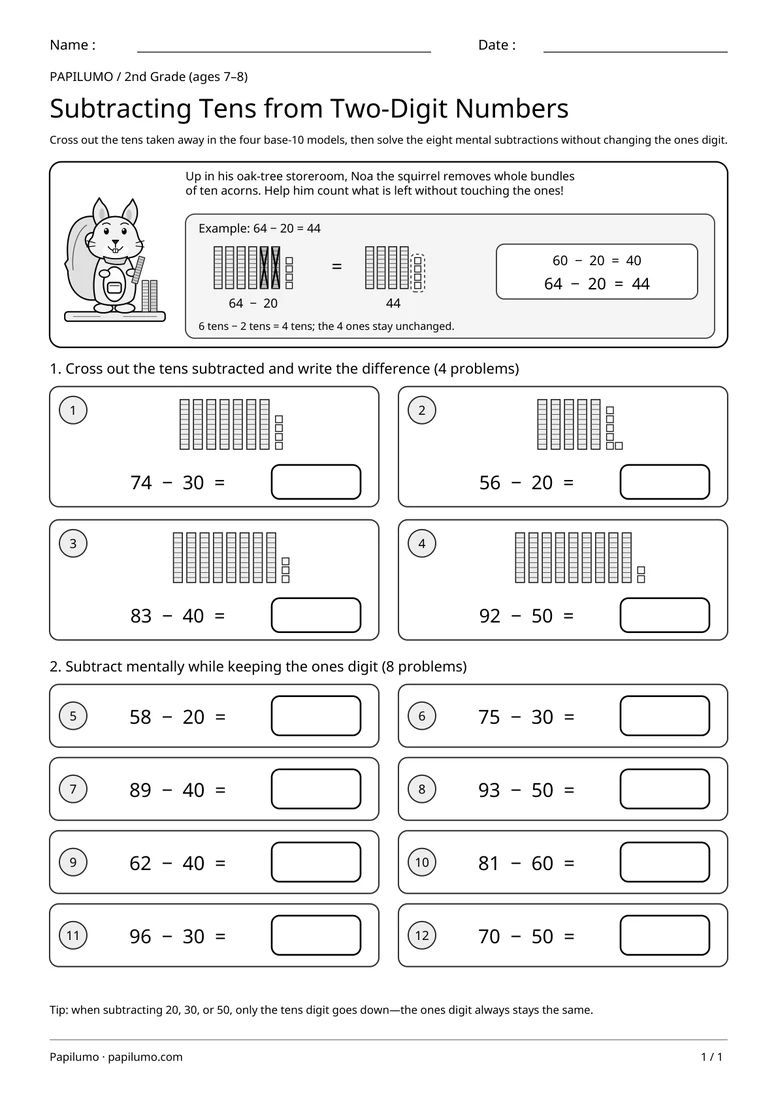
Print the student worksheet at actual size (100%) on plain white A4 or letter paper without scaling down margins, and provide a sharpened pencil with a clean eraser. Keep the separate one-page PDF answer key out of sight during independent practice. Before solving question 1, examine Noa the squirrel’s top model panel together and trace with one finger the remaining ten-rods, the two crossed-out ten-rods, and the four single ones cubes that remain untouched inside the dashed frame.
A concrete example to get started
Inside the top example box beside Noa the squirrel, the worked equation 64 − 20 = 44 makes place-value subtraction crystal clear. On the left, 64 appears as 6 ten-rods and 4 single cubes, with the last 2 ten-rods visibly shaded and crossed out to take away 20. Removing those two rods leaves 4 ten-rods and the exact same 4 ones cubes highlighted on the right, showing 44. The summary box reinforces the shortcut: 60 − 20 = 40, so 64 − 20 = 44 because the ones digit 4 stays unchanged.
Supporting the activity
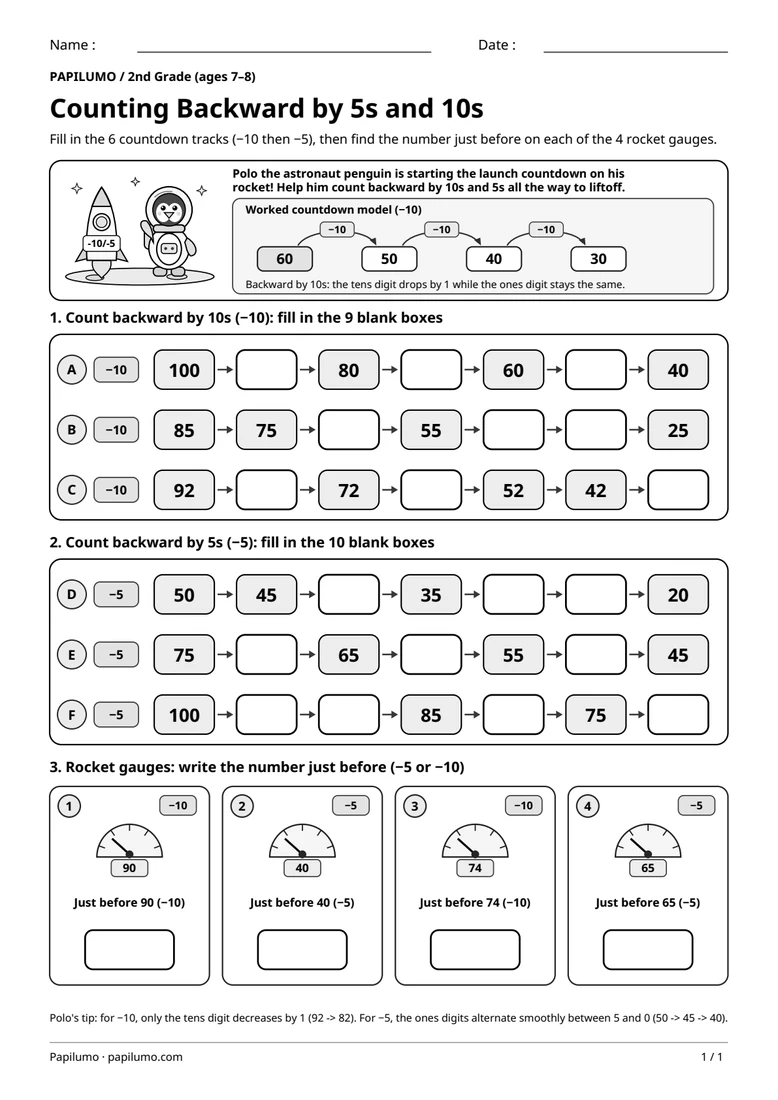
In Part 1, students use four base-10 visual cards, crossing out the removed ten-rods themselves before writing each difference: 74 − 30 = [44], 56 − 20 = [36], 83 − 40 = [43], and 92 − 50 = [42]. In Part 2, learners transition to eight clean mental subtraction cards: 58 − 20 = [38], 75 − 30 = [45], 89 − 40 = [49], 93 − 50 = [43], 62 − 40 = [22], 81 − 60 = [21], 96 − 30 = [66], and finally 70 − 50 = [20], confirming that zero ones also remain zero. To vary the practice, try Counting Backward by 5s and 10s with Polo the Astronaut Penguin: Fill in the 6 countdown tracks (−10 then −5), then find the number just before on each of the 4 rocket gauges.
What to notice and how to check
When reviewing with the separate PDF answer key, check both the crossed-out ten-rods and the four differences in Part 1 (44, 36, 43, and 42), then verify the eight mental answers in Part 2. If a ones digit shifts accidentally or a zero disappears in 70 − 50 = 20, ask the child to compare tens and ones aloud separately: how many tens before and after, and which ones digit stayed fixed? Reading each finished equation aloud cements the pattern.
Making the task easier
Circle the tens digit in each number, subtract them, and place the unchanged ones digit right behind.
Keep the learning aim, but reduce how much the child has to handle at once. Cover part of the page with another sheet and reveal one task at a time. Demonstrate a separate example, then leave a real opportunity to work something out. An answer reached with support is still a useful attempt; it does not yet show that the same task can be completed independently.
Taking the idea beyond the worksheet
Pick a starting number between 61 and 99, subtract 10, 20, 30, and 40 in turn, and check that the ones never move.
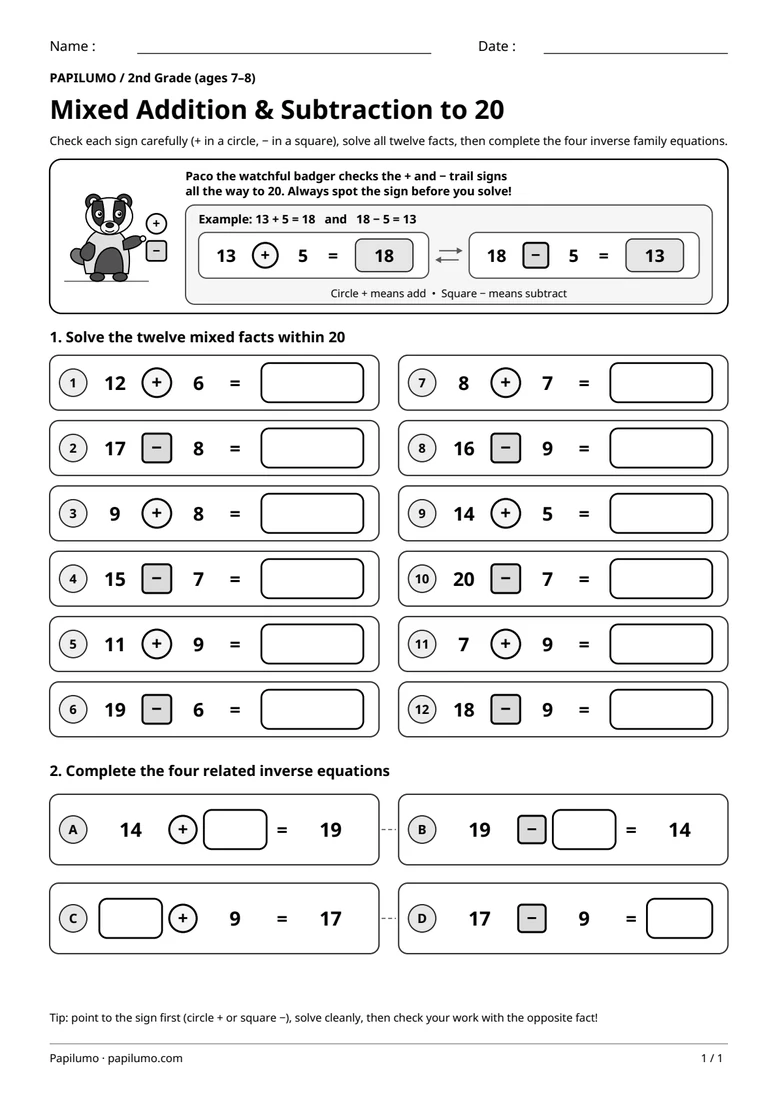
Use the follow-up to meet the same idea in a different setting. Offer it once the first task makes sense, without insisting that the whole page must be perfect. The child might explain a strategy, make an example or set a challenge for an adult. Return to the worksheet only when it helps connect the two situations. A short conversation or a practical activity can be enough to finish the session. To continue exploring, use Mixed Addition and Subtraction to 20 with Paco the Badger: Check each sign carefully (+ in a circle, − in a square), solve all twelve facts, then complete the four inverse family equations.
Downloading and printing the PDF
This free PDF contains one worksheet designed for A4 paper. Download the file using the button on this page and open it in your PDF reader. Choose actual size or a 100% scale, check the orientation in the print preview and turn off any browser headers or footers. The illustrations use vector lines, so their outlines stay sharp when printed. Check the margins on one copy before preparing several sheets for a group. The level shown on the page is a guide, rather than a requirement to complete the activity at a particular age.