
What this worksheet helps children practise
Plug your answer back in place of the letter to make sure both sides of the equals sign match!
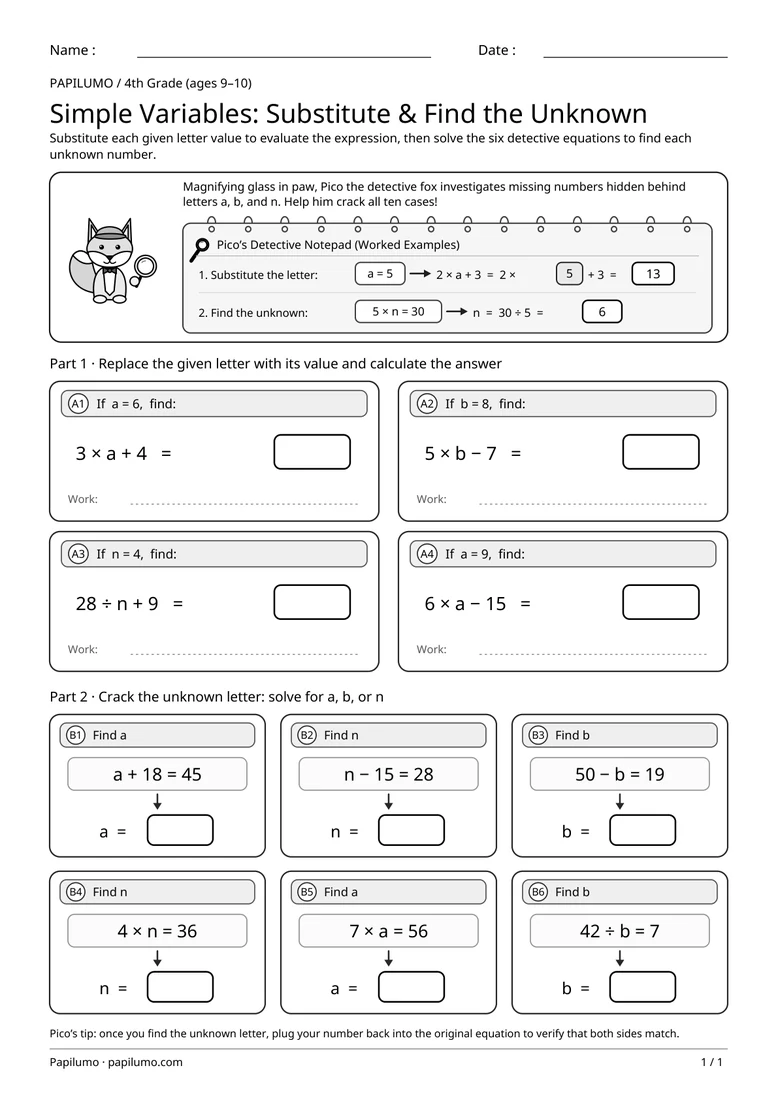
Treating a letter such as a, b, or n as a placeholder for a number builds early algebraic fluency in 4th Grade and prepares learners for multi-step problem solving. In Part 1, students practice substitution and order of operations by replacing the variable with its given integer and multiplying or dividing before adding or subtracting. In Part 2, they apply inverse operations and number-fact reasoning to solve addition, subtraction, multiplication, and division equations while checking that their solution makes the statement true. For a related skill, use Shape Algebra Grid Puzzles with Pico the Detective Fox: Use the row sums on the right and column sums at the bottom to find the secret whole number (1–12) for each shape.
Preparing a short session
Print the student page at 100% actual size on crisp white A4 or letter paper so the expressions, dashed work lines, and answer boxes remain spacious, and provide a sharpened pencil and eraser. Keep the separate answer key PDF aside during independent work. Before starting Part 1, read Pico’s detective notepad together, reminding your student that a variable letter simply stands in for one whole number waiting to be plugged in or discovered.
A concrete example to get started
Inside the detective notepad beside Pico the fox, two worked models demonstrate both worksheet tasks step by step. Model 1 starts with a = 5 and evaluates 2 × a + 3: swap a for 5 to get 2 × 5 + 3, multiply first to reach 10, and add 3 for 13. Model 2 tackles 5 × n = 30 by asking which factor times 5 equals 30, using 30 ÷ 5 to reveal n = 6, since 5 × 6 = 30.
Supporting the activity
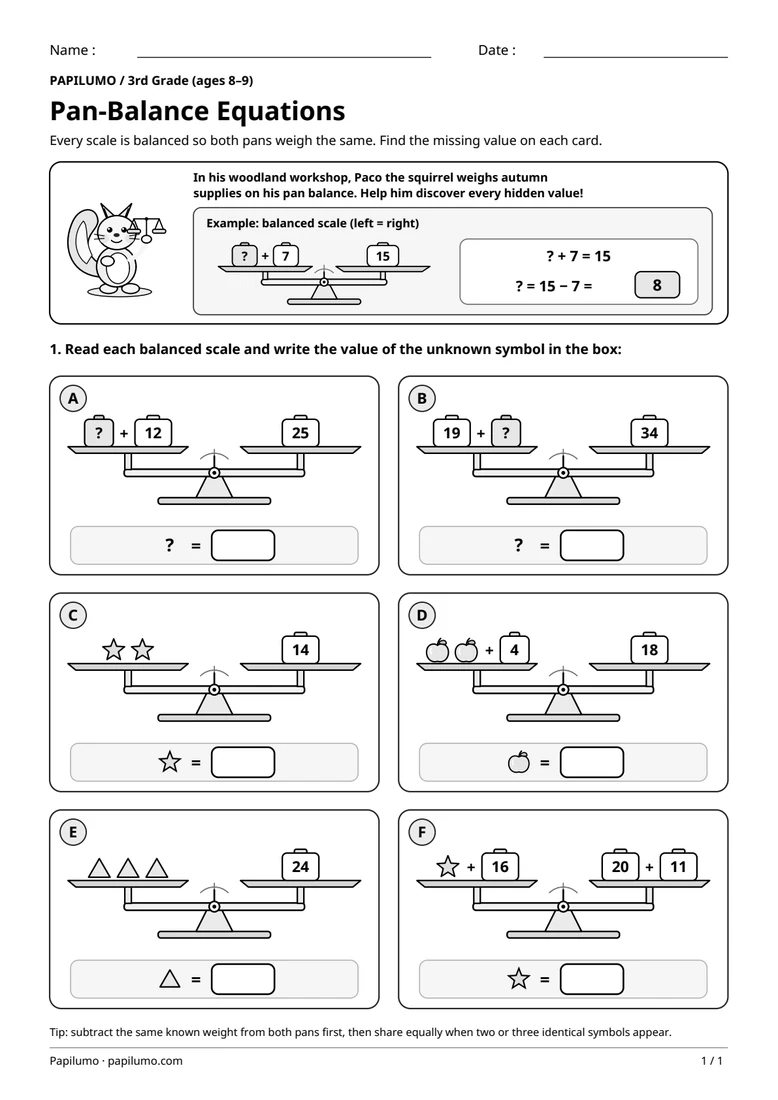
In Part 1, learners evaluate four expressions step by step using the dotted work line: when a = 6, 3 × a + 4 = 22; when b = 8, 5 × b − 7 = 33; when n = 4, 28 ÷ n + 9 = 16; and when a = 9, 6 × a − 15 = 39. In Part 2, they solve six one-step equations: a + 18 = 45 gives a = 27; n − 15 = 28 gives n = 43; 50 − b = 19 gives b = 31; 4 × n = 36 gives n = 9; 7 × a = 56 gives a = 8; and 42 ÷ b = 7 gives b = 6. To vary the practice, try Pan-Balance Equations and Puzzles with Paco the Squirrel: Every scale is balanced so both pans weigh the same. Find the missing value on each card.
What to notice and how to check
When reviewing with the separate answer key PDF, glance first at the Part 1 dotted work lines to confirm multiplication and division were completed before addition or subtraction. In Part 2, pay special attention to equations where the unknown appears second after minus or division, such as 50 − b = 19 (solved via 50 − 19 = 31 rather than adding) and 42 ÷ b = 7 (where b = 42 ÷ 7 = 6). Always have your learner plug each answer back in to verify.
Making the task easier
Lightly write the given number right above the letter in pencil before copying the full calculation onto the dotted line.
Keep the learning aim, but reduce how much the child has to handle at once. Cover part of the page with another sheet and reveal one task at a time. Demonstrate a separate example, then leave a real opportunity to work something out. An answer reached with support is still a useful attempt; it does not yet show that the same task can be completed independently.
Taking the idea beyond the worksheet
Create a mystery clue for Pico using a hidden letter n in a two-step expression and challenge a classmate to solve it.
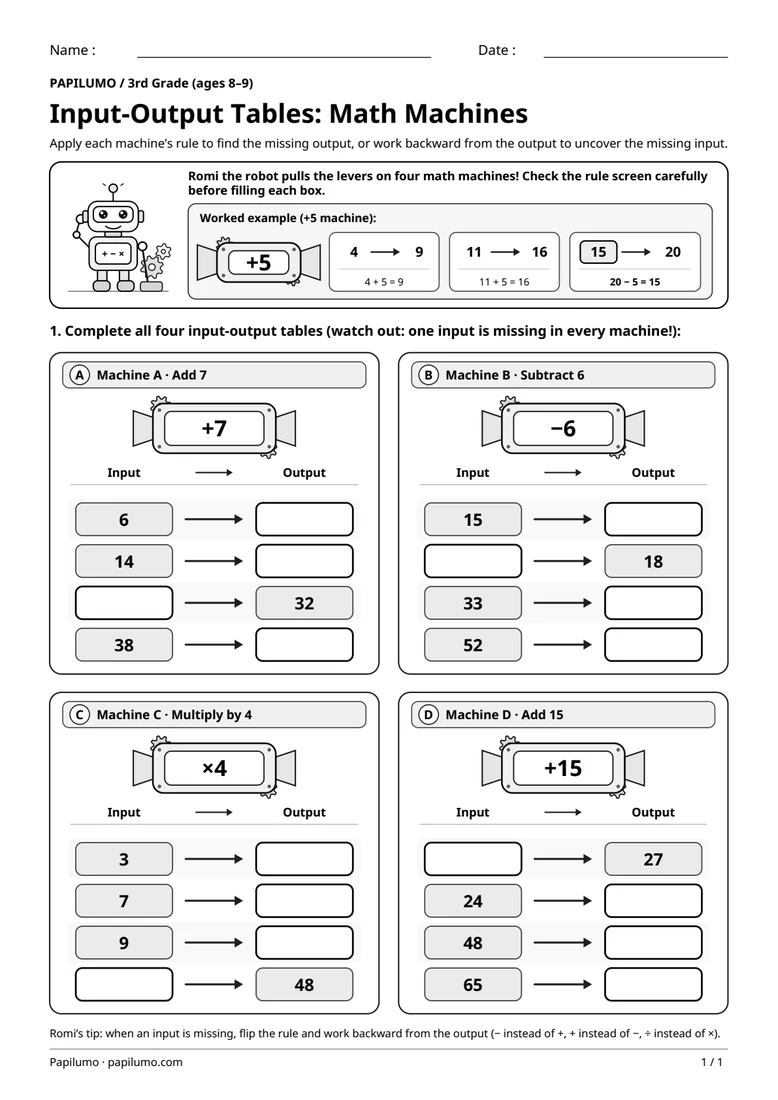
Use the follow-up to meet the same idea in a different setting. Offer it once the first task makes sense, without insisting that the whole page must be perfect. The child might explain a strategy, make an example or set a challenge for an adult. Return to the worksheet only when it helps connect the two situations. A short conversation or a practical activity can be enough to finish the session. To continue exploring, use Input-Output Tables and Math Machines with Romi the Robot: Apply each machine’s rule to find the missing output, or work backward from the output to uncover the missing input.
Downloading and printing the PDF
This free PDF contains one worksheet designed for A4 paper. Download the file using the button on this page and open it in your PDF reader. Choose actual size or a 100% scale, check the orientation in the print preview and turn off any browser headers or footers. The illustrations use vector lines, so their outlines stay sharp when printed. Check the margins on one copy before preparing several sheets for a group. The level shown on the page is a guide, rather than a requirement to complete the activity at a particular age.