What this worksheet helps children practise
Always remove the same known number from both pans first before splitting repeated symbols!
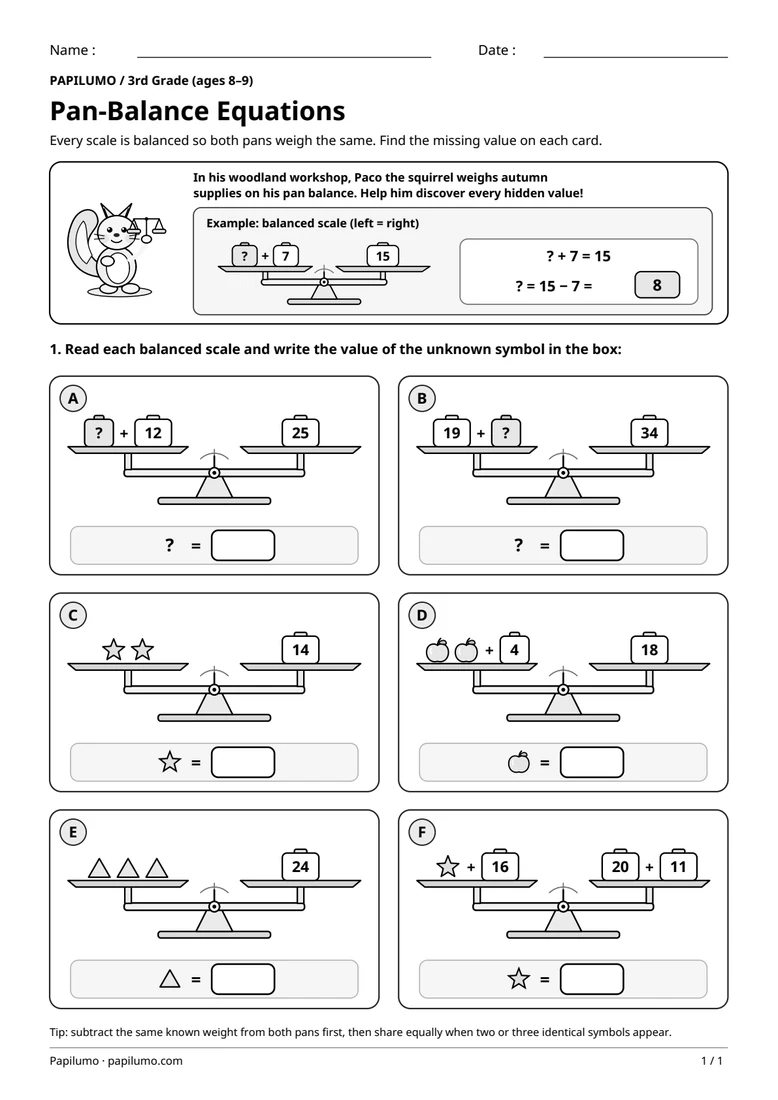
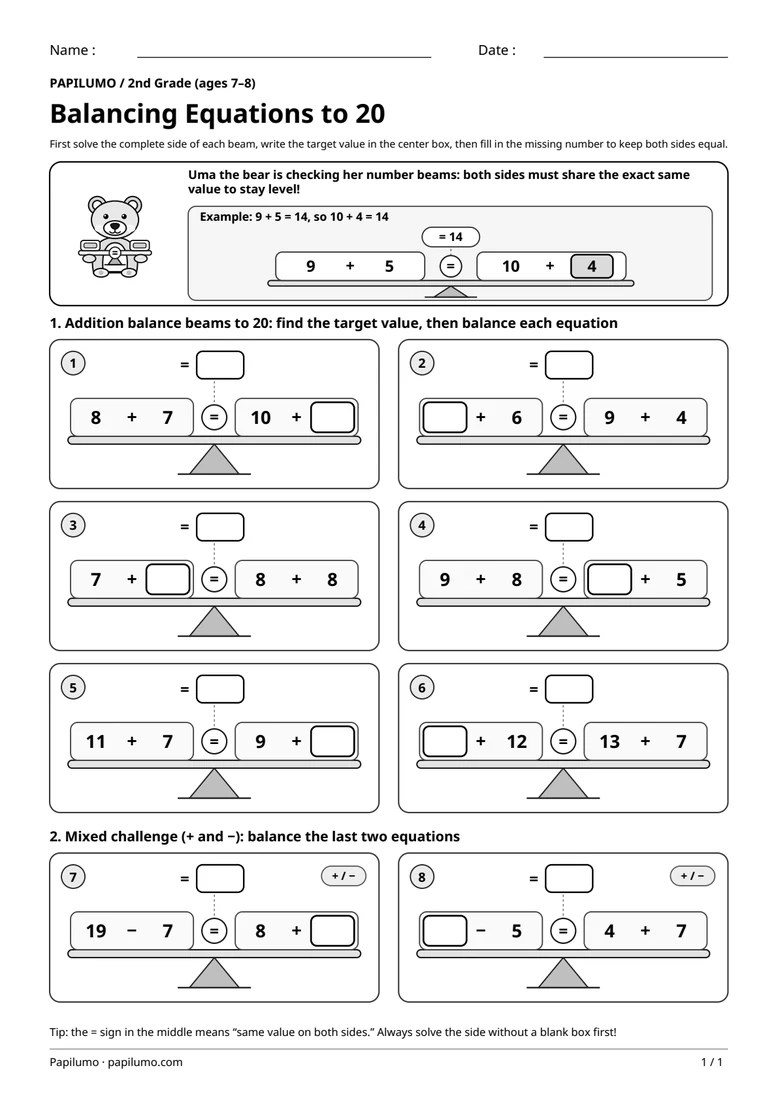
Solving balanced pan-scale puzzles in 3rd grade builds a rock-solid understanding of the equal sign as true equivalence—meaning both sides hold the exact same total value rather than merely signaling an answer box. Learners practice inverse subtraction to isolate a missing addend, equal sharing by two or three when matching icons sit on one pan, and two-step reasoning when operations appear on both sides. These visual balance models create a natural bridge between mental arithmetic and formal equations later in elementary school. For a related skill, use Balancing Addition Equations to 20 with Uma the Bear: First solve the complete side of each beam, write the target value in the center box, then fill in the missing number to keep both sides equal.
Preparing a short session
Print the student worksheet at actual size (100%) on plain white letter or A4 paper without shrinking page margins. Provide a sharpened pencil, a clean eraser, and a small piece of scratch paper for jotting down intermediate steps on multi-step scales. Keep the separate answer key PDF out of sight while your child works. Before starting Card A, point out the centered needle on Paco the squirrel’s example scale showing horizontal equilibrium, and remind learners that each card A–F is an independent puzzle.
A concrete example to get started
In the top example box beside Paco the squirrel, the left pan holds a mystery weight labeled « ? » together with a 7 block, while the right pan holds a single 15 block. Because the horizontal beam stays completely level, both sides share the exact same value: ? + 7 = 15. Removing 7 from both sides leaves the mystery weight alone on the left and gives ? = 15 − 7 = 8. Keeping that fair « take the same amount off both pans » rule in mind unlocks every card below.
Supporting the activity
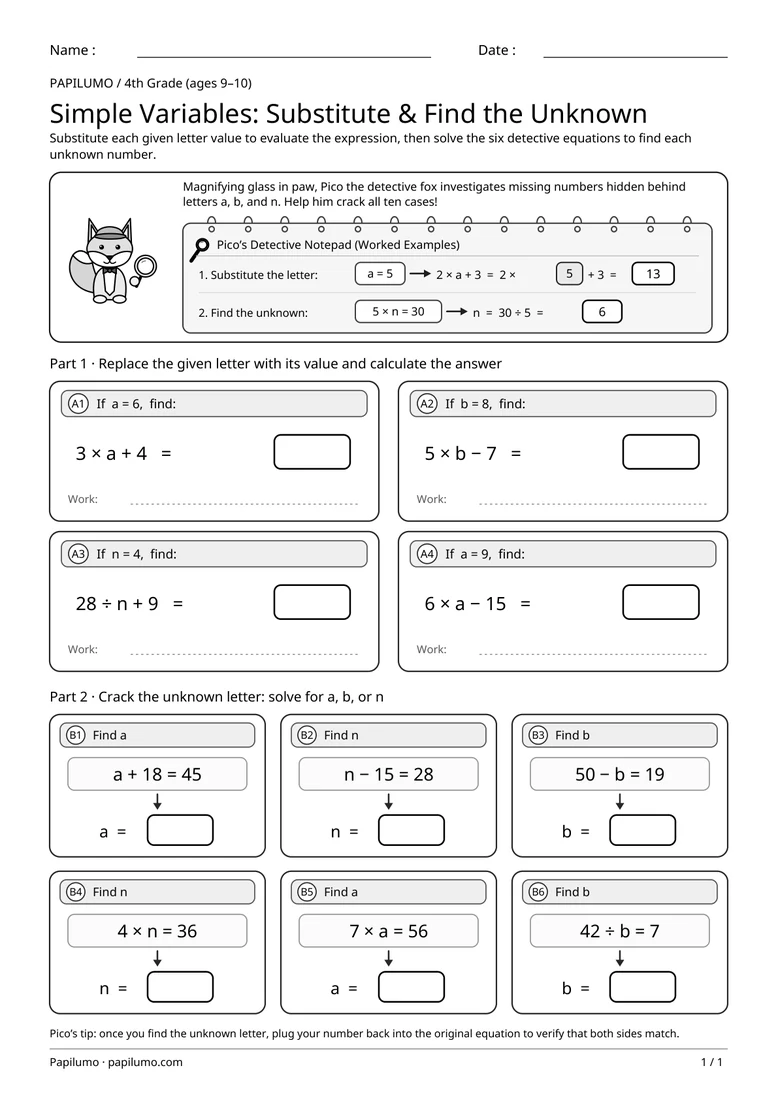
The six cards step upward smoothly from A to F. Cards A (? + 12 = 25, giving 13) and B (19 + ? = 34, giving 15) build fluency finding unknown addends. Card C places two identical stars opposite 14 so each star equals 7, while Card D pairs two apples plus 4 against 18—removing 4 leaves 14 for two apples, so one apple equals 7. Card E splits 24 across three equal triangles (8 each), and Card F combines sums on both sides: a star plus 16 equals 20 + 11 (31), so the star equals 15. To vary the practice, try Simple Variables & Finding the Unknown Value with Pico the Detective Fox: Substitute each given letter value to evaluate the expression, then solve the six detective equations to find each unknown number.
What to notice and how to check
When reviewing with the separate PDF answer key, check all six completed boxes: 13 (Card A), 15 (Card B), 7 (Card C), 7 (Card D), 8 (Card E), and 15 (Card F). Invite your child to substitute each answer back onto the left and right pans and add aloud to prove both sides match. If Card D or Card F causes a slip, walk through one small step at a time on scratch paper: subtract 4 from 18 before halving, or total 20 + 11 first before subtracting 16.
Making the task easier
Lightly cross out matching amounts on scratch paper or draw small equal groups to share totals for two or three identical icons.
Keep the learning aim, but reduce how much the child has to handle at once. Cover part of the page with another sheet and reveal one task at a time. Demonstrate a separate example, then leave a real opportunity to work something out. An answer reached with support is still a useful attempt; it does not yet show that the same task can be completed independently.
Taking the idea beyond the worksheet
Design two new balanced scales of your own using three matching squares plus a small weight on one pan.
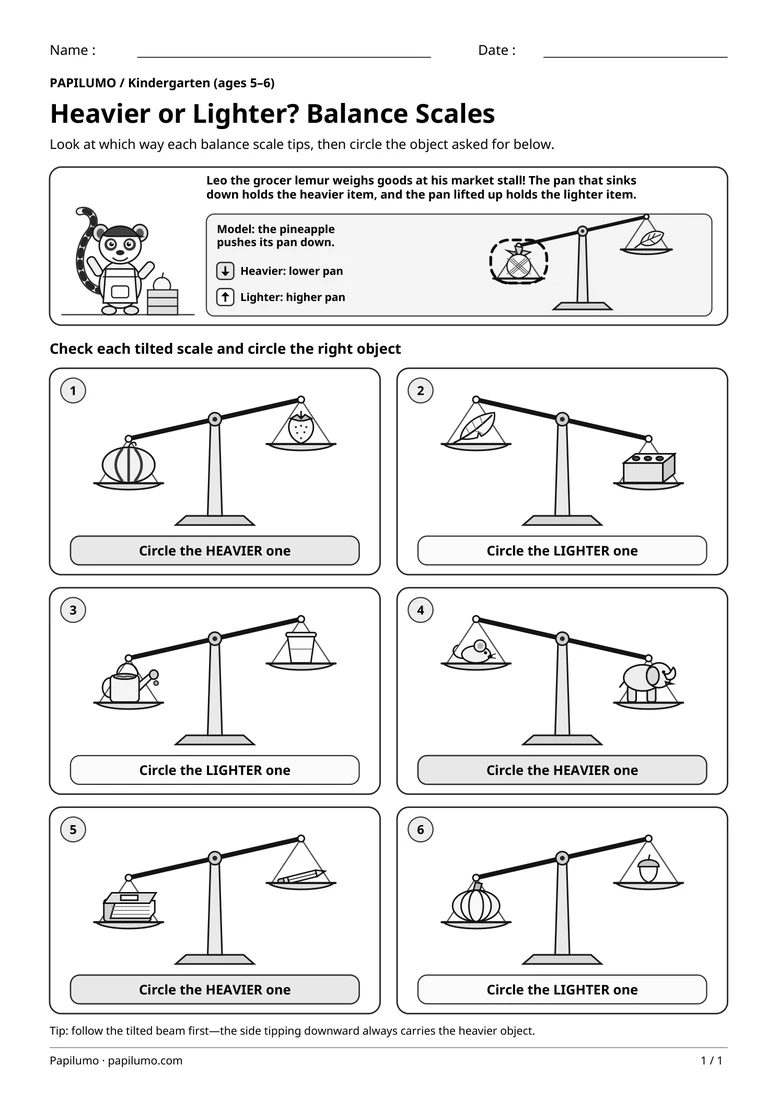
Use the follow-up to meet the same idea in a different setting. Offer it once the first task makes sense, without insisting that the whole page must be perfect. The child might explain a strategy, make an example or set a challenge for an adult. Return to the worksheet only when it helps connect the two situations. A short conversation or a practical activity can be enough to finish the session. To continue exploring, use Heavier or Lighter? Balance Scales with Leo the Grocer Lemur: Look at which way each balance scale tips, then circle the object asked for below.
Downloading and printing the PDF
This free PDF contains one worksheet designed for A4 paper. Download the file using the button on this page and open it in your PDF reader. Choose actual size or a 100% scale, check the orientation in the print preview and turn off any browser headers or footers. The illustrations use vector lines, so their outlines stay sharp when printed. Check the margins on one copy before preparing several sheets for a group. The level shown on the page is a guide, rather than a requirement to complete the activity at a particular age.