

What this worksheet helps children practise
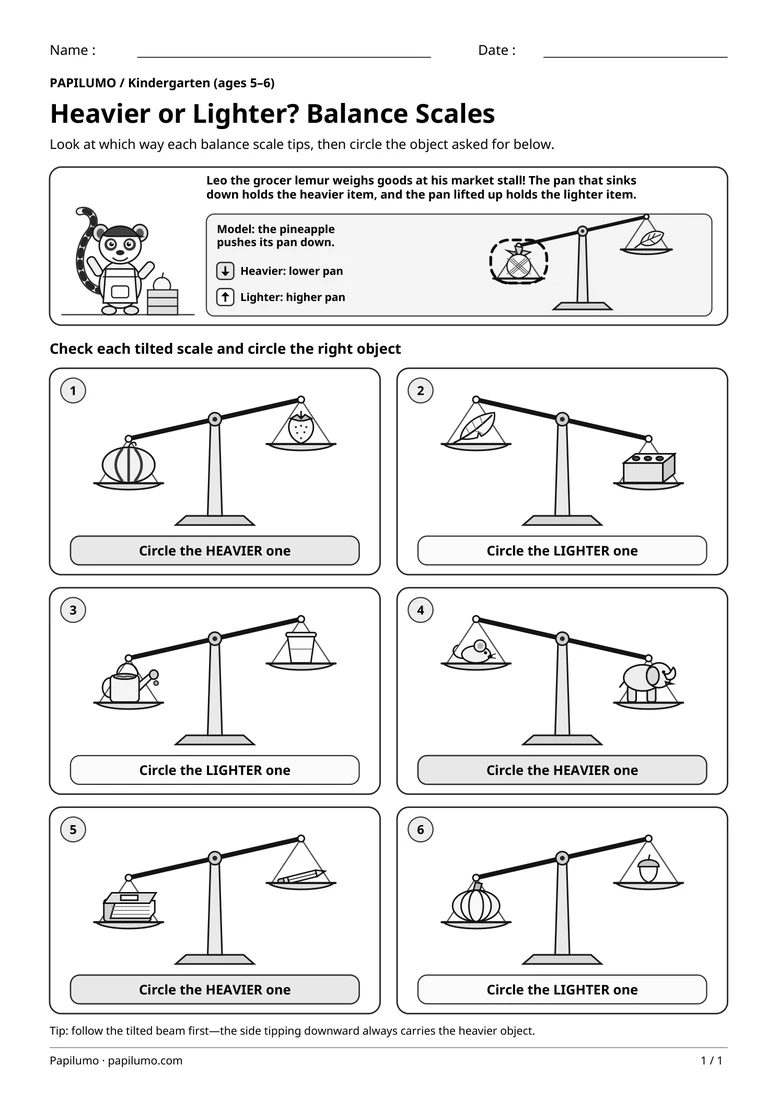
Trace the tilted bar with your finger first: the lower side is heavier and the higher side is lighter.
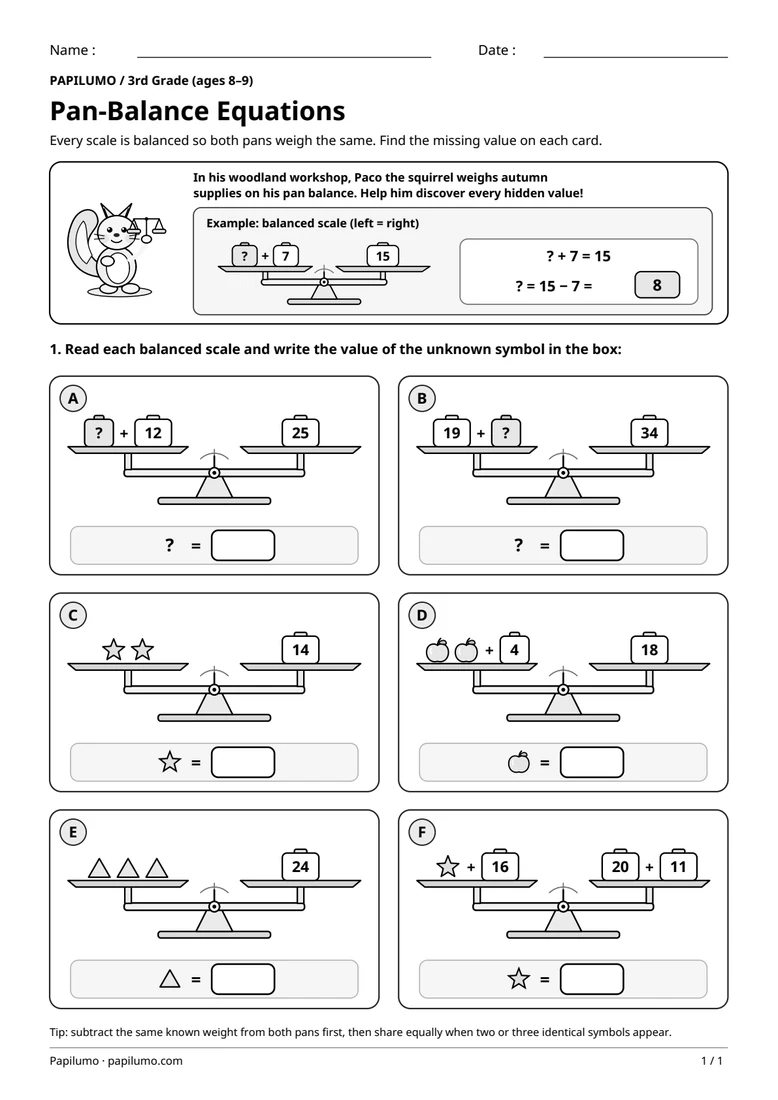
Reading tilted two-pan balance scales in kindergarten builds foundational measurement intuition well before children ever encounter standard units like grams, ounces, or pounds. Young learners connect a concrete physical movement—one pan sinking down while the other pan rises upward—to core comparative weight vocabulary such as heavier than and lighter than. Alternating cleanly between heavier and lighter prompts also teaches children to check each card carefully instead of automatically circling the larger drawing or always picking the lower pan. For a related skill, use Pan-Balance Equations and Puzzles with Paco the Squirrel: Every scale is balanced so both pans weigh the same. Find the missing value on each card.
Preparing a short session
Print the student worksheet at actual size (100%) on plain white A4 or letter paper with a sharpened pencil or fine marker, keeping the separate answer key out of sight during the activity. Before picking up a pencil, invite your child to hold both arms out like a human balance scale: place a heavy shoe or book in one palm and a soft tissue or dry leaf in the other so they feel which arm drops down. Then introduce Leo the grocer lemur at the top and read the direction aloud.
A concrete example to get started
Inside the top model box next to Leo the lemur, point first to the two visual reminders on the left: the downward arrow means the heavier object rests on the lower pan, while the upward arrow means the lighter object sits on the higher pan. Next, examine the worked balance scale on the right. The left pan dips downward under the weight of the pineapple while the right pan rises upward holding a single leaf. A dashed oval already circles the pineapple to demonstrate how to mark an answer.
Supporting the activity
Guide your child across the six numbered cards from 1 to 6, reading the short prompt beneath each balance scale aloud together. On card 1 (watermelon and strawberry), children circle the heavier object. On card 2 (feather and brick), they find the lighter one. On card 3 (full watering can and paper cup), they circle the lighter item. On card 4 (mouse and elephant), they pick the heavier animal. On card 5 (thick book and pencil), they circle the heavier object, and on card 6 (pumpkin and acorn), the lighter one. To vary the practice, try Tallest and Shortest Height with Gaspard the Giraffe: Look closely at the three drawings standing on each ground line: circle the tallest and underline the shortest.
What to notice and how to check
When reviewing the completed sheet with the separate PDF answer key, verify that each choice matches both the tilt of the beam and the exact word in the card prompt. The six correct answers are: card 1 watermelon (left, lower pan); card 2 feather (left, upper pan); card 3 paper cup (right, upper pan); card 4 elephant (right, lower pan); card 5 thick book (left, lower pan); and card 6 acorn (right, upper pan). Ask your child to explain one answer aloud by pointing to the tipped beam.
Making the task easier
Point to the lower pan and say heavy, then point to the higher pan and say light, before checking which word the box asks for.
Keep the learning aim, but reduce how much the child has to handle at once. Cover part of the page with another sheet and reveal one task at a time. Demonstrate a separate example, then leave a real opportunity to work something out. An answer reached with support is still a useful attempt; it does not yet show that the same task can be completed independently.
Taking the idea beyond the worksheet
Hold two safe kitchen items—one in each hand with eyes closed—guess which is heavier, then test them with a real balance or kitchen scale.
Use the follow-up to meet the same idea in a different setting. Offer it once the first task makes sense, without insisting that the whole page must be perfect. The child might explain a strategy, make an example or set a challenge for an adult. Return to the worksheet only when it helps connect the two situations. A short conversation or a practical activity can be enough to finish the session. To continue exploring, use Shortest and Longest: Compare Lengths with Gus the Giraffe: Check the dashed starting line and circle the requested object in each of the six sets.
Downloading and printing the PDF
This free PDF contains one worksheet designed for A4 paper. Download the file using the button on this page and open it in your PDF reader. Choose actual size or a 100% scale, check the orientation in the print preview and turn off any browser headers or footers. The illustrations use vector lines, so their outlines stay sharp when printed. Check the margins on one copy before preparing several sheets for a group. The level shown on the page is a guide, rather than a requirement to complete the activity at a particular age.