

What this worksheet helps children practise
Always plug your reverse input answer back through the forward rule—if it lands on the printed output, your answer is rock solid!
Practicing input-output math machines gives third graders a concrete bridge between everyday mental arithmetic and early algebraic thinking. As numbers enter the funnel on the left and exit transformed on the right by a steady rule, learners sharpen mental addition, subtraction, and multiplication by 4 while discovering how inverse operations undo a single step. Working backward to discover which input produces 32 under +7, 18 under −6, 48 under ×4, or 27 under +15 builds flexible number sense, reliable self-checking habits, and lasting confidence with missing-number equations. For a related skill, use Shape Algebra Grid Puzzles with Pico the Detective Fox: Use the row sums on the right and column sums at the bottom to find the secret whole number (1–12) for each shape.
Preparing a short session
Print the student worksheet at actual size (100%) on plain white A4 or letter paper without scaling down the margins, and hand your learner a sharpened pencil and a clean eraser for neat adjustments. Keep the separate one-page PDF answer key out of view until every machine is complete. Before filling in the first table, spend a quiet moment reviewing Romi the robot and the +5 example banner at the top so the Input column, Output column, and directional arrows feel completely clear and natural.
A concrete example to get started
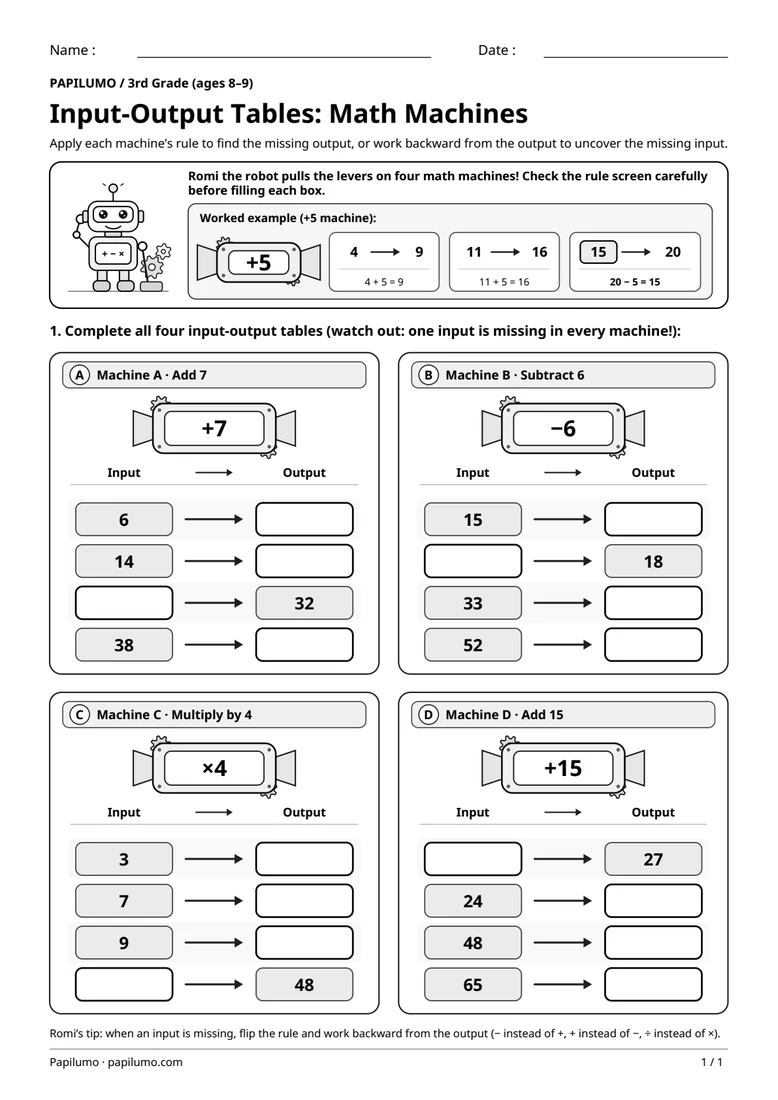
Inside the top worked-example panel beside Romi the robot, the +5 machine demonstrates both forward and reverse reasoning side by side. Going forward, an input of 4 becomes 9 (4 + 5 = 9) and an input of 11 becomes 16 (11 + 5 = 16). On the third row, the arrow points to an output of 20 while the starting input is hidden: reversing the +5 rule (20 − 5 = 15) reveals 15, and checking 15 + 5 = 20 proves the answer works.
Supporting the activity
In the four machines below, Machine A (+7) turns inputs 6, 14, and 38 into 13, 21, and 45, while row three challenges students to reverse output 32 back to input 25. Machine B (−6) sends 15, 33, and 52 out as 9, 27, and 46, and asks which input gives 18 (24). Machine C (×4) reinforces times-four facts from 3, 7, and 9 to 12, 28, and 36, plus dividing 48 back to 12. Machine D (+15) opens by reversing 27 to 12 before finding 39, 63, and 80. To vary the practice, try 10 More, 10 Less, 1 More, 1 Less Crosses with Zia the Mole: Fill in the six 100-chart cross cutouts around each center, then solve the two reverse challenges starting from the shaded tile.
What to notice and how to check
When reviewing with the separate one-page answer key, confirm all sixteen boxes machine by machine: A (13, 21, 25, 45), B (9, 24, 27, 46), C (12, 28, 36, 12), and D (12, 39, 63, 80). Whenever a reverse-input box looks off—most often adding instead of subtracting or subtracting instead of adding—have your student feed their answer back into the left side of the machine and apply the forward rule aloud. Testing whether 12 + 15 equals 27 makes mistakes obvious right away.
Making the task easier
Lightly pencil the undo rule (−7, +6, ÷4, or −15) right next to the single blank input row before solving it.
Keep the learning aim, but reduce how much the child has to handle at once. Cover part of the page with another sheet and reveal one task at a time. Demonstrate a separate example, then leave a real opportunity to work something out. An answer reached with support is still a useful attempt; it does not yet show that the same task can be completed independently.
Taking the idea beyond the worksheet
Invent a fifth Machine E on the back of the sheet using ×3 or −12, complete with three forward rows and one mystery input.
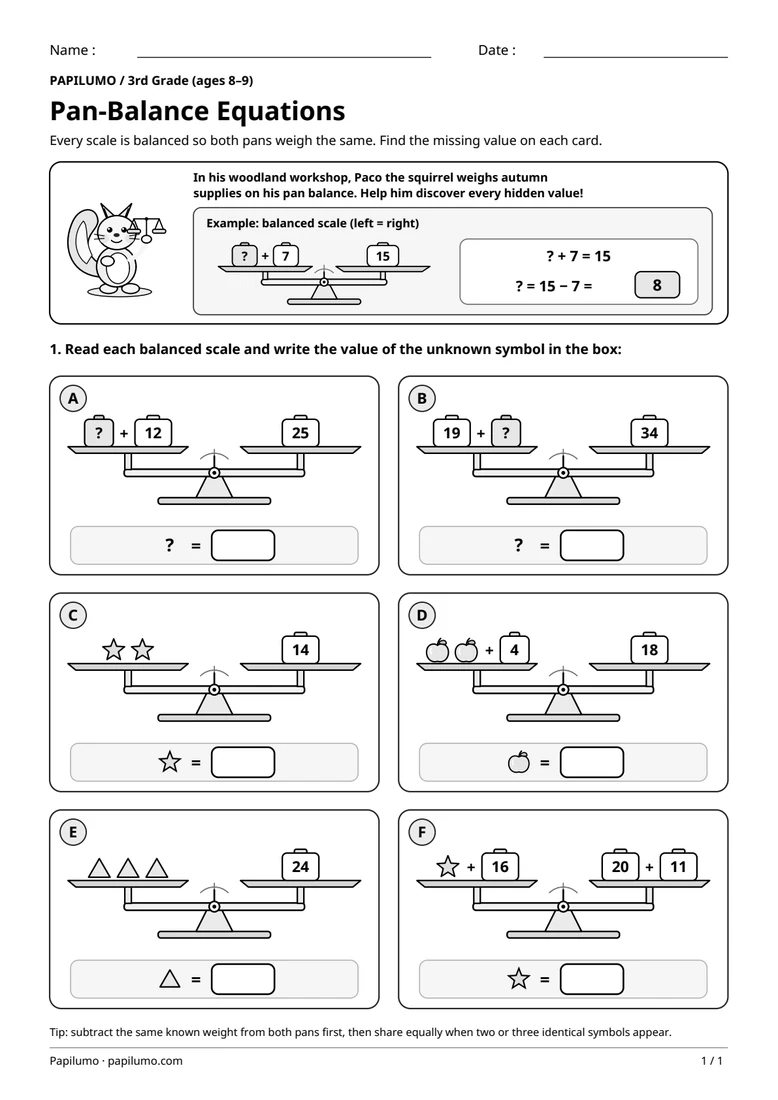
Use the follow-up to meet the same idea in a different setting. Offer it once the first task makes sense, without insisting that the whole page must be perfect. The child might explain a strategy, make an example or set a challenge for an adult. Return to the worksheet only when it helps connect the two situations. A short conversation or a practical activity can be enough to finish the session. To continue exploring, use Pan-Balance Equations and Puzzles with Paco the Squirrel: Every scale is balanced so both pans weigh the same. Find the missing value on each card.
Downloading and printing the PDF
This free PDF contains one worksheet designed for A4 paper. Download the file using the button on this page and open it in your PDF reader. Choose actual size or a 100% scale, check the orientation in the print preview and turn off any browser headers or footers. The illustrations use vector lines, so their outlines stay sharp when printed. Check the margins on one copy before preparing several sheets for a group. The level shown on the page is a guide, rather than a requirement to complete the activity at a particular age.