
What this worksheet helps children practise
For both division lines, always start by writing the biggest number from the top of the triangle!
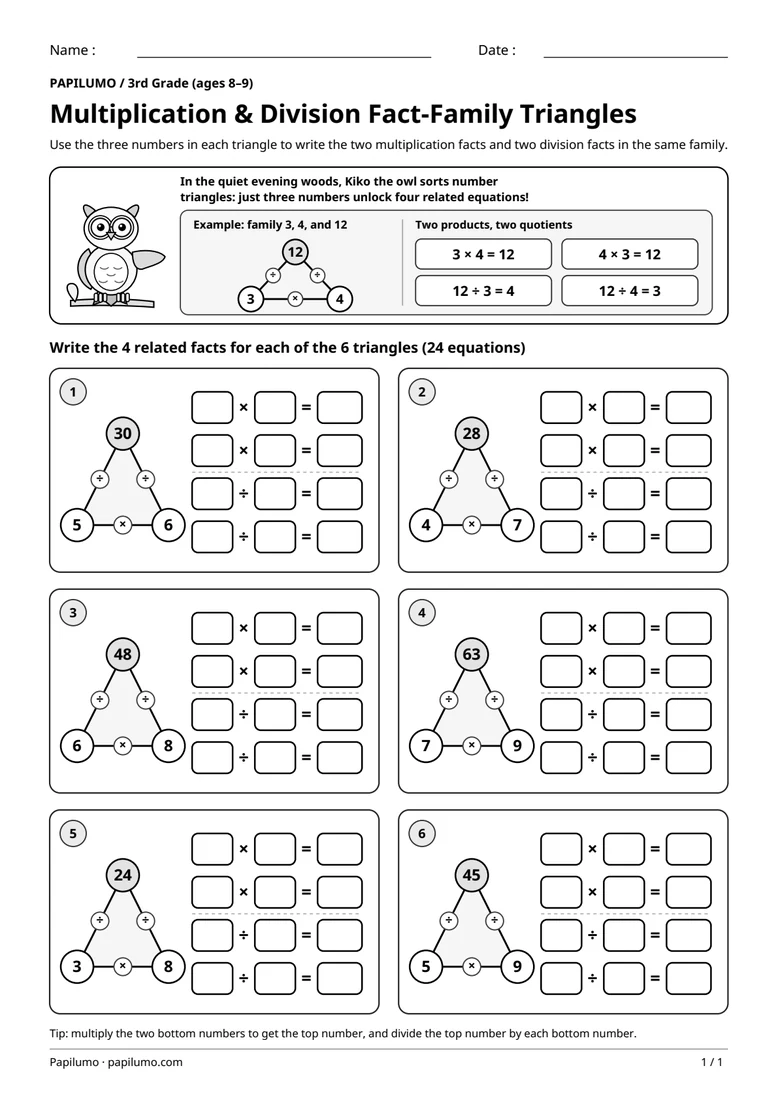
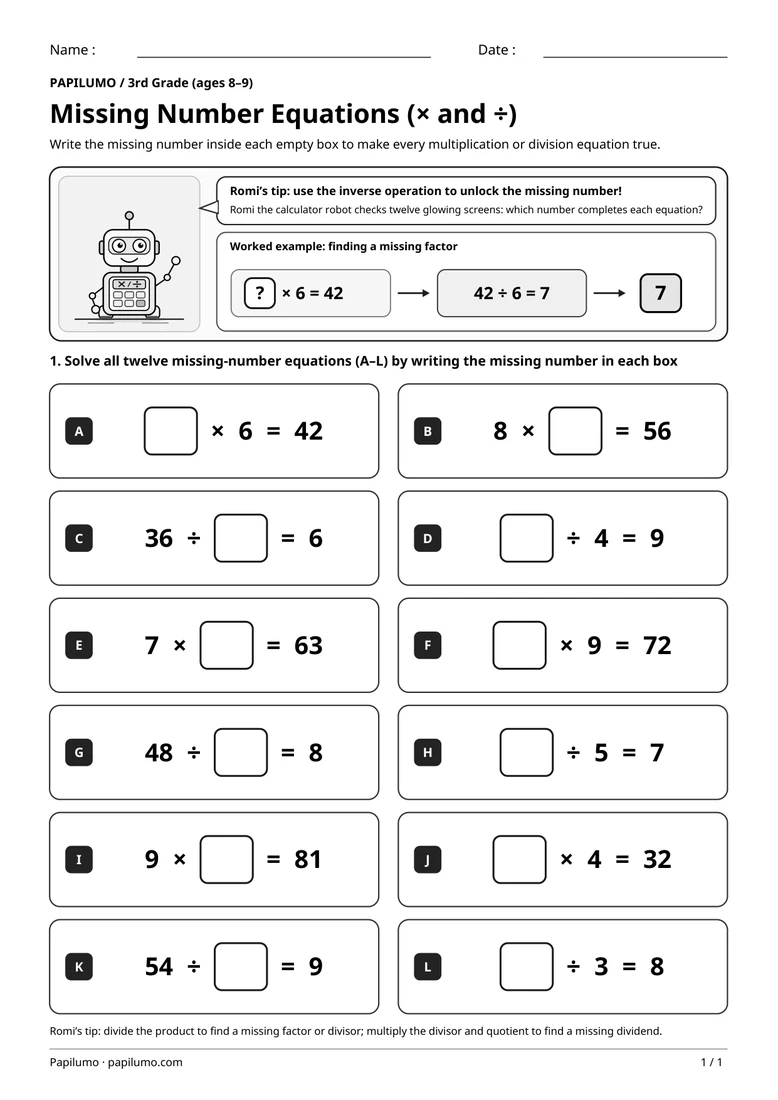
Practicing multiplication and division fact families in 3rd grade turns times-table recall into flexible inverse reasoning. When students link 5, 6, and 30 inside one triangle, they see immediately that swapping factors keeps the product unchanged (5×6 = 30 and 6×5 = 30) and that division reverses multiplication (30÷5 = 6 and 30÷6 = 5). Understanding this reciprocal structure strengthens commutative fluency, eliminates guesswork on division facts, and builds lasting confidence for multi-digit multiplication and division. For a related skill, use Missing Number Multiplication & Division Equations with Romi: Write the missing number inside each empty box to make every multiplication or division equation true.
Preparing a short session
Print the student sheet at actual size (100%) on plain white A4 or letter paper without scaling margins, and supply a sharp pencil with a clean eraser. Keep the separate one-page answer key PDF tucked out of sight during practice. Before your child writes the first number, trace the three corners of the worked triangle beside Kiko the owl together: identify the largest number at the top (12) and the two smaller factors below (3 and 4), then read all four completed equations.
A concrete example to get started
Inside the top model box, Kiko the owl clearly demonstrates the rule shared by every single card on the sheet: the bottom corners 3 and 4 connect across the × sign to form 3×4 = 12 and 4×3 = 12. Along both slanted sides, the ÷ signs guide division directly downward from the top peak: 12÷3 = 4 and 12÷4 = 3. Having this clear visual key permanently anchored at the top helps learners avoid reversing dividend and divisor in division sentences.
Supporting the activity
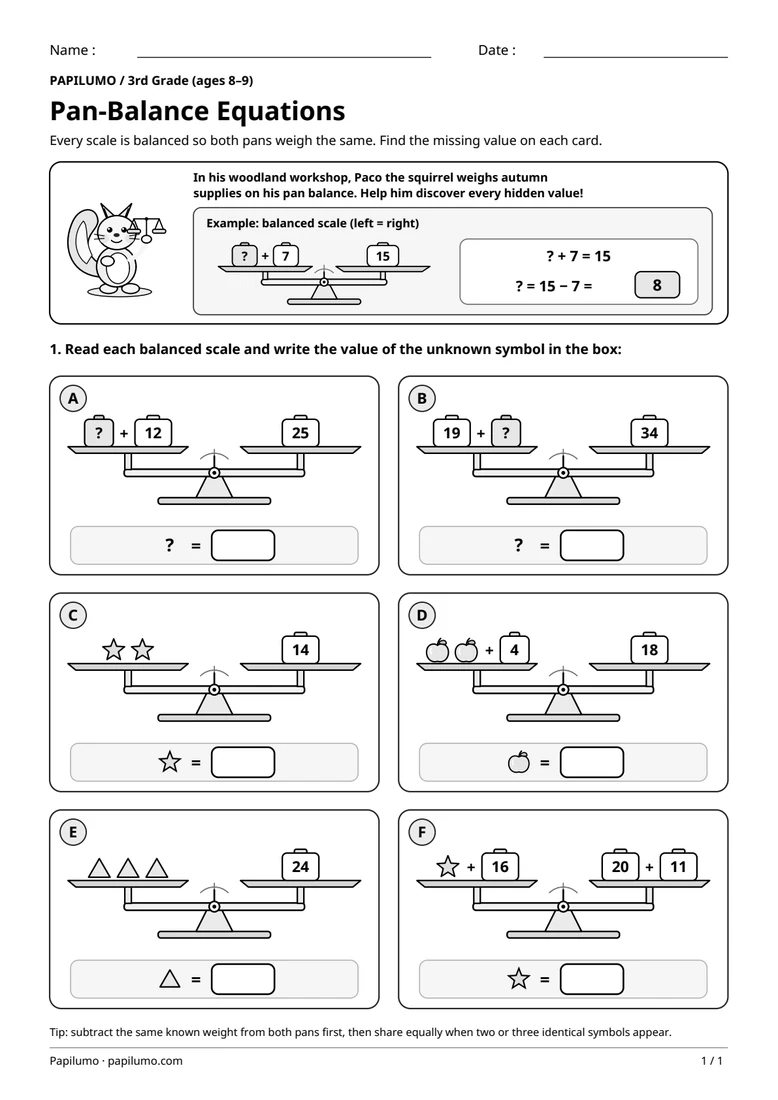
Across the six practice cards, students complete twenty-four spacious equations: card 1 (30, 5, 6) yields 5×6 = 30, 6×5 = 30, 30÷5 = 6, and 30÷6 = 5; card 2 (28, 4, 7) gives 4×7 = 28, 7×4 = 28, 28÷4 = 7, and 28÷7 = 4; card 3 (48, 6, 8) builds 6×8 = 48, 8×6 = 48, 48÷6 = 8, and 48÷8 = 6; card 4 (63, 7, 9) covers 7×9 = 63, 9×7 = 63, 63÷7 = 9, and 63÷9 = 7; card 5 (24, 3, 8) gives 3×8 = 24, 8×3 = 24, 24÷3 = 8, and 24÷8 = 3; and card 6 completes (45, 5, 9) with 5×9 = 45, 9×5 = 45, 45÷5 = 9, and 45÷9 = 5. To vary the practice, try Pan-Balance Equations and Puzzles with Paco the Squirrel: Every scale is balanced so both pans weigh the same. Find the missing value on each card.
What to notice and how to check
When reviewing with the separate one-page answer key, first verify that both multiplication rows on each card place the peak number after = and swap factors rather than repeating the same order twice. Next, confirm that every division row begins with the top number (30, 28, 48, 63, 24, or 45) and divides cleanly by each bottom factor. If a student swaps numbers in division, trace downward from the peak together before erasing and correcting.
Making the task easier
Cover two corners of a triangle with your fingers—the number left uncovered is the missing number in the equation.
Keep the learning aim, but reduce how much the child has to handle at once. Cover part of the page with another sheet and reveal one task at a time. Demonstrate a separate example, then leave a real opportunity to work something out. An answer reached with support is still a useful attempt; it does not yet show that the same task can be completed independently.
Taking the idea beyond the worksheet
Pick a new fact family from the 8 times table, sketch your own triangle on scratch paper, and write all four equations.
Use the follow-up to meet the same idea in a different setting. Offer it once the first task makes sense, without insisting that the whole page must be perfect. The child might explain a strategy, make an example or set a challenge for an adult. Return to the worksheet only when it helps connect the two situations. A short conversation or a practical activity can be enough to finish the session. To continue exploring, use Division Word Problems Within 48 with Basil the Baker Badger: Read each problem, circle equal groups in the picture array, then complete the division equation and final answer.
Downloading and printing the PDF
This free PDF contains one worksheet designed for A4 paper. Download the file using the button on this page and open it in your PDF reader. Choose actual size or a 100% scale, check the orientation in the print preview and turn off any browser headers or footers. The illustrations use vector lines, so their outlines stay sharp when printed. Check the margins on one copy before preparing several sheets for a group. The level shown on the page is a guide, rather than a requirement to complete the activity at a particular age.