What this worksheet helps children practise
Plug your number back into the blank box and read the full equation aloud to make sure both sides agree!
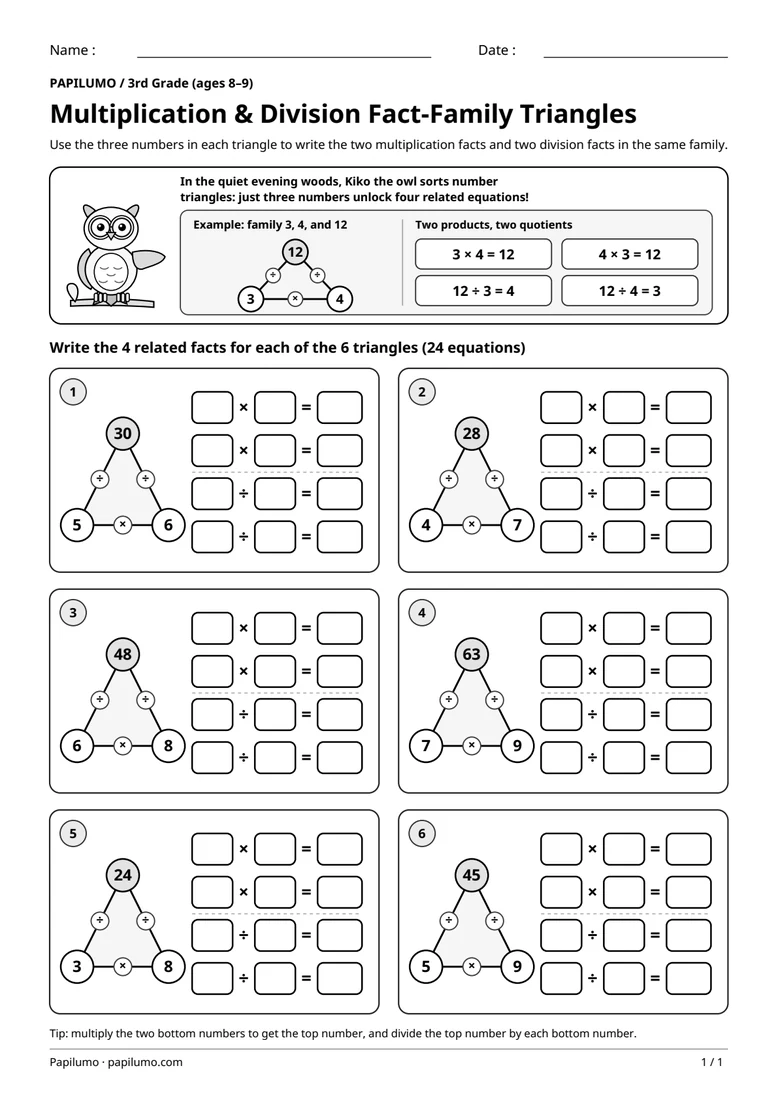
Solving one-step missing-number equations builds genuine algebraic thinking in 3rd Grade rather than passive table chanting. When children work out ? × 6 = 42, 36 ÷ ? = 6, or ? ÷ 4 = 9, they learn to tell which number represents the total product and which numbers represent the equal groups or group size. Strengthening this reversible link between multiplication and division prepares learners directly for multi-step word problems, unknown-quantity equations, and division with larger numbers. For a related skill, use Multiplication and Division Fact Families: Triangles with Kiko the Owl: Use the three numbers in each triangle to write the two multiplication facts and two division facts in the same family.
Preparing a short session
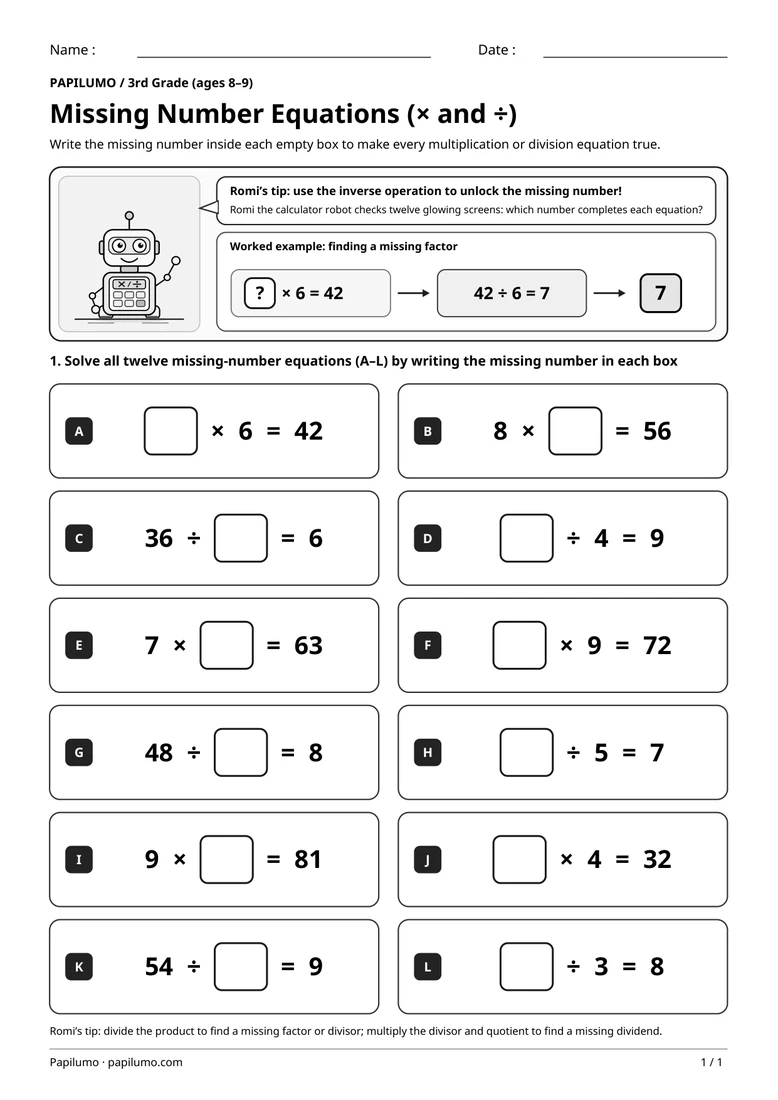
Print the student page at actual size (100%) on plain white letter or A4 paper without shrinking margins, and set out a sharpened pencil, an eraser, and optional scratch paper. Before starting the twelve cards, look together at Romi’s framed banner at the top of the sheet so your student sees how an inverse fact unlocks any blank square. Keep the separate one-page answer key PDF out of reach during independent practice so learners verify answers using multiplication and division facts first.
A concrete example to get started
In the worked example box beside Romi the calculator robot, a clear three-step path models how to solve any blank box. Starting from [ ? ] × 6 = 42, learners see that 42 is the total product and 6 is a known factor. A crisp arrow points to the inverse division equation 42 ÷ 6 = 7, followed by the solved square [7]. Reviewing this visual sequence together shows students right away that every missing-number equation belongs to one connected fact family.
Supporting the activity
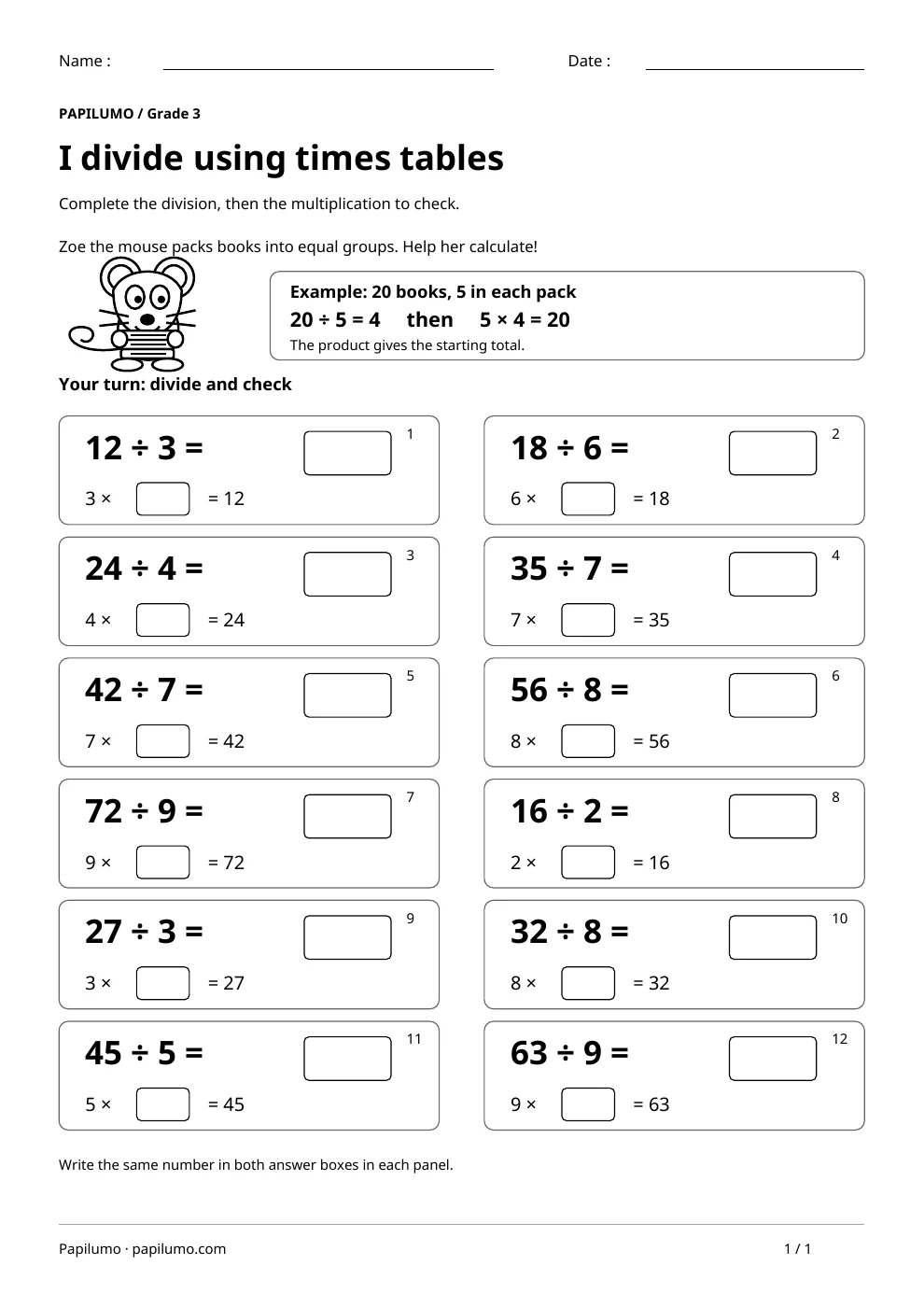
The twelve cards A through L balance six multiplication equations and six division equations across every unknown slot: cards A (? × 6 = 42), F (? × 9 = 72), and J (? × 4 = 32) hide the first factor, while B (8 × ? = 56), E (7 × ? = 63), and I (9 × ? = 81) hide the second factor. Cards C (36 ÷ ? = 6), G (48 ÷ ? = 8), and K (54 ÷ ? = 9) ask for the missing divisor, whereas D (? ÷ 4 = 9), H (? ÷ 5 = 7), and L (? ÷ 3 = 8) require finding two-digit dividends. To vary the practice, try Division Facts: Check with Multiplication: Complete the division, then the multiplication to check.
What to notice and how to check
When checking finished work against the separate answer key PDF, inspect the three missing-dividend cards first (D = 36, H = 35, and L = 24), since 3rd graders sometimes divide by mistake instead of multiplying 9 × 4, 7 × 5, and 8 × 3. Next verify all twelve answers from A to L in exact order: 7, 7, 6, 36, 9, 8, 6, 35, 9, 8, 6, and 24. Finally, have your child read two completed equations aloud to confirm both sides match cleanly.
Making the task easier
Whenever the first number before ÷ is missing, like ? ÷ 4 = 9, turn it into a multiplication check first: 9 × 4.
Keep the learning aim, but reduce how much the child has to handle at once. Cover part of the page with another sheet and reveal one task at a time. Demonstrate a separate example, then leave a real opportunity to work something out. An answer reached with support is still a useful attempt; it does not yet show that the same task can be completed independently.
Taking the idea beyond the worksheet
Pick three cards from the grid and write all four related multiplication and division equations in each fact family.
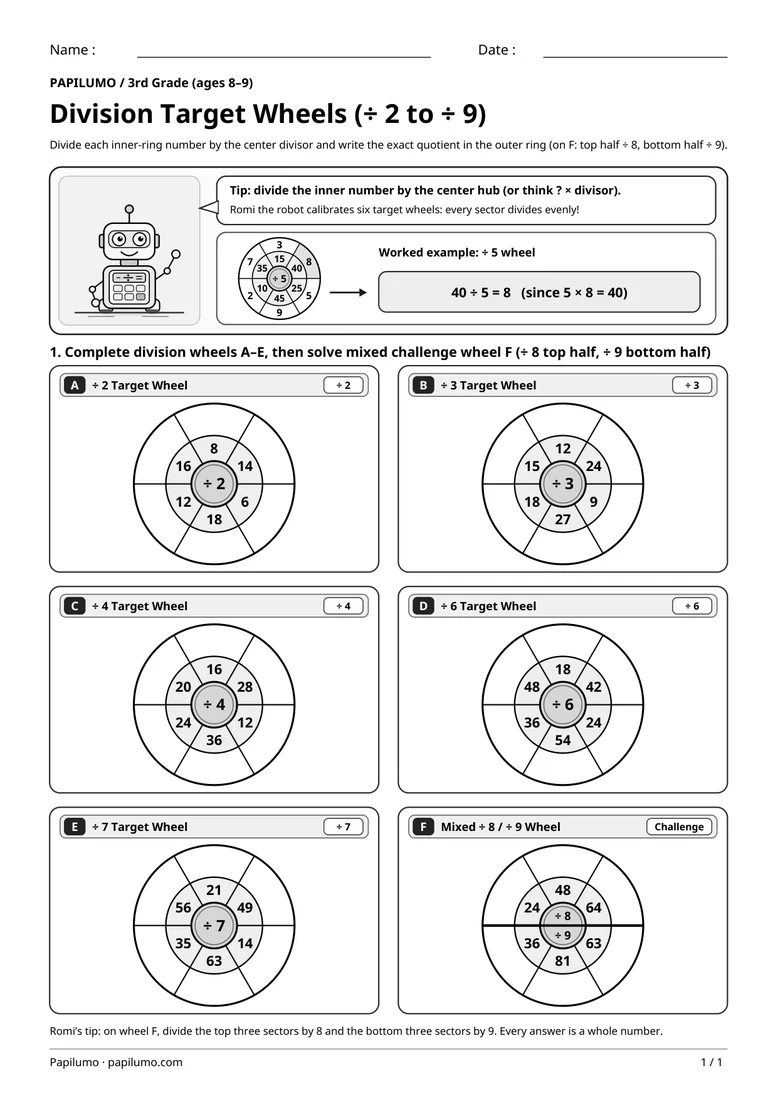
Use the follow-up to meet the same idea in a different setting. Offer it once the first task makes sense, without insisting that the whole page must be perfect. The child might explain a strategy, make an example or set a challenge for an adult. Return to the worksheet only when it helps connect the two situations. A short conversation or a practical activity can be enough to finish the session. To continue exploring, use Division Target Wheels (2 to 9) with Romi: Divide each inner-ring number by the center divisor and write the exact quotient in the outer ring (on F: top half ÷ 8, bottom half ÷ 9).
Downloading and printing the PDF
This free PDF contains one worksheet designed for A4 paper. Download the file using the button on this page and open it in your PDF reader. Choose actual size or a 100% scale, check the orientation in the print preview and turn off any browser headers or footers. The illustrations use vector lines, so their outlines stay sharp when printed. Check the margins on one copy before preparing several sheets for a group. The level shown on the page is a guide, rather than a requirement to complete the activity at a particular age.