


What this worksheet helps children practise
Circle equal groups on the array first, then double-check your division answer with multiplication.
Solving division word problems in 3rd grade requires linking two core meanings of division without mixing them up: equal sharing, where learners know the number of groups and find the size of each group, and equal grouping, where learners know the group size and find how many groups fit. Circling rows of six muffins or columns of four wheels turns text into clear visual structure before writing ÷ and =. Because each array is neatly aligned, students also strengthen the inverse link between division and multiplication facts. For a related skill, use Equal sharing within 12: Mimo’s cookies: Draw one dot for each cookie on the plates. Put the same number on every plate.
Preparing a short session
Print the student page at actual size (100%) on plain white letter or A4 paper without shrinking margins, and provide a sharpened pencil with an eraser. Before starting Problem 1, introduce Basil the baker badger and review the worked cookie example at the top: point to the 18 cookies grouped into 3 rows of 6 and trace 18 ÷ 3 = 6. Keep the separate answer key PDF tucked away while your student circles equal groups and completes all sixteen boxes independently.
A concrete example to get started
In the top example panel, Basil shares 18 cookies equally into 3 boxes. The picture tray displays 18 cookies in 3 looped rows of 6, pointing to the equation 18 ÷ 3 = 6 and the conclusion, 6 cookies per box. That model builds a steady four-step routine for every problem: check the starting total, identify whether the question asks for group size or number of groups, circle equal sets cleanly in pencil, and write the division sentence before completing the answer.
Supporting the activity
The four cards ask students to write sixteen numbers altogether: twelve inside the equation boxes and four in the answer sentences. Problem 1 (24 ÷ 6 = 4) groups 24 muffins into boxes of 6 for 4 boxes. Problem 2 (35 ÷ 5 = 7) shares 35 stars equally among 5 friends, giving 7 stars each. Problem 3 (32 ÷ 4 = 8) sorts 32 wheels onto 4-wheel toy cars to build 8 cars. Problem 4 (42 ÷ 6 = 7) places 42 books evenly across 6 shelves for 7 books per shelf. To vary the practice, try Division with Remainders Using Equal Groups with Basile: Circle equal groups in each set, count how many groups and leftovers you see, and fill in the division equation.
What to notice and how to check
When checking with the separate PDF answer key, inspect the pencil loops on every array first to confirm all groups hold the exact same count with none left over. Verify next that the largest total, the dividend, sits first before the ÷ sign, followed by the divisor from the story and the quotient repeated in the answer sentence. If a fact feels uncertain, check together aloud using reverse multiplication: 4 × 6 = 24, 5 × 7 = 35, 8 × 4 = 32, and 6 × 7 = 42.
Making the task easier
Use small counters or dry beans to build the equal groups on a table before drawing loops on the worksheet.
Keep the learning aim, but reduce how much the child has to handle at once. Cover part of the page with another sheet and reveal one task at a time. Demonstrate a separate example, then leave a real opportunity to work something out. An answer reached with support is still a useful attempt; it does not yet show that the same task can be completed independently.
Taking the idea beyond the worksheet
Write one new bakery word problem for Basil matching 48 ÷ 6 = 8 using loaves or cinnamon rolls.
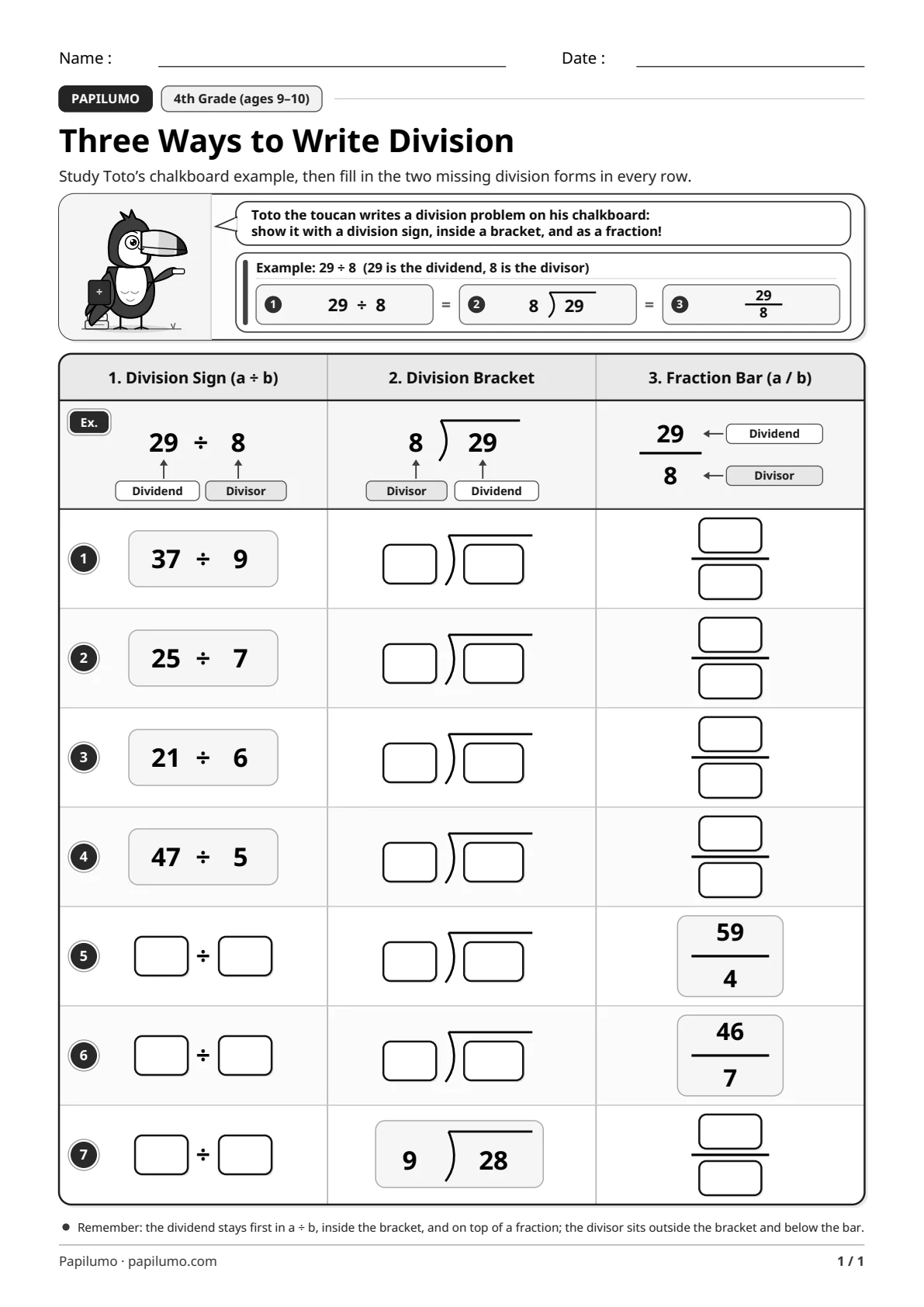
Use the follow-up to meet the same idea in a different setting. Offer it once the first task makes sense, without insisting that the whole page must be perfect. The child might explain a strategy, make an example or set a challenge for an adult. Return to the worksheet only when it helps connect the two situations. A short conversation or a practical activity can be enough to finish the session. To continue exploring, use Three Ways to Write Division with Toto the Toucan: Study Toto’s chalkboard example, then fill in the two missing division forms in every row.
Downloading and printing the PDF
This free PDF contains one worksheet designed for A4 paper. Download the file using the button on this page and open it in your PDF reader. Choose actual size or a 100% scale, check the orientation in the print preview and turn off any browser headers or footers. The illustrations use vector lines, so their outlines stay sharp when printed. Check the margins on one copy before preparing several sheets for a group. The level shown on the page is a guide, rather than a requirement to complete the activity at a particular age.