

What this worksheet helps children practise
Jot the count lightly beneath Steps 1, 2, and 3 first—the +1, +2, or +3 rule jumps right out!
Analyzing growing shape patterns bridges concrete geometry and early algebraic thinking in second grade. Rather than simply repeating alternating colors, learners notice how a figure expands from one step to the next, convert each visual arrangement into an exact count, and apply a constant addition rule to predict a later term without drawing every future piece. Comparing stacked columns, paired dot rows, L-shaped corners, and rows of three triangles strengthens spatial structure, skip-counting fluency, and careful verification. For a related skill, use Missing shapes in repeating patterns: Look at each pattern. Draw the missing shapes in the empty boxes.
Preparing a short session
Print the student page at actual size (100%) on plain white letter or A4 paper without shrinking margins, and provide a sharpened pencil with a clean eraser. Keep the separate answer key out of sight while children explore each sequence independently. Before drawing anything, read Zia the architect marmot’s short story and worked example together aloud, tracing the growing stack from one cube to four cubes and reminding students that every row uses one steady rule from +1, +2, or +3.
A concrete example to get started
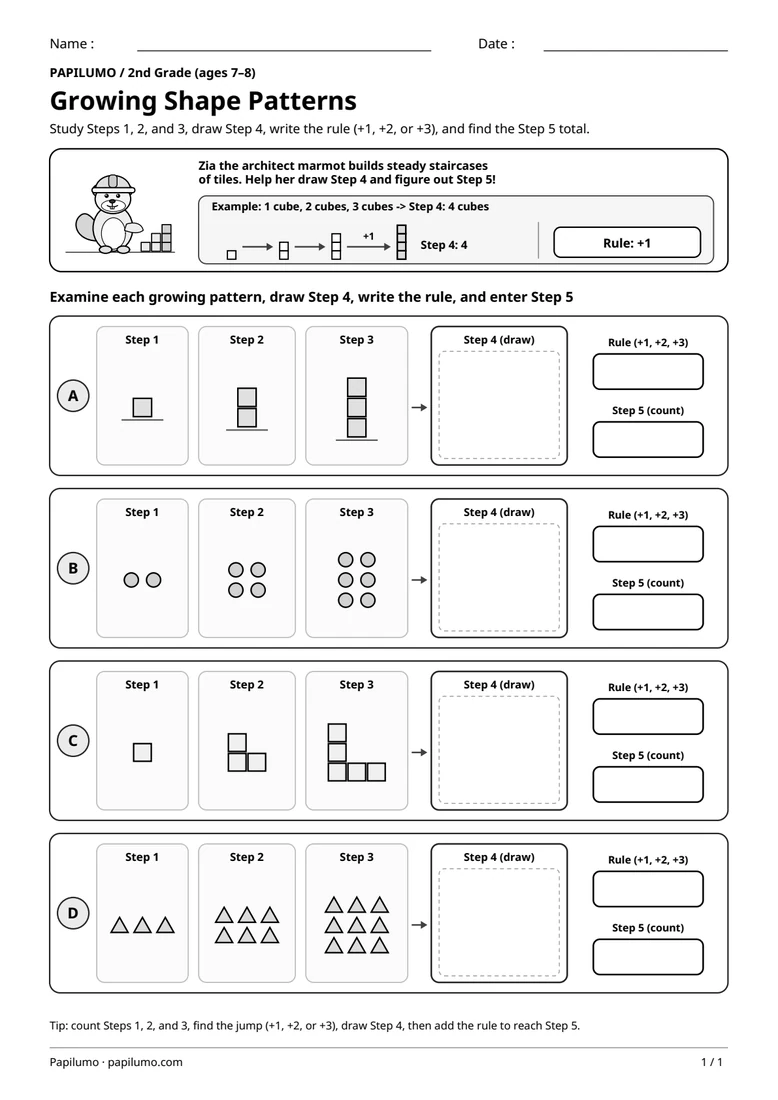
In the top example panel, Zia illustrates the exact thinking routine with simple building cubes: Step 1 shows 1 cube, Step 2 stacks 2 cubes, and Step 3 stacks 3 cubes. Because one additional cube joins the column at each step, the rule is +1 and Step 4 builds a 4-cube tower. Walking through this visual anchor ensures children understand all three tasks on every row below: inspect the growth, draw Step 4 in matching layout, record the rule, and predict Step 5.
Supporting the activity
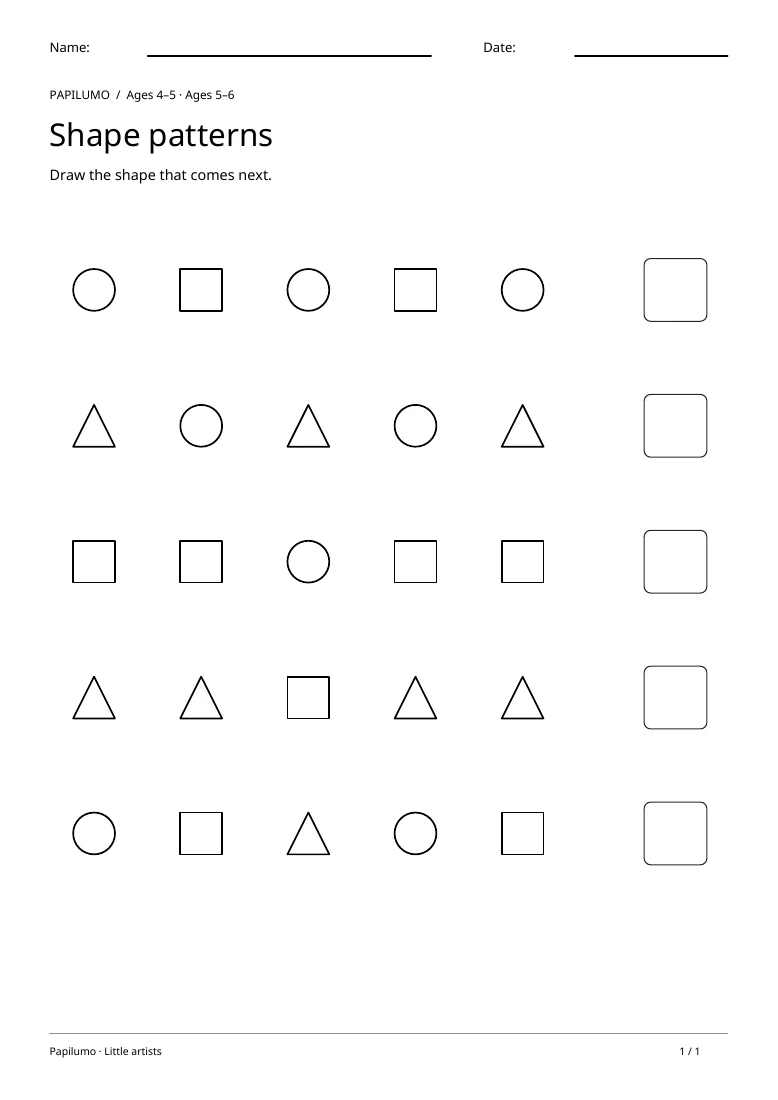
Four varied patterns fill the worksheet. Pattern A uses staircase columns of 1, 2, and 3 squares: the rule is +1, Step 4 draws a stack of 4 squares, and Step 5 totals 5. Pattern B shows paired dot rows of 2, 4, and 6: the rule is +2, Step 4 draws 8 dots in four tidy pairs, and Step 5 reaches 10. Pattern C arranges L-corners of 1, 3, and 5 tiles: the rule is +2, Step 4 draws a 7-tile L-corner, and Step 5 equals 9. Pattern D groups triangles in rows of three (3, 6, 9): the rule is +3, Step 4 draws 12 triangles in four rows, and Step 5 reaches 15. To vary the practice, try Kindergarten Pattern Worksheet: What Shape Comes Next?: Draw the shape that comes next.
What to notice and how to check
When reviewing with the separate answer key, which cleanly draws every Step 4 figure and fills all rule and Step 5 boxes, check both accurate counts and faithful structure. Verify 4 stacked squares, 8 paired dots, a 7-tile L-corner with four squares along each arm, and 12 triangles arranged in four neat rows of three. Confirm the four rules (+1, +2, +2, +3) and the four Step 5 counts (5, 10, 9, and 15), pausing on Pattern C if a child confuses the L-corner growth with a rectangle.
Making the task easier
Circle the newly added shapes in Step 2 and Step 3 with a pencil before sketching Step 4.
Keep the learning aim, but reduce how much the child has to handle at once. Cover part of the page with another sheet and reveal one task at a time. Demonstrate a separate example, then leave a real opportunity to work something out. An answer reached with support is still a useful attempt; it does not yet show that the same task can be completed independently.
Taking the idea beyond the worksheet
Design a new growing tile pattern on the back with a +4 rule by drawing Steps 1 to 3 and challenging a partner to predict Step 5.
Use the follow-up to meet the same idea in a different setting. Offer it once the first task makes sense, without insisting that the whole page must be perfect. The child might explain a strategy, make an example or set a challenge for an adult. Return to the worksheet only when it helps connect the two situations. A short conversation or a practical activity can be enough to finish the session. To continue exploring, use 4 × 4 Picture Sudoku for Kids: Sea Animals: Cut out the eight pictures and complete the grid.
Downloading and printing the PDF
This free PDF contains one worksheet designed for A4 paper. Download the file using the button on this page and open it in your PDF reader. Choose actual size or a 100% scale, check the orientation in the print preview and turn off any browser headers or footers. The illustrations use vector lines, so their outlines stay sharp when printed. Check the margins on one copy before preparing several sheets for a group. The level shown on the page is a guide, rather than a requirement to complete the activity at a particular age.