What this worksheet helps children practise
Always count the spaces between dots along the straight edges before circling Yes or No!
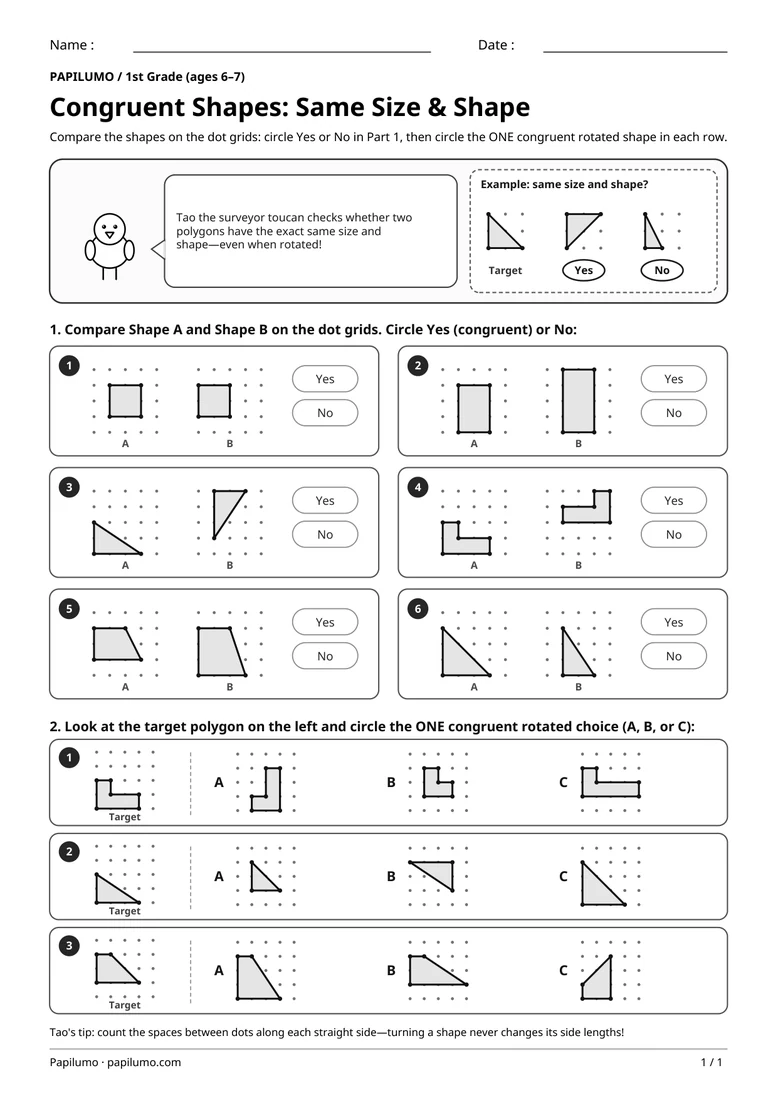
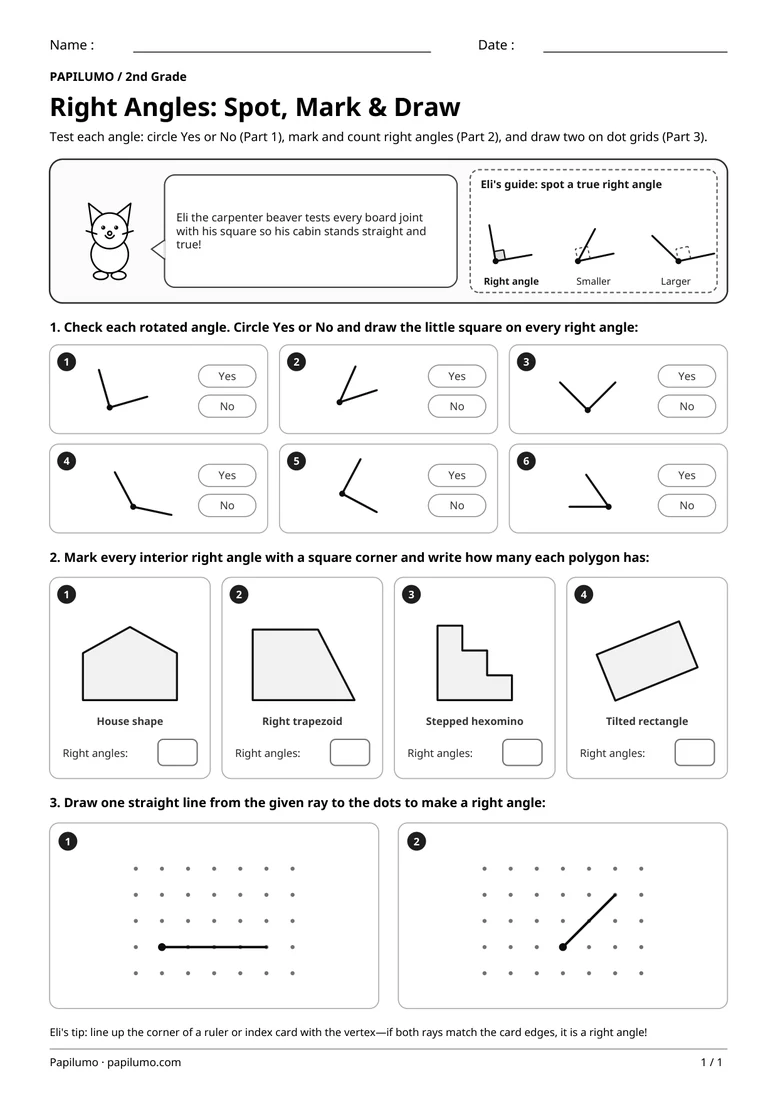
Recognizing congruent shapes in 1st grade means understanding that two polygons match only when they preserve both exact shape and exact size regardless of how they are turned on the page. By carefully counting dot-to-dot intervals along the straight sides of squares, rectangles, right triangles, L-shapes, and trapezoids across quarter-turn and half-turn rotations, young learners look past orientation changes, strengthen spatial memory on grids, and spot stretched, shrunken, or widened distractors with calm visual precision and growing geometric confidence. For a related skill, use Right Angles: Identify, Mark Square Corners, and Draw with Eli (2nd Grade): Test each angle: circle Yes or No (Part 1), mark and count right angles (Part 2), and draw two on dot grids (Part 3).
Preparing a short session
Print the student worksheet at actual size (100%) on plain white A4 or letter paper without cropping margins, and supply a sharpened pencil with a clean eraser on an uncluttered desk. Keep the separate one-page answer key tucked safely out of sight until both parts are completely finished. Before starting Part 1, look at Tao the toucan and the top worked model together, practicing aloud how to count the open spaces between dots along each straight edge rather than counting the individual dots themselves one by one.
A concrete example to get started
Inside the top banner right beside Tao the surveyor toucan, the worked model places three mini dot grids side by side: a 2-by-2 right triangle target, a congruent quarter-turn rotated 2-by-2 triangle with Yes circled cleanly underneath, and a narrower 1-by-2 right triangle with No circled clearly. Seeing both the Yes and No cases side by side shows children right away that rotation preserves exact dimensions while changing even a single side length immediately breaks congruence between two shapes on a dot grid.
Supporting the activity
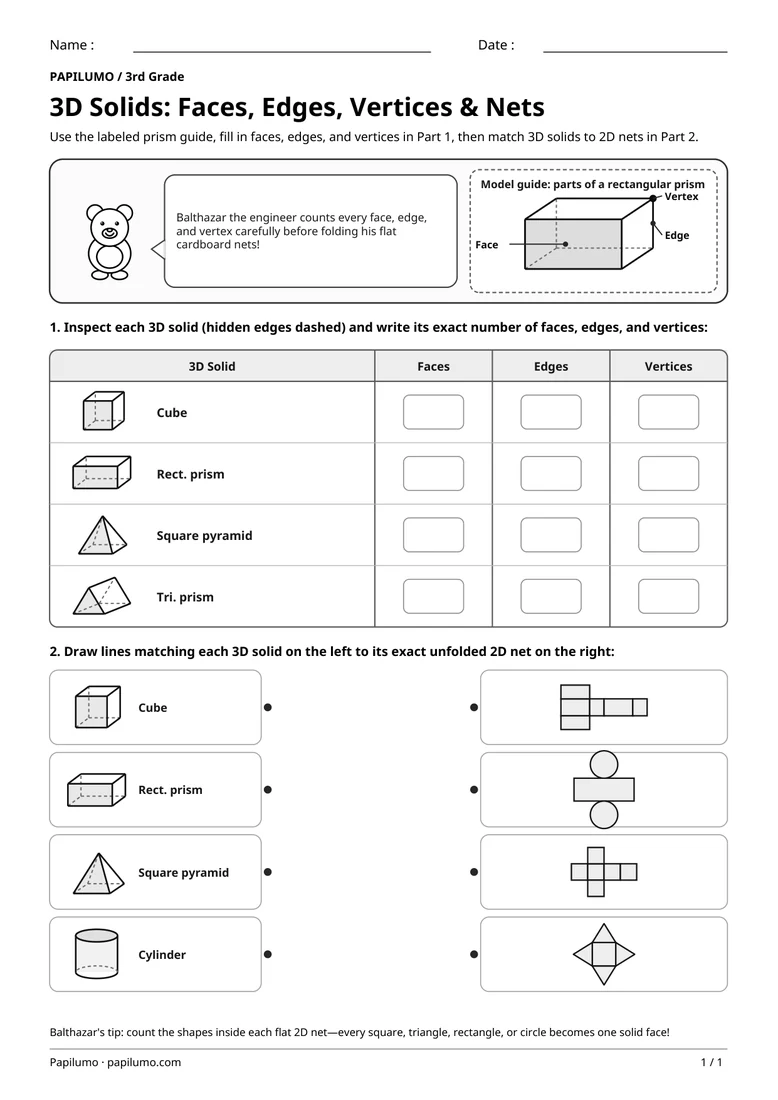
Part 1 features six numbered pairs on crisp 5-by-5 dot grids: two identical 2-by-2 squares (Yes), a 2-by-3 versus 2-by-4 rectangle (No), a 3-by-2 right triangle rotated 90 degrees (Yes), a 3-by-2 L-shape flipped 180 degrees (Yes), two right trapezoids with heights 2 and 3 (No), and a 3-by-3 versus 2-by-3 right triangle (No). Part 2 offers three challenge rows asking students to inspect the left target and circle the single congruent rotated match among choices A, B, and C: choice A in row 1, choice B in row 2, and choice C in row 3. To vary the practice, try 3D Solids: Faces, Edges, Vertices, and 2D Nets with Balthazar (3rd Grade): Use the labeled prism guide, fill in faces, edges, and vertices in Part 1, then match 3D solids to 2D nets in Part 2.
What to notice and how to check
When checking together, place the separate one-page answer key beside your child's sheet: Part 1 circles Yes or No cleanly for all six pairs alongside helpful side-dimension notes, while Part 2 highlights choice A in row 1, choice B in row 2, and choice C in row 3. If a rotated L-shape or trapezoid felt tricky at first, count the longest vertical and horizontal spans together step by step with a pencil tip to verify why only one choice truly matches the target shape.
Making the task easier
Write small numbers next to the two main perpendicular sides of each figure before comparing sizes.
Keep the learning aim, but reduce how much the child has to handle at once. Cover part of the page with another sheet and reveal one task at a time. Demonstrate a separate example, then leave a real opportunity to work something out. An answer reached with support is still a useful attempt; it does not yet show that the same task can be completed independently.
Taking the idea beyond the worksheet
On scrap dot paper, draw your own L-shape and try sketching the exact same shape rotated a quarter turn.
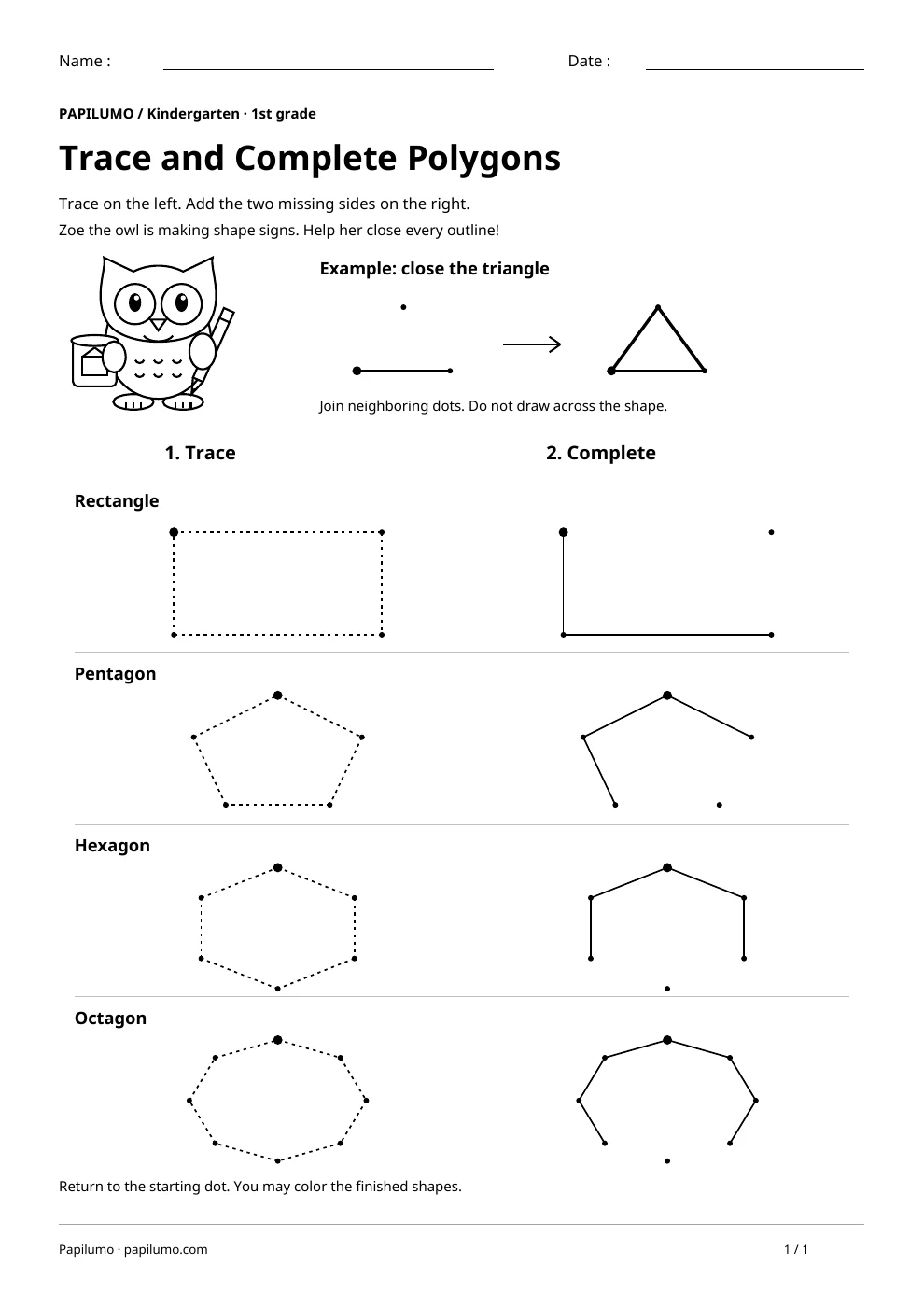
Use the follow-up to meet the same idea in a different setting. Offer it once the first task makes sense, without insisting that the whole page must be perfect. The child might explain a strategy, make an example or set a challenge for an adult. Return to the worksheet only when it helps connect the two situations. A short conversation or a practical activity can be enough to finish the session. To continue exploring, use Trace and Complete Polygons with Zoe: Trace on the left. Add the two missing sides on the right.
Downloading and printing the PDF
This free PDF contains one worksheet designed for A4 paper. Download the file using the button on this page and open it in your PDF reader. Choose actual size or a 100% scale, check the orientation in the print preview and turn off any browser headers or footers. The illustrations use vector lines, so their outlines stay sharp when printed. Check the margins on one copy before preparing several sheets for a group. The level shown on the page is a guide, rather than a requirement to complete the activity at a particular age.