What this worksheet helps children practise
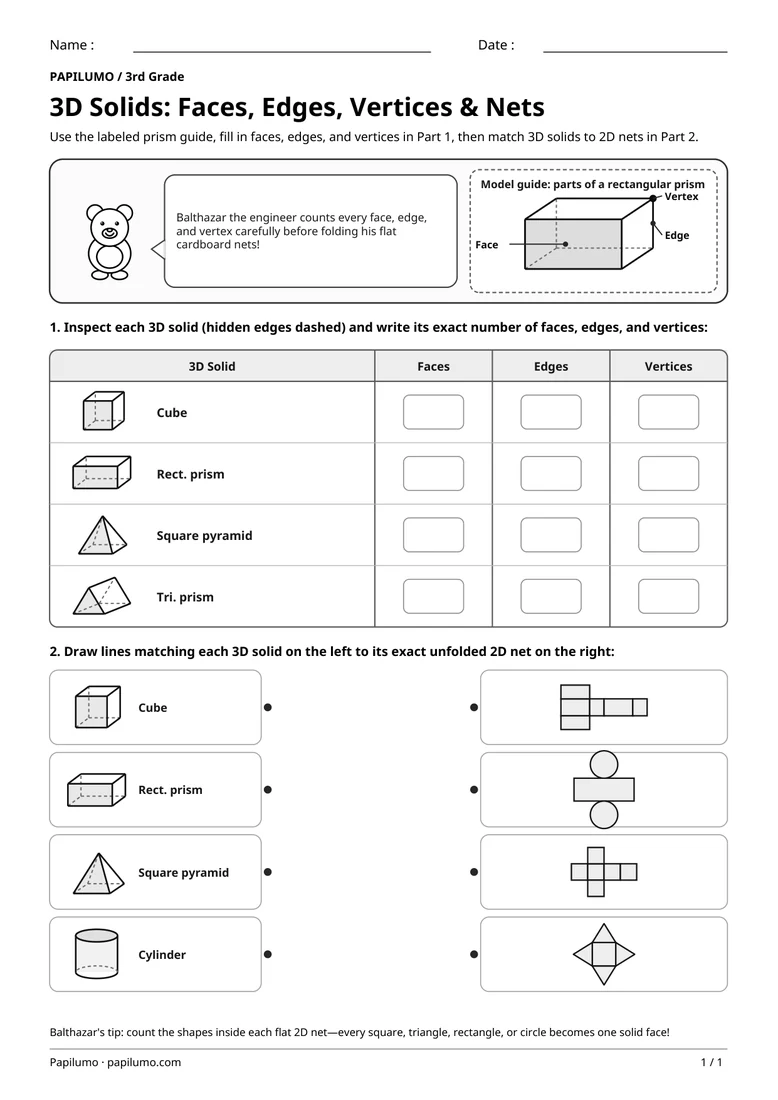
Count the solid front faces and edges first, then add the dashed hidden ones at the back!
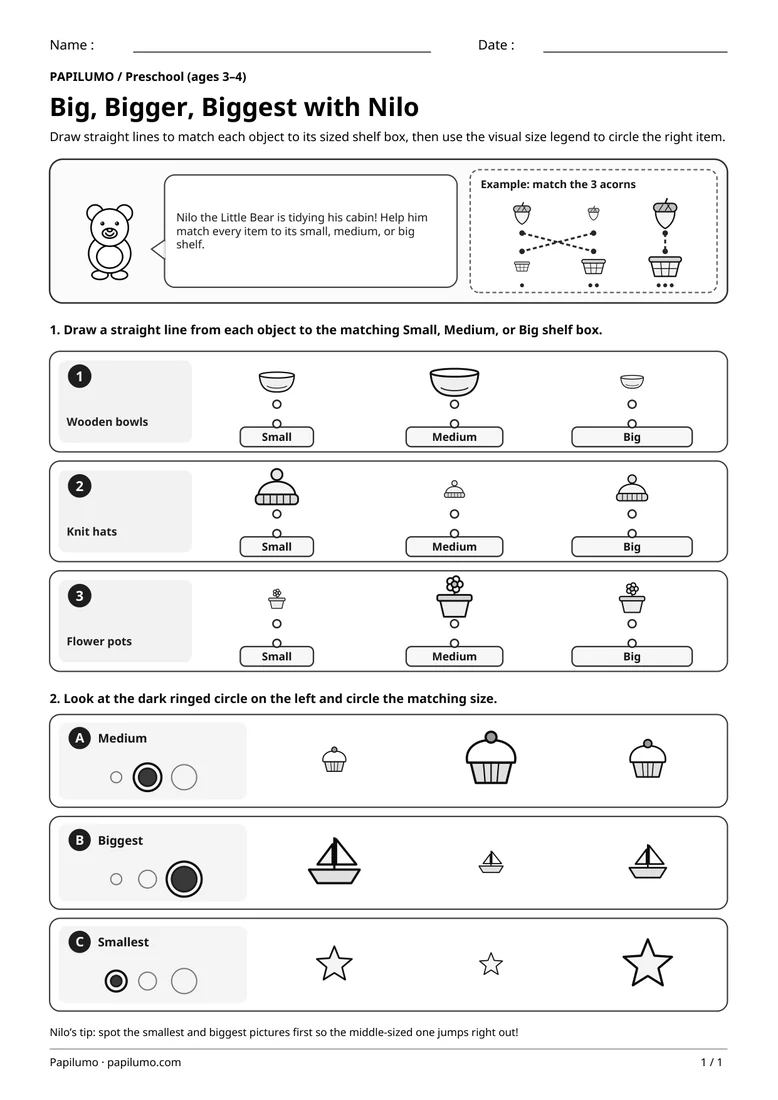
Understanding 3D geometric solids in 3rd Grade requires clearly distinguishing each flat surface face, each straight line edge where two neighboring faces meet, and each sharp pointed vertex corner where three or more edges join together—and then connecting those exact counts to flat unfolded 2D nets. By systematically tallying attributes for cubes, rectangular prisms, square pyramids, and triangular prisms alongside matching a cube, prism, pyramid, and cylinder to their component 2D faces, learners strengthen mental folding skills, precise geometric vocabulary, and spatial reasoning without scissors or glue. For a related skill, use Big, Bigger, Biggest: Order 3 Sizes with Nilo: Draw straight lines to match each object to its sized shelf box, then use the visual size legend to circle the right item.
Preparing a short session
Print the student page cleanly at 100% scale on crisp white A4 paper without shrinking or cropping margins, and lay out a sharp pencil, a clean eraser, and a small straightedge ruler for drawing tidy matching lines across Part 2. Keep the separate one-page answer key completely out of reach until both sections are done. Setting a real cardboard tissue box or small wooden block beside the worksheet works nicely as a concrete model so students can trace real faces and edges with their fingers before writing down counts.
A concrete example to get started
In the top banner right beside Balthazar the engineer, a perspective rectangular prism rendered with clear dashed hidden edges points accurately to three labeled features: a softly shaded front rectangle marked Face, a straight upper border marked Edge, and a pointed corner marked Vertex. Keeping those visual callouts sitting directly above the exercise table prevents common elementary vocabulary mix-ups between flat faces, straight edges, and sharp corners before students begin counting hidden segments throughout Part 1.
Supporting the activity
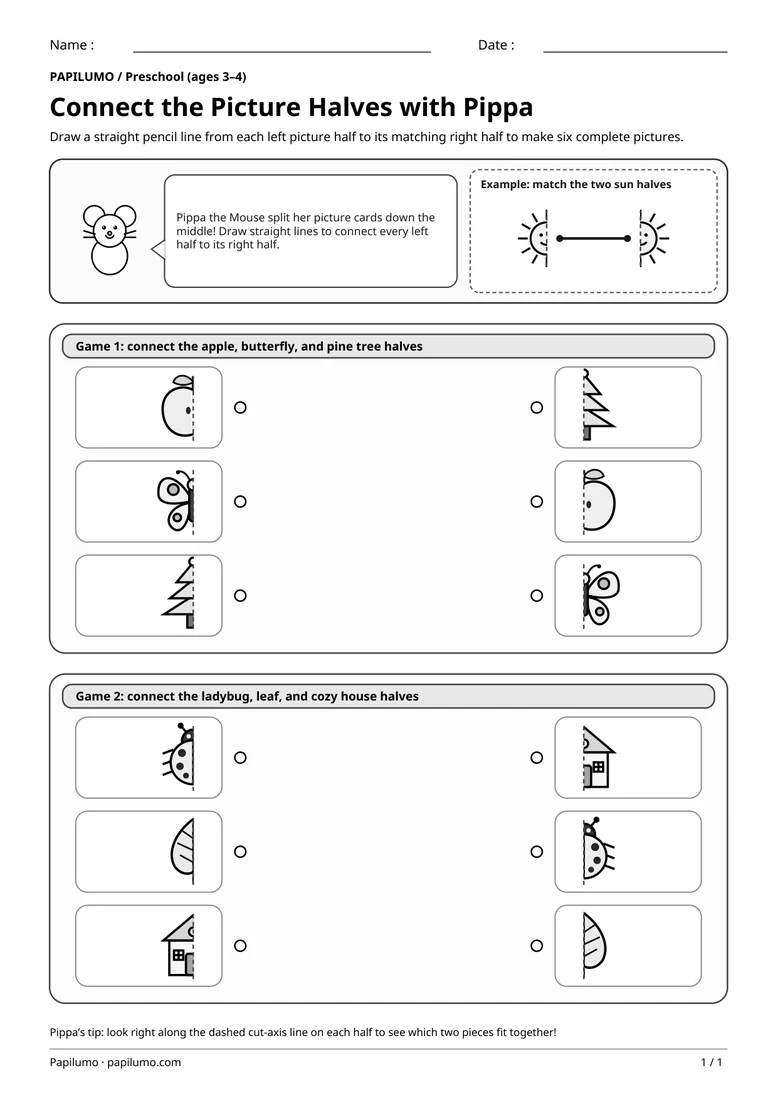
Part 1 features a tidy four-row property table where students carefully count and fill in Faces, Edges, and Vertices for four 3D solids drawn with dashed hidden lines: Cube (6, 12, 8), Rectangular Prism (6, 12, 8), Square Pyramid (5, 8, 5), and Triangular Prism (5, 9, 6). Part 2 presents four visual matching pairs linking a cube, rectangular prism, square pyramid, and cylinder on the left to four shuffled unfolded 2D nets on the right—six squares, six rectangles, square plus four triangles, and rectangle with two circular bases. To vary the practice, try Connect the Picture Halves: Draw-a-Line Match with Pippa: Draw a straight pencil line from each left picture half to its matching right half to make six complete pictures.
What to notice and how to check
Check completed student pages effortlessly side by side against the separate one-page answer key PDF: Part 1 clearly displays exact verified values across all twelve cells (Cube 6/12/8, Rectangular Prism 6/12/8, Square Pyramid 5/8/5, and Triangular Prism 5/9/6), while Part 2 draws bold connecting lines from every 3D solid on the left to its unique unfolded 2D net on the right. When reviewing any miscounted edge or vertex, count the solid front lines first and then tally every dashed back segment one by one together.
Making the task easier
Put a tiny pencil tick next to each vertex and edge as you count so none are counted twice.
Keep the learning aim, but reduce how much the child has to handle at once. Cover part of the page with another sheet and reveal one task at a time. Demonstrate a separate example, then leave a real opportunity to work something out. An answer reached with support is still a useful attempt; it does not yet show that the same task can be completed independently.
Taking the idea beyond the worksheet
Sketch a second valid 6-square cube net on scrap paper and check which squares would touch opposite sides.
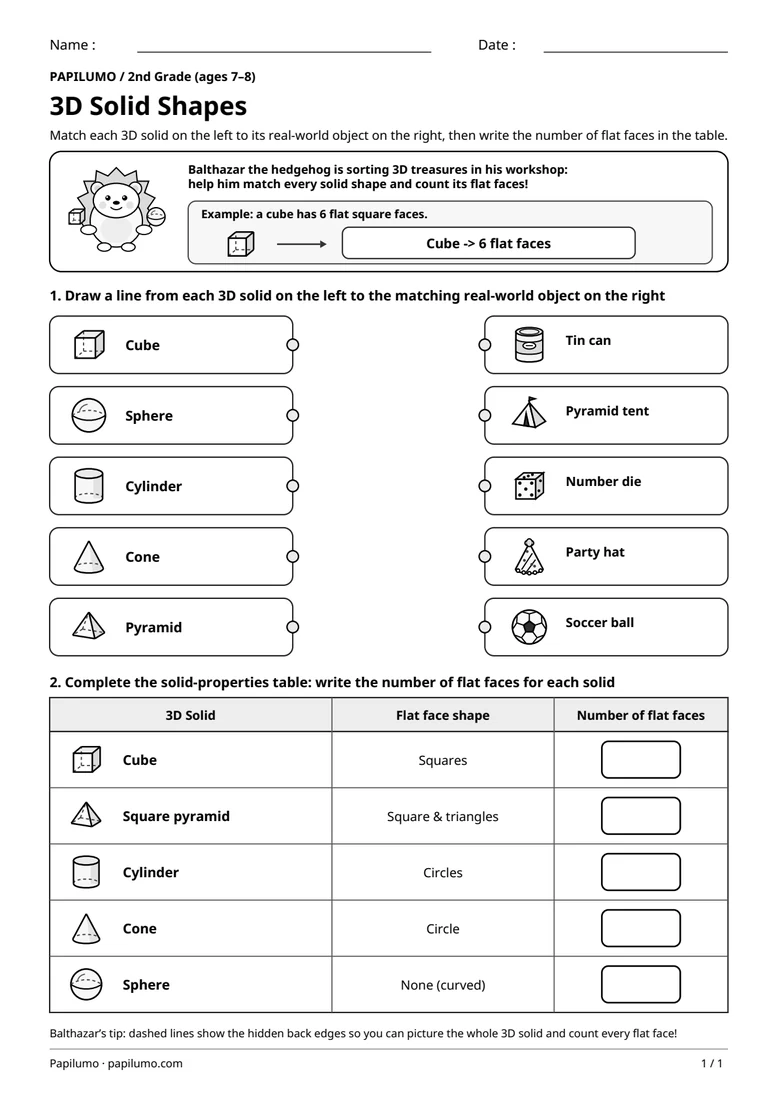
Use the follow-up to meet the same idea in a different setting. Offer it once the first task makes sense, without insisting that the whole page must be perfect. The child might explain a strategy, make an example or set a challenge for an adult. Return to the worksheet only when it helps connect the two situations. A short conversation or a practical activity can be enough to finish the session. To continue exploring, use 3D Solid Shapes: Match Objects and Count Flat Faces with Balthazar the Hedgehog: Match each 3D solid on the left to its real-world object on the right, then write the number of flat faces in the table.
Downloading and printing the PDF
This free PDF contains one worksheet designed for A4 paper. Download the file using the button on this page and open it in your PDF reader. Choose actual size or a 100% scale, check the orientation in the print preview and turn off any browser headers or footers. The illustrations use vector lines, so their outlines stay sharp when printed. Check the margins on one copy before preparing several sheets for a group. The level shown on the page is a guide, rather than a requirement to complete the activity at a particular age.