
What this worksheet helps children practise
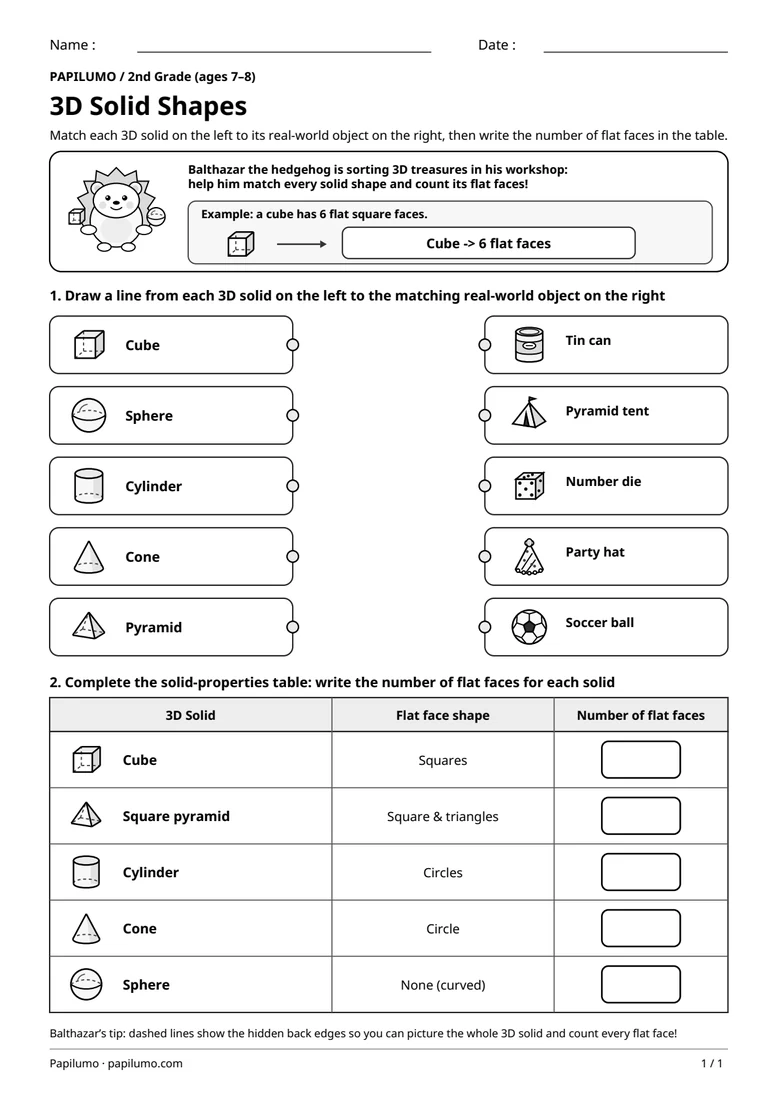
Count the top and bottom faces first, then travel all the way around the sides so hidden faces never slip past you!
Moving from flat 2D polygons to 3D solid figures is a core milestone in 2nd grade geometry. To identify a solid in any orientation, students must look beyond overall silhouettes and analyze its exact structural attributes: flat faces that let a shape rest steadily or stack neatly, versus curved surfaces that let it roll smoothly across a table. Reading dashed hidden edges strengthens spatial visualization, while counting flat faces connects three-dimensional objects directly back to the squares, triangles, and circles studied in early elementary math. For a related skill, use Polygons: Count Sides and Vertices with Balthazar: Mark each corner (vertex) with a pencil dot, count the straight sides and vertices, then write both numbers.
Preparing a short session
Print the student sheet at actual size (100%) on plain white A4 or letter paper without cropping margins, and provide a sharpened pencil, a short ruler if desired, and a clean soft eraser. Keep the separate PDF answer key neatly out of sight throughout independent work. Before drawing the very first line, read the directions aloud together, look closely at Balthazar the hedgehog and the worked cube model at the top, and name all five labeled solids on the left plus all five pictured objects on the right.
A concrete example to get started
In the top example panel beside Balthazar the hedgehog, a crisp vector cube highlights solid front edges alongside three dashed lines for the hidden back edges. A clear arrow leads directly to the summary: Cube -> 6 flat faces. This visual reference teaches children how to count hidden faces systematically without missing the bottom or rear sides: four vertical faces around the middle, one flat square face on top, and one flat square face on the bottom make six flat square faces altogether.
Supporting the activity
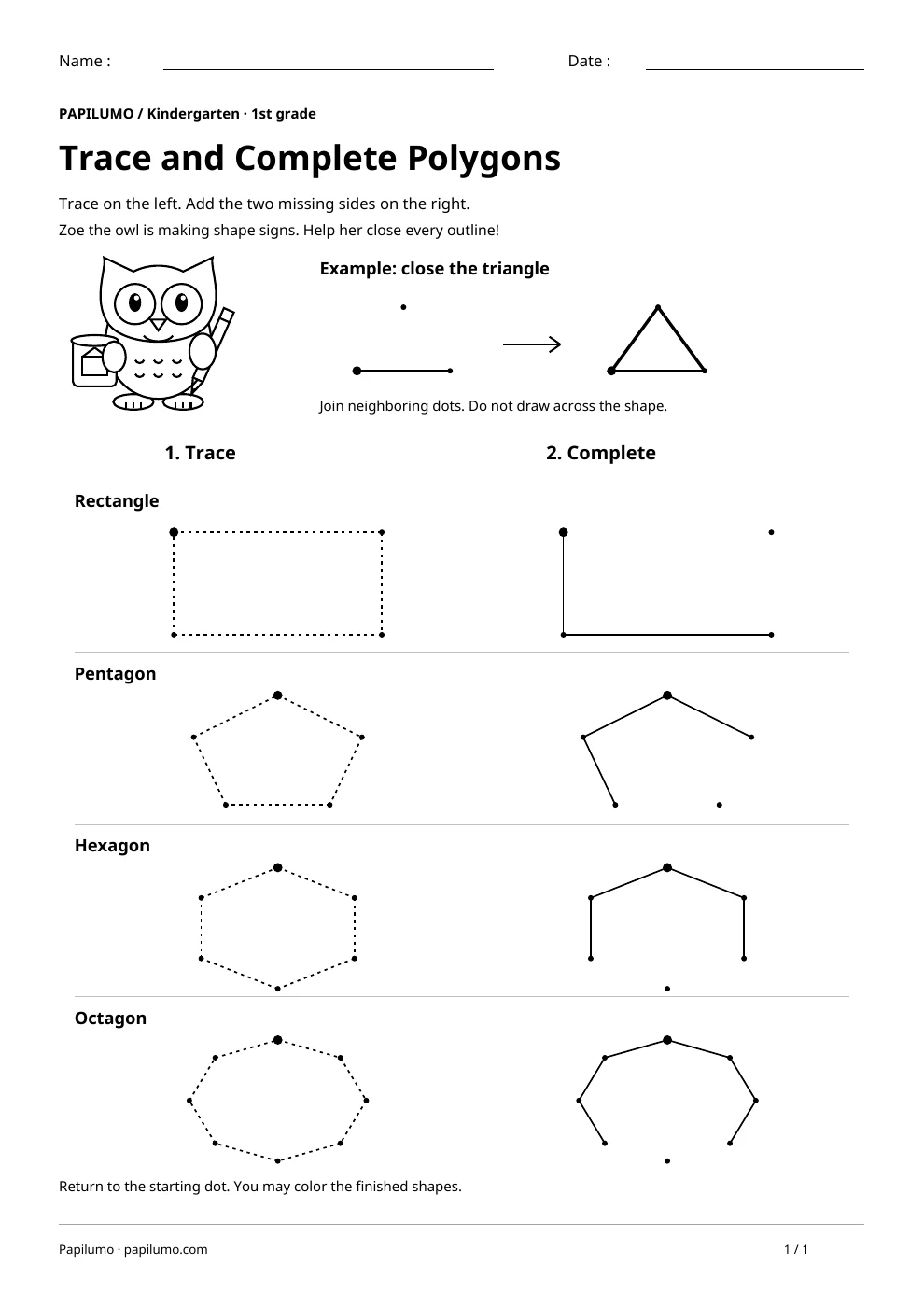
In Part 1, students connect each labeled dot on the left to its matching everyday object on the right: the cube matches the number die, the sphere matches the soccer ball, the cylinder matches the tin can, the cone matches the pointed party hat, and the pyramid matches the pyramid tent. In Part 2, the properties table lists each solid’s flat face shape as a gentle geometric clue while leaving five generous blank boxes to record the exact counts in descending order: cube 6, square pyramid 5, cylinder 2, cone 1, and sphere 0. To vary the practice, try Trace and Complete Polygons with Zoe: Trace on the left. Add the two missing sides on the right.
What to notice and how to check
When reviewing with the separate one-page answer key, which displays all five matching lines and the completed table, check each visual match first and then verify the five numbers entered down the right column (6, 5, 2, 1, and 0). If a student writes 3 or 4 for the cube or pyramid because hidden rear or bottom faces were missed, place a real six-sided die or small box in their hands so they can touch each flat face one by one before erasing neatly and updating the box.
Making the task easier
Grab a real household object for each solid (a die, soup can, or ball) and tap every flat face with your finger as you count.
Keep the learning aim, but reduce how much the child has to handle at once. Cover part of the page with another sheet and reveal one task at a time. Demonstrate a separate example, then leave a real opportunity to work something out. An answer reached with support is still a useful attempt; it does not yet show that the same task can be completed independently.
Taking the idea beyond the worksheet
Hunt around your kitchen or bedroom for one cylinder and one cube, then sketch both everyday objects on the back of your page.
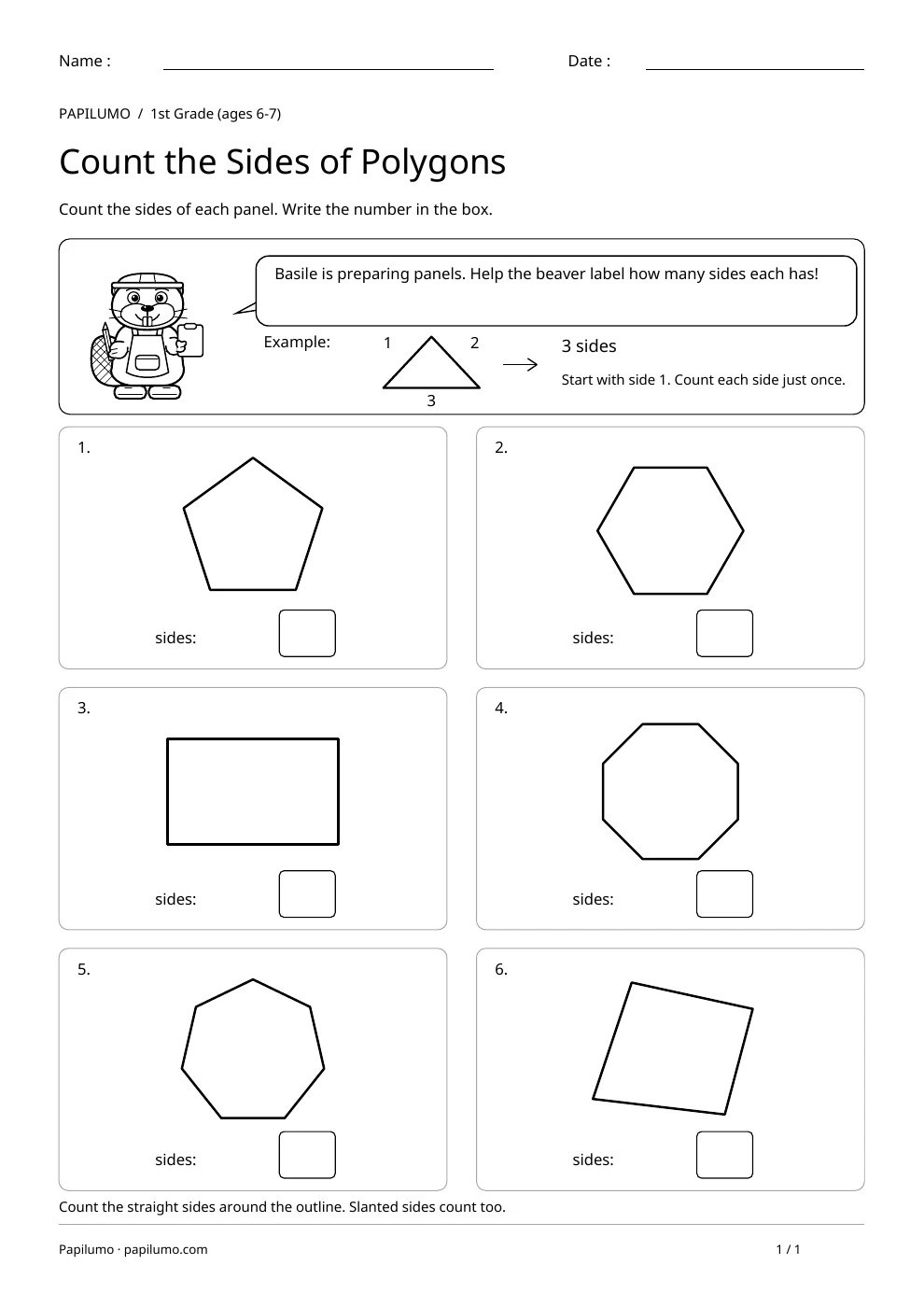
Use the follow-up to meet the same idea in a different setting. Offer it once the first task makes sense, without insisting that the whole page must be perfect. The child might explain a strategy, make an example or set a challenge for an adult. Return to the worksheet only when it helps connect the two situations. A short conversation or a practical activity can be enough to finish the session. To continue exploring, use Count the Sides of Polygons with Basile: Count the sides of each panel. Write the number in the box.
Downloading and printing the PDF
This free PDF contains one worksheet designed for A4 paper. Download the file using the button on this page and open it in your PDF reader. Choose actual size or a 100% scale, check the orientation in the print preview and turn off any browser headers or footers. The illustrations use vector lines, so their outlines stay sharp when printed. Check the margins on one copy before preparing several sheets for a group. The level shown on the page is a guide, rather than a requirement to complete the activity at a particular age.