What this worksheet helps children practise
Find the tiniest item and the biggest item first, then draw a steady straight line to each shelf.
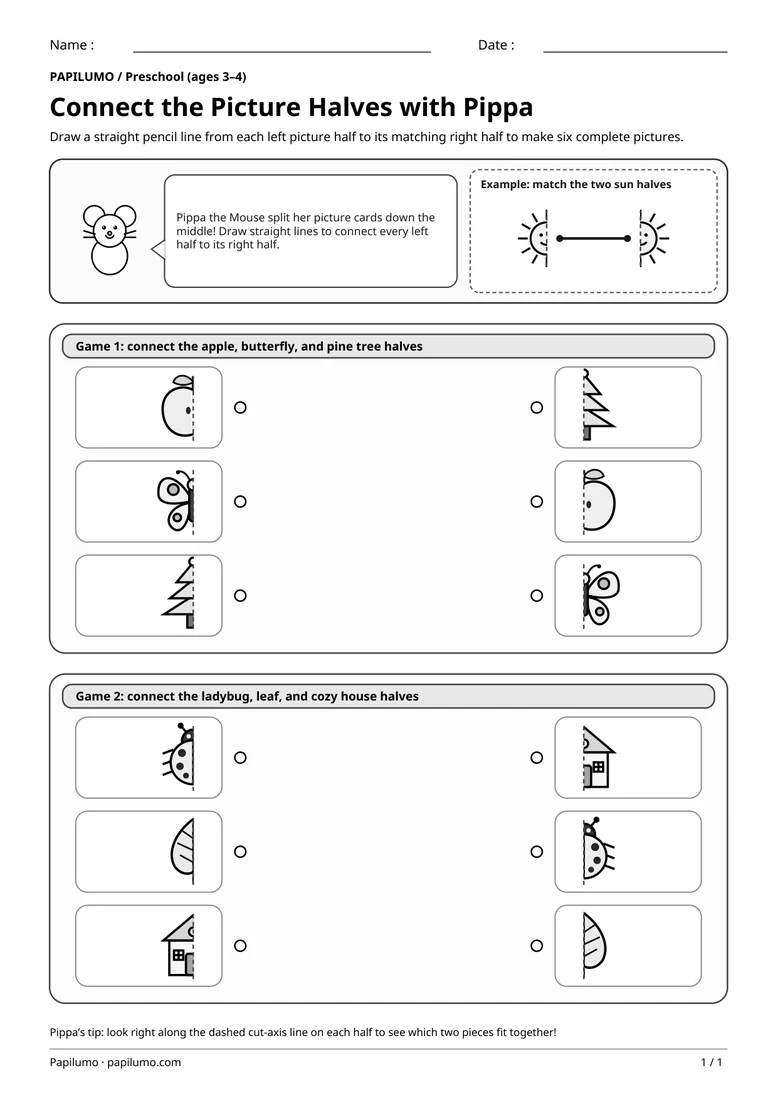
Comparing three distinct sizes in preschool builds early measurement thinking, proportional observation, and foundational ordering logic long before formal numbers appear. Moving beyond simple big-versus-small pairs to recognize a middle-sized object teaches young children relational reasoning: something counts as medium only when compared alongside both a smaller and a larger neighbor. Tracing straight matching lines between clear anchor dots also strengthens eye-hand coordination, wrist steadiness, and intentional crayon control, while circling target shapes builds visual discrimination and confidence following picture legends independently. For a related skill, use Connect the Picture Halves: Draw-a-Line Match with Pippa: Draw a straight pencil line from each left picture half to its matching right half to make six complete pictures.
Preparing a short session
Print the student worksheet at actual size (100%) on plain white A4 paper and sit together at a bright, uncluttered table with a chunky triangular pencil, soft wax crayon, or washable thick marker. Keep the separate one-page answer key PDF tucked neatly out of sight until your child completes both sections. Before picking up a crayon, invite your child to scan each row from left to right and point out with one finger which picture looks tiniest, which looks largest, and which sits right in the middle.
A concrete example to get started
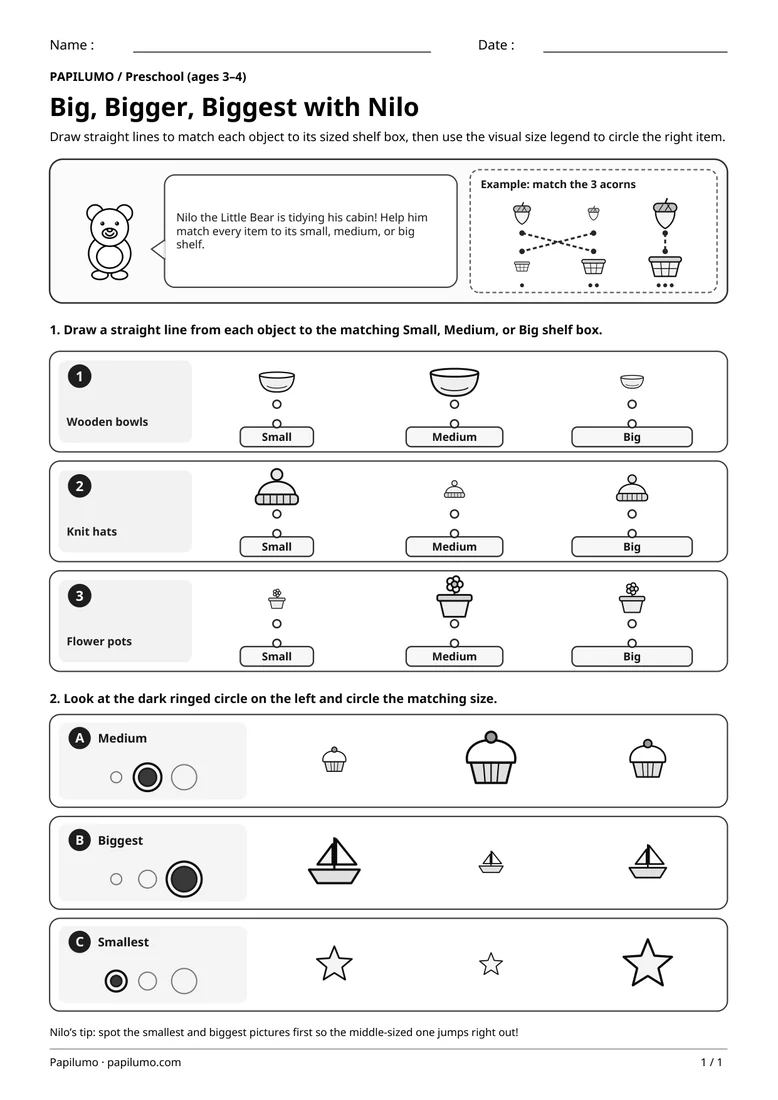
Inside the framed top banner beside smiling Nilo the Little Bear, a clear speech bubble sets up the cabin tidying story right next to a worked mini example box. Three acorns in mixed sizes—medium, small, and big—sit above three proportionally sized baskets ordered cleanly from small to big, complete with one, two, and three visual dot cues underneath. Clean connecting lines link each acorn straight into its matching basket. This instant visual model shows young learners exactly how matching lines work before tackling Part 1.
Supporting the activity
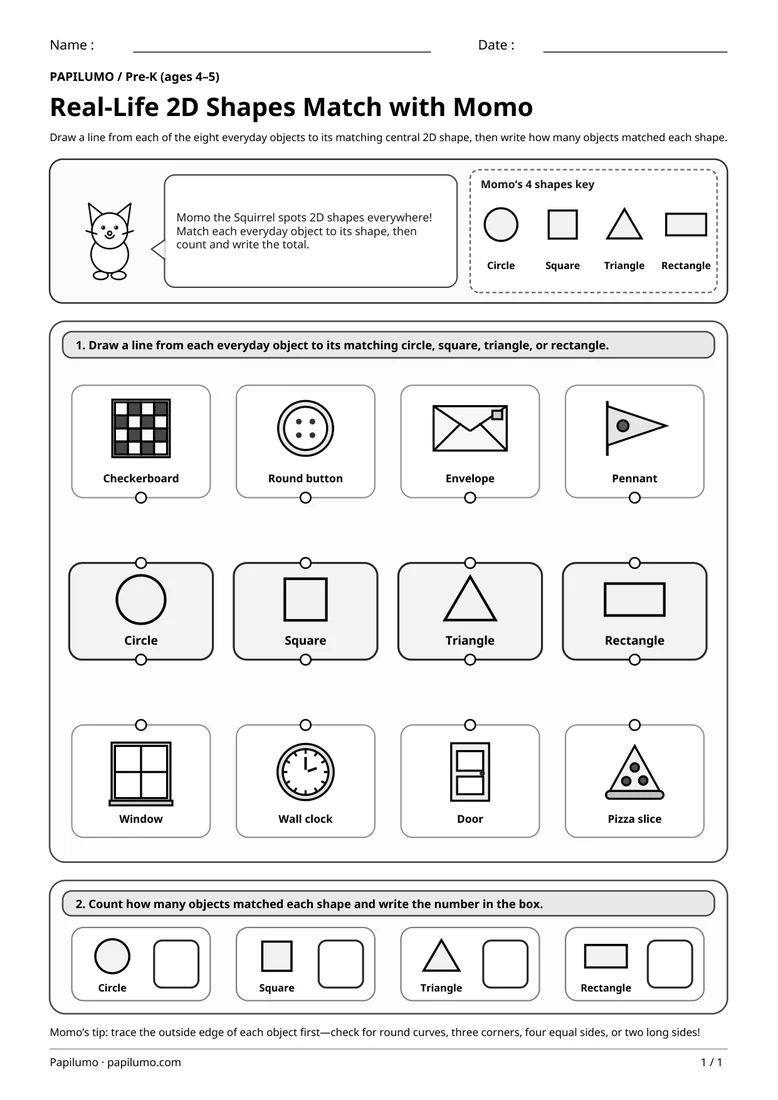
Below the top banner, two clearly separated sections guide preschool learners step by step across the page. In Part 1, three roomy rows feature wooden bowls, cozy knit hats, and blooming flower pots arranged in shuffled sizes; children draw straight lines from each item dot down to the matching Small, Medium, or Big shelf box below. In Part 2, three clean rows display visual size-legend icons with one dark highlighted ring: circle the middle-sized cupcake in row A, the biggest sailboat in row B, and the smallest star in row C. To vary the practice, try Real-Life 2D Shapes Match: Circle, Square, Triangle, Rectangle: Draw a line from each of the eight everyday objects to its matching central 2D shape, then write how many objects matched each shape.
What to notice and how to check
Once all nine connecting lines and three circles are complete, place the one-page miniature answer key beside your child’s worksheet to review each row together warmly and celebrate careful looking. Verify that every wooden bowl, knit hat, and flower pot connects cleanly to its exact sized shelf box and that rows A, B, and C clearly circle the medium cupcake, largest sailboat, and tiniest star. If a middle-sized choice felt tricky, compare the three pictures side by side by finger again, then invite your child to color Nilo’s cozy objects.
Making the task easier
Point to the small, medium, and big items in each row with your finger before drawing any pencil lines.
Keep the learning aim, but reduce how much the child has to handle at once. Cover part of the page with another sheet and reveal one task at a time. Demonstrate a separate example, then leave a real opportunity to work something out. An answer reached with support is still a useful attempt; it does not yet show that the same task can be completed independently.
Taking the idea beyond the worksheet
Color the bowls, knit hats, flower pots, cupcakes, sailboats, and stars using three colors by size.
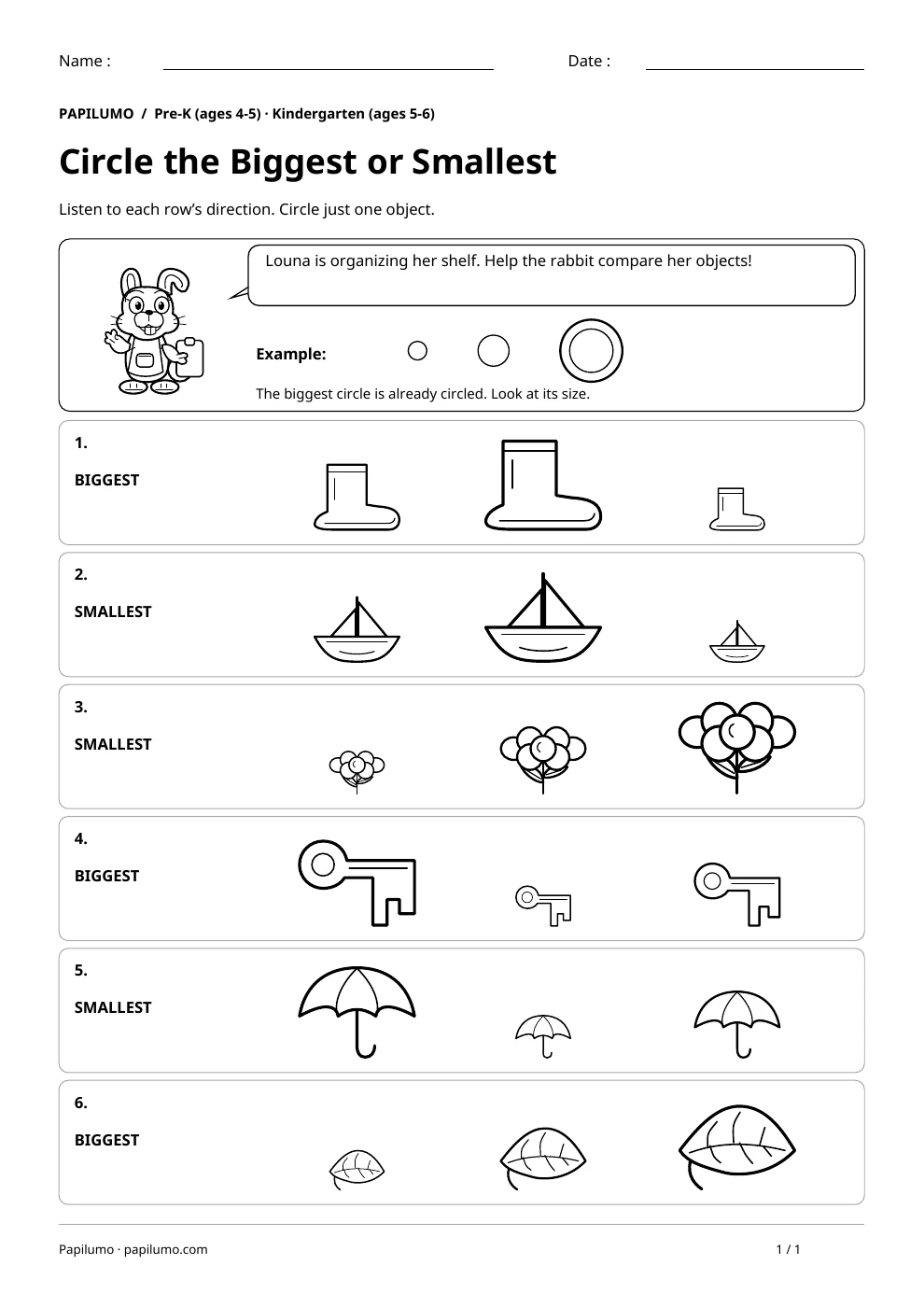
Use the follow-up to meet the same idea in a different setting. Offer it once the first task makes sense, without insisting that the whole page must be perfect. The child might explain a strategy, make an example or set a challenge for an adult. Return to the worksheet only when it helps connect the two situations. A short conversation or a practical activity can be enough to finish the session. To continue exploring, use Biggest and Smallest Objects: Compare Sizes: Listen to each row’s direction. Circle just one object.
Downloading and printing the PDF
This free PDF contains one worksheet designed for A4 paper. Download the file using the button on this page and open it in your PDF reader. Choose actual size or a 100% scale, check the orientation in the print preview and turn off any browser headers or footers. The illustrations use vector lines, so their outlines stay sharp when printed. Check the margins on one copy before preparing several sheets for a group. The level shown on the page is a guide, rather than a requirement to complete the activity at a particular age.