


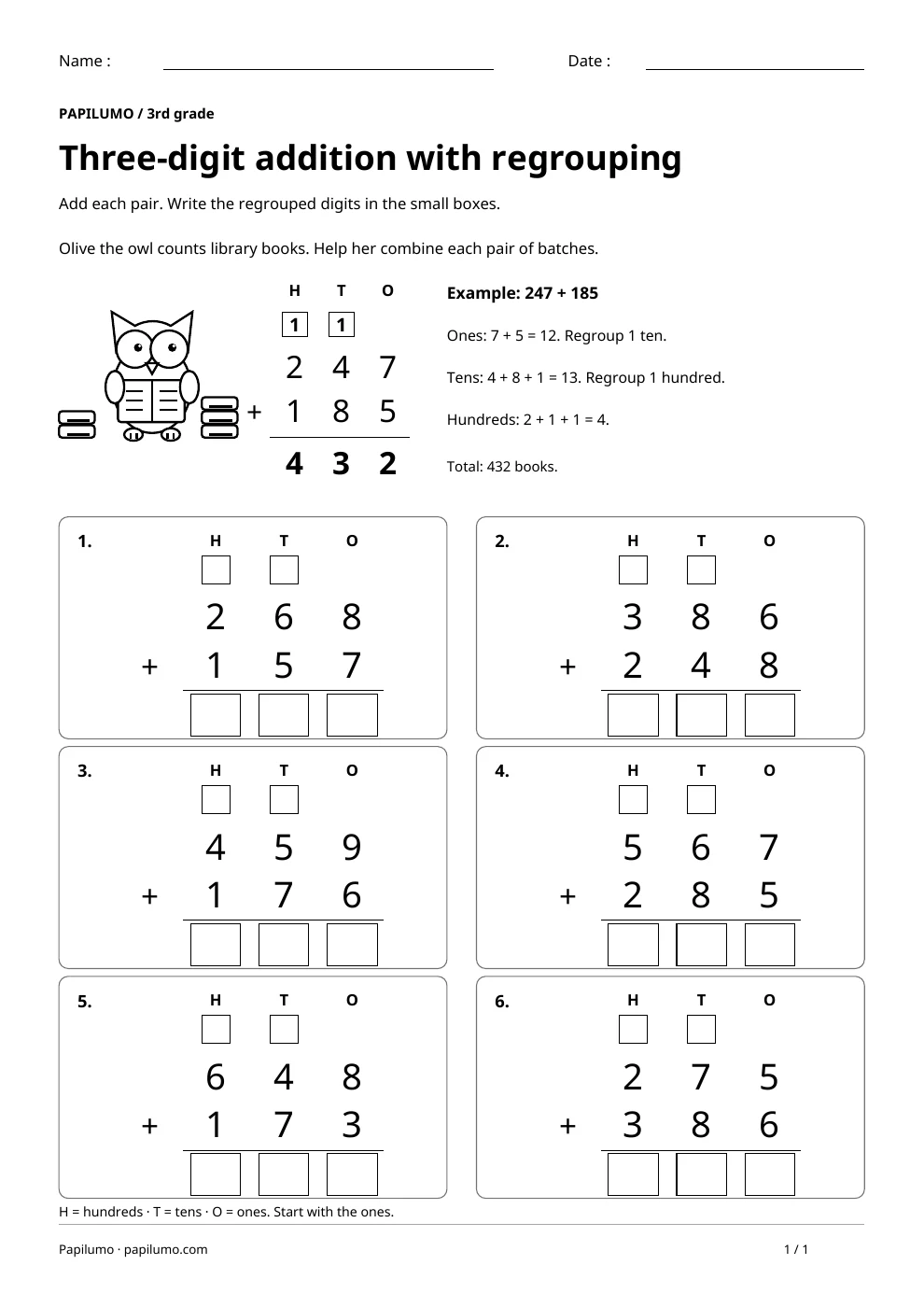
What this worksheet helps children practise
If only two printed rows are included, guide a finger down the ones column while naming all three digits. Repeat the movement in the tens column, beginning at the carry box. If the carried 1 seems meaningless, model the example with twelve loose counters and move ten into a group. That group joins the tens. The written carry records an actual quantity. Avoid teaching it as a digit that moves merely because a rule says to move it.
The focus is keeping all three addends in the calculation. Children add three ones digits, then combine three tens digits with the newly regrouped ten. That extra contribution is easy to miss when moving from two addends to three. Use the sheet after place value and two-digit addition with regrouping are familiar. It is suitable for guided extension or review, depending on the learner’s readiness. There is no timed element, and explaining a step matters more than finishing quickly. For a related skill, use Three-digit addition without regrouping: Add each pair. Write one digit in each answer box.
Preparing a short session
Print at actual size and provide a pencil and eraser. Counters or craft sticks can help make regrouping visible. Keep the answer key out of sight while the child works. Identify T for tens and O for ones, and read all three numbers in the first problem. The small box records a ten; each lower box holds one digit of the sum. Kiko’s three-line checklist is a reminder to check all three deliveries before accepting the total.
A concrete example to get started
The example shows 24 + 13 + 15. First add the ones: 4 + 3 + 5 makes 12 ones. Exchange ten of them for one new ten, leaving two ones. Write 2 in the ones answer box and 1 above the tens column. Now add 2 + 1 + 1 + 1, including the regrouped ten as well as the three printed tens digits. Five tens and two ones make 52. Point to each contribution so the carry is not mistaken for another original addend.
Supporting the activity
Start with one set, then work through a row at a time. The child may add two ones digits first and then include the third, saying the running total aloud. Record the ones digit and carried ten before moving left to the tens. All six problems require a carry of 1, and none needs a hundreds column. This sheet does not introduce a carry of 2. Its purpose is to make the three-addend routine secure without adding several new place-value demands at once. To vary the practice, try Three-digit addition with sums over 1,000: Add each pair. Write the regrouped digits and the four-digit sum.
What to notice and how to check
The answers in order are 57, 75, 81, 77, 78, and 74. Each carry box contains 1 on the key. Check the process as well as the final number. An answer that is ten too small may indicate an omitted carry. A different error may come from skipping one addend or misremembering an addition fact. Ask the child to reread all three ones digits and then every contribution to the tens column. Compare with the key after that explanation and allow time to revise.
Making the task easier
Cover the other five problems and support one calculation. An adult can write while the child explains, separating handwriting from reasoning. Another option is to build each addend as tens and ones on scrap paper before connecting it to the printed columns. Return to two-addend practice if the child still loses track of place value. Completing the entire page in one sitting is unnecessary. One accurately explained exchange is a useful step toward handling all six independently.
Keep the learning aim, but reduce how much the child has to handle at once. Cover part of the page with another sheet and reveal one task at a time. Demonstrate a separate example, then leave a real opportunity to work something out. An answer reached with support is still a useful attempt; it does not yet show that the same task can be completed independently.
Taking the idea beyond the worksheet
Check a sum by adding the first two numbers and then the third. For 26 + 17 + 14, this gives 43 + 14, which equals 57. Both approaches should represent the same quantity. Next, invite the child to invent three two-digit numbers whose total is below 100 and whose ones digits add to a number from 10 through 19. Check those conditions together before writing the invented problem in columns. Ask the child to explain why exactly one ten is regrouped.
Use the follow-up to meet the same idea in a different setting. Offer it once the first task makes sense, without insisting that the whole page must be perfect. The child might explain a strategy, make an example or set a challenge for an adult. Return to the worksheet only when it helps connect the two situations. A short conversation or a practical activity can be enough to finish the session. To continue exploring, use Three-digit addition with regrouping: Add each pair. Write the regrouped digits in the small boxes.
Downloading and printing the PDF
This free PDF contains one worksheet designed for A4 paper. Download the file using the button on this page and open it in your PDF reader. Choose actual size or a 100% scale, check the orientation in the print preview and turn off any browser headers or footers. The illustrations use vector lines, so their outlines stay sharp when printed. Check the margins on one copy before preparing several sheets for a group. The level shown on the page is a guide, rather than a requirement to complete the activity at a particular age.