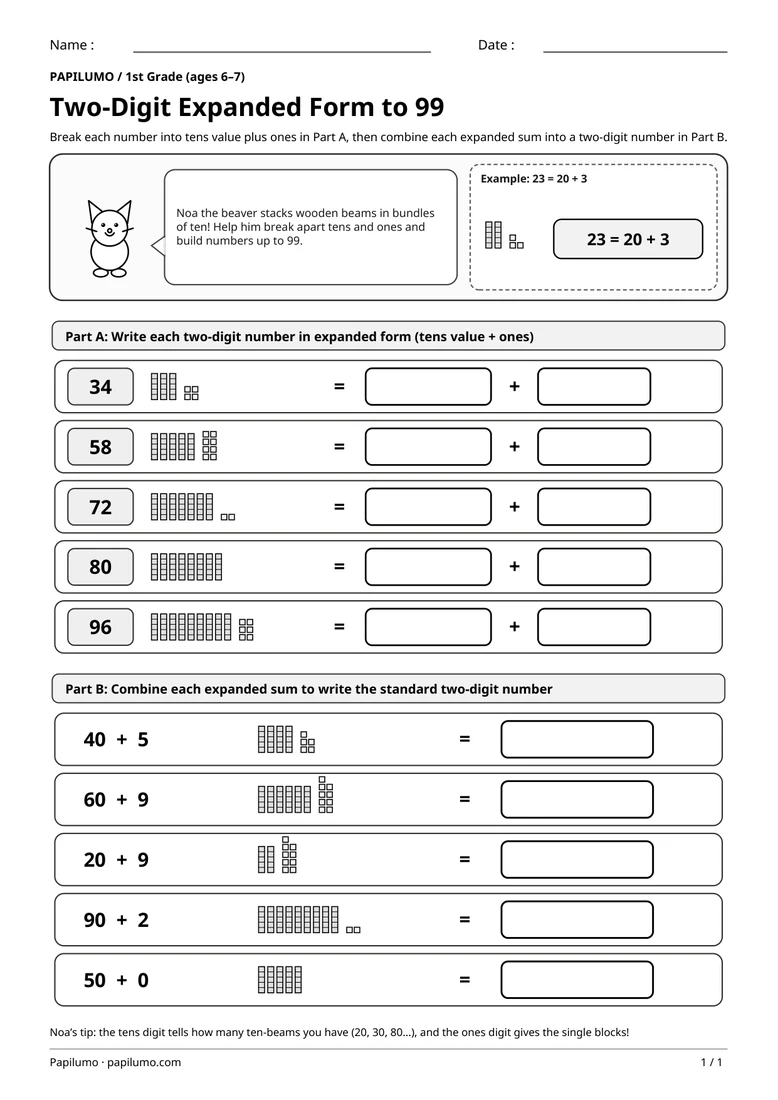


What this worksheet helps children practise
Count the ten-beams by tens (30, 50, 80...) for the first box, then write the single ones digit in the second box.
Moving fluently between standard notation (47) and expanded form (40 + 7) builds essential place-value understanding in first grade. Students quickly see that the left digit in 58 does not mean five single blocks—it represents five full groups of ten, or 50, alongside eight ones. Including zero-ones cases such as 80 = 80 + 0 and 50 + 0 = 50 prevents common place-value errors where learners omit the zero or concatenate digits into 405 instead of 45, preparing them directly for smooth two-digit mental addition. For a related skill, use Two-Digit Number Riddles to 99 with Pico the Detective Fox (1st Grade): Read the clues on each riddle card, circle the single matching number from the three choices, and write it in the answer box.
Preparing a short session
Print the student page at actual size (100%) on plain white A4 paper and keep the separate one-page answer key PDF neatly out of sight while your child works at a quiet desk. Offer a sharpened pencil and a soft eraser so digits fit cleanly inside every box without crowding. Before starting, skip-count by tens together from 10 to 90 while drawing quick vertical ten-sticks on scrap paper, showing clearly why three ten-beams equal 30 and eight ten-beams equal 80.
A concrete example to get started
Inside the framed top banner next to Noa the beaver, a worked model illustrates the number 23 clearly from start to finish. Two segmented ten-beams and three single unit cubes sit right beside the completed equation 23 = 20 + 3. Seeing the tens beams paired directly with 20 and the three unit blocks paired with 3 immediately helps first graders connect visual place-value models to expanded notation before filling in Part A and Part B.
Supporting the activity
Part A presents five two-digit numbers—34, 58, 72, 80, and 96—alongside compact tens-and-ones mini icons and two blank boxes connected by a plus sign so students clearly write 30 + 4, 50 + 8, 70 + 2, 80 + 0, and 90 + 6. Part B flips the task with five expanded sums—40 + 5, 60 + 9, 20 + 9, 90 + 2, and 50 + 0—each paired with a clear writing box for the standard number. To vary the practice, try Rounding Two-Digit Numbers to the Nearest 10 with Sami (2nd Grade): Check Sami’s rounding hill, mark each number on its segment and circle the nearest ten in Part A, then round the 8 numbers in Part B.
What to notice and how to check
When all five decompositions and all five standard numbers are written, place the separate answer key PDF beside your child’s worksheet to verify every single line calmly together. Check Part A to make sure every first box shows a decade number ending in zero (30, 50, 70, 80, 90) and that 80 includes + 0 rather than leaving the ones box blank. In Part B, confirm 45, 69, 29, 92, and 50, watching carefully that 40 + 5 becomes 45 rather than 405, and read each completed equation aloud to build steady place-value confidence.
Making the task easier
Touch each ten-beam and count by tens aloud—10, 20, 30—before writing the tens value in the first blank box.
Keep the learning aim, but reduce how much the child has to handle at once. Cover part of the page with another sheet and reveal one task at a time. Demonstrate a separate example, then leave a real opportunity to work something out. An answer reached with support is still a useful attempt; it does not yet show that the same task can be completed independently.
Taking the idea beyond the worksheet
Pick three two-digit house numbers or ages under 99 and write each one in expanded form on the back of the sheet.
Use the follow-up to meet the same idea in a different setting. Offer it once the first task makes sense, without insisting that the whole page must be perfect. The child might explain a strategy, make an example or set a challenge for an adult. Return to the worksheet only when it helps connect the two situations. A short conversation or a practical activity can be enough to finish the session. To continue exploring, use Tens and Ones to 99: Count the tens rods and single squares. Complete each table.
Downloading and printing the PDF
This free PDF contains one worksheet designed for A4 paper. Download the file using the button on this page and open it in your PDF reader. Choose actual size or a 100% scale, check the orientation in the print preview and turn off any browser headers or footers. The illustrations use vector lines, so their outlines stay sharp when printed. Check the margins on one copy before preparing several sheets for a group. The level shown on the page is a guide, rather than a requirement to complete the activity at a particular age.