

What this worksheet helps children practise
Count the ten-rods first, trace the dashed digits slowly from top to bottom, then write the number neatly on the line!
Building fluency with decade numbers from 10 to 100 is an essential cornerstone of 1st Grade place-value understanding. By viewing one to ten segmented ten-rods side by side, pupils discover visually that 30 equals three neat groups of ten and 100 equals ten full tens. Combining dashed outline tracing with independent writing and number-word reading reinforces crisp digit formation, strengthens skip-counting by 10s, and helps early learners connect spoken decade names like forty, seventy, and ninety to the exact tens digit standing in front of zero. For a related skill, use Seeing Teen Numbers as One Full Ten Plus Ones: Each full box is 10. Count the extra dots and write the number.
Preparing a short session
Print the student worksheet at actual size (100%) on plain white letter or A4 paper without shrinking the margins, and provide a well-sharpened pencil along with a soft eraser. Before beginning the ten stepped cards, study Theo’s framed top banner together, read his speech bubble aloud, and count all ten stacked cubes inside one sample rod to verify that every single rod equals ten. Keep the separate one-page answer key PDF tucked out of reach until your child finishes writing every decade number.
A concrete example to get started
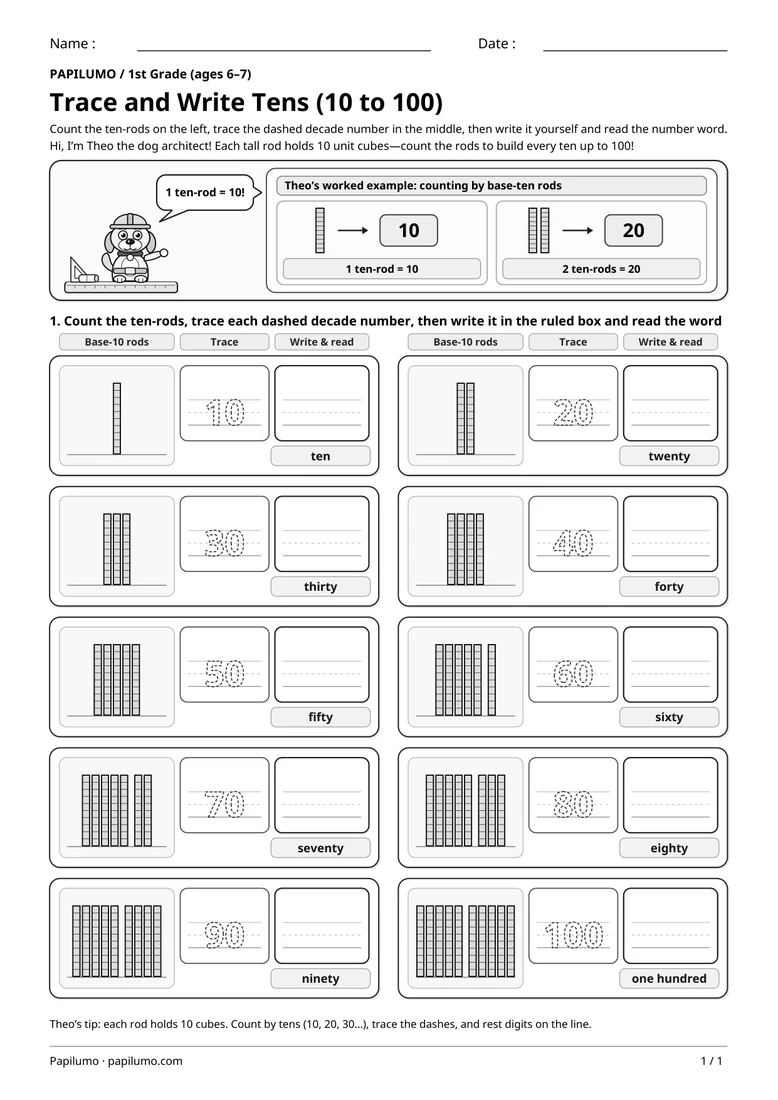
In the worked example panel beside Theo the dog architect, two clear mini-diagrams demonstrate the base-ten pattern right away. On the left, a single segmented ten-rod points via a crisp arrow to the boxed number 10 above the label 1 ten-rod = 10. On the right, two aligned ten-rods point cleanly to 20 above the label 2 ten-rods = 20. Learners immediately recognize that the leading digit matches the exact count of ten-rods while the trailing zero signals whole tens with no leftover ones.
Supporting the activity
The main body arranges ten clean stepped cards in two columns of five rows, moving smoothly from 10 and 20 at the top down to 90 and 100 at the bottom. On each card, pupils first count the segmented base-ten rods on the left—grouped cleanly in five plus extras from 60 upward—then trace the large dashed outline numeral between the handwriting guide lines in the center. Finally, they write the decade numeral independently inside the empty ruled box on the right and read the printed word beneath it, from ten through one hundred. To vary the practice, try Two-Digit Number Riddles to 99 with Pico the Detective Fox (1st Grade): Read the clues on each riddle card, circle the single matching number from the three choices, and write it in the answer box.
What to notice and how to check
When reviewing completed work against the separate answer key PDF, first check that every dashed numeral in the center boxes was traced completely with neat, closed zeros—paying extra attention to the double zero in 100. Next, inspect the handwritten decades in the right-hand boxes to verify correct digit order, upright sizing between the top line and baseline, and steady alignment for 40, 60, 80, and 90. Finish by having your child point to each group of rods and read all ten number words aloud.
Making the task easier
For 60 through 100, spot the first bundle of five rods as 50, then count on by tens from there.
Keep the learning aim, but reduce how much the child has to handle at once. Cover part of the page with another sheet and reveal one task at a time. Demonstrate a separate example, then leave a real opportunity to work something out. An answer reached with support is still a useful attempt; it does not yet show that the same task can be completed independently.
Taking the idea beyond the worksheet
Cover the numbers and count backward by tens from one hundred down to ten as if removing one rod at a time.
Use the follow-up to meet the same idea in a different setting. Offer it once the first task makes sense, without insisting that the whole page must be perfect. The child might explain a strategy, make an example or set a challenge for an adult. Return to the worksheet only when it helps connect the two situations. A short conversation or a practical activity can be enough to finish the session. To continue exploring, use Turning Base-Ten Rods and Squares Into Two-Digit Numbers: Count the tens rods and single squares. Complete each table.
Downloading and printing the PDF
This free PDF contains one worksheet designed for A4 paper. Download the file using the button on this page and open it in your PDF reader. Choose actual size or a 100% scale, check the orientation in the print preview and turn off any browser headers or footers. The illustrations use vector lines, so their outlines stay sharp when printed. Check the margins on one copy before preparing several sheets for a group. The level shown on the page is a guide, rather than a requirement to complete the activity at a particular age.