


What this worksheet helps children practise
Compare the letters in their exact order. An adult may read any unfamiliar word so the activity remains a word-matching task.
Let the child choose an answer and then compare it with the model letter by letter. Equal length does not guarantee an exact match. Ask the child to read the chosen word rather than only point to it, and separate any difficulty decoding the word from a simple visual comparison mistake.
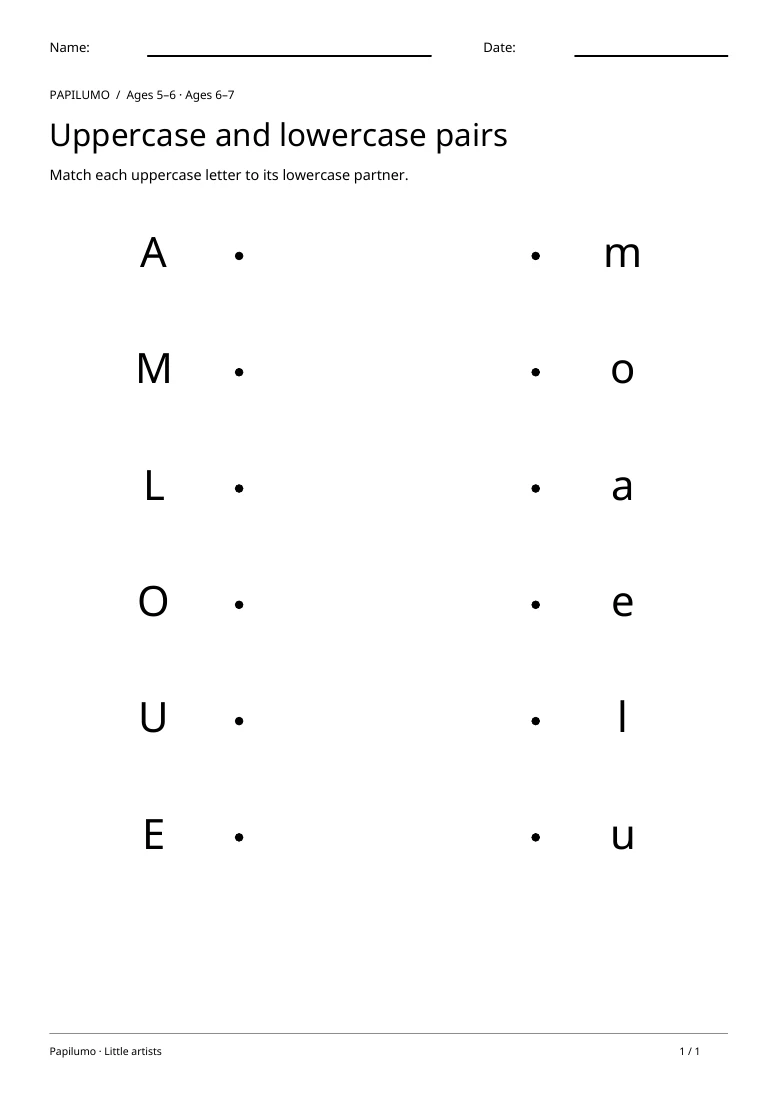
This activity asks the child to attend to a written unit and use it as the instruction requires. A short word, a matching model and a sentence do not involve exactly the same work. Some tasks focus on letter order, others on combining familiar sounds or understanding a piece of information. Identify the actual purpose before beginning. An adult can help a child access the text without supplying the answer. Successful visual matching does not necessarily mean that the word was read independently. Keeping that distinction in mind helps you choose a useful next activity rather than assuming that every reading skill has been mastered. For a related skill, use Uppercase and Lowercase Letter Matching Worksheet: Match each uppercase letter to its lowercase partner.
Preparing a short session
Put the page on a stable surface with a sharpened pencil and enough room for the child to move their hand. Look at the whole sheet together before asking for an answer. Point out the places for looking, drawing or writing. Read the instruction once, then invite the child to explain what they will do in their own words. This can reveal a misunderstanding before the first attempt. Choose a moment when there is time to think calmly, without making the worksheet into a race against the clock.
A concrete example to get started
For a separate practice attempt, write cat as a model and cat, cap and act as choices. Compare all the letters in order. The same letters in a different order are not the same written word. An adult may read the model before the child compares it.
Supporting the activity
Read the instruction first and identify the model or sentence that provides the information. Let the child move through the writing in reading order and point to the part they are comparing. When sounding out, use correspondences they have already met instead of introducing several unfamiliar rules during the task. For a sentence, check that important words are understood before asking the question. You can read an unfamiliar word and then hand the decision back to the child. Avoid signalling the correct option through a glance or pointing gesture. The purpose is to see how written information is being used, rather than whether the child can guess your expectation. To vary the practice, try CVC Words Starting with M: Read and Match: Read the model word and circle the identical word.
What to notice and how to check
A useful check returns to the text. Ask the child to show the letters that match the model or the words that support an answer. A choice based only on the first letter needs a comparison all the way to the end. An answer that seems likely in everyday life is not always the information given by the sentence. Listen to the explanation before opening the answer sheet. If decoding takes all the child’s attention, revisit the meaning orally and leave a shorter reading task for another session. Avoid drawing a general conclusion about reading ability from a single completed worksheet.
Making the task easier
Offer two choices instead of three.
Keep the learning aim, but reduce how much the child has to handle at once. Cover part of the page with another sheet and reveal one task at a time. Demonstrate a separate example, then leave a real opportunity to work something out. An answer reached with support is still a useful attempt; it does not yet show that the same task can be completed independently.
Taking the idea beyond the worksheet
Copy a word and underline one changed letter.
Use the follow-up to meet the same idea in a different setting. Offer it once the first task makes sense, without insisting that the whole page must be perfect. The child might explain a strategy, make an example or set a challenge for an adult. Return to the worksheet only when it helps connect the two situations. A short conversation or a practical activity can be enough to finish the session. To continue exploring, use CVC Words Starting with L: Read and Match: Read each model word and find its exact match.
Downloading and printing the PDF
This free PDF contains one worksheet designed for A4 paper. Download the file using the button on this page and open it in your PDF reader. Choose actual size or a 100% scale, check the orientation in the print preview and turn off any browser headers or footers. The illustrations use vector lines, so their outlines stay sharp when printed. Check the margins on one copy before preparing several sheets for a group. The level shown on the page is a guide, rather than a requirement to complete the activity at a particular age.