
What this worksheet helps children practise
Separate scissor practice from picture matching. If cutting is difficult, prepare the four pieces and let the child make the matching decisions independently.
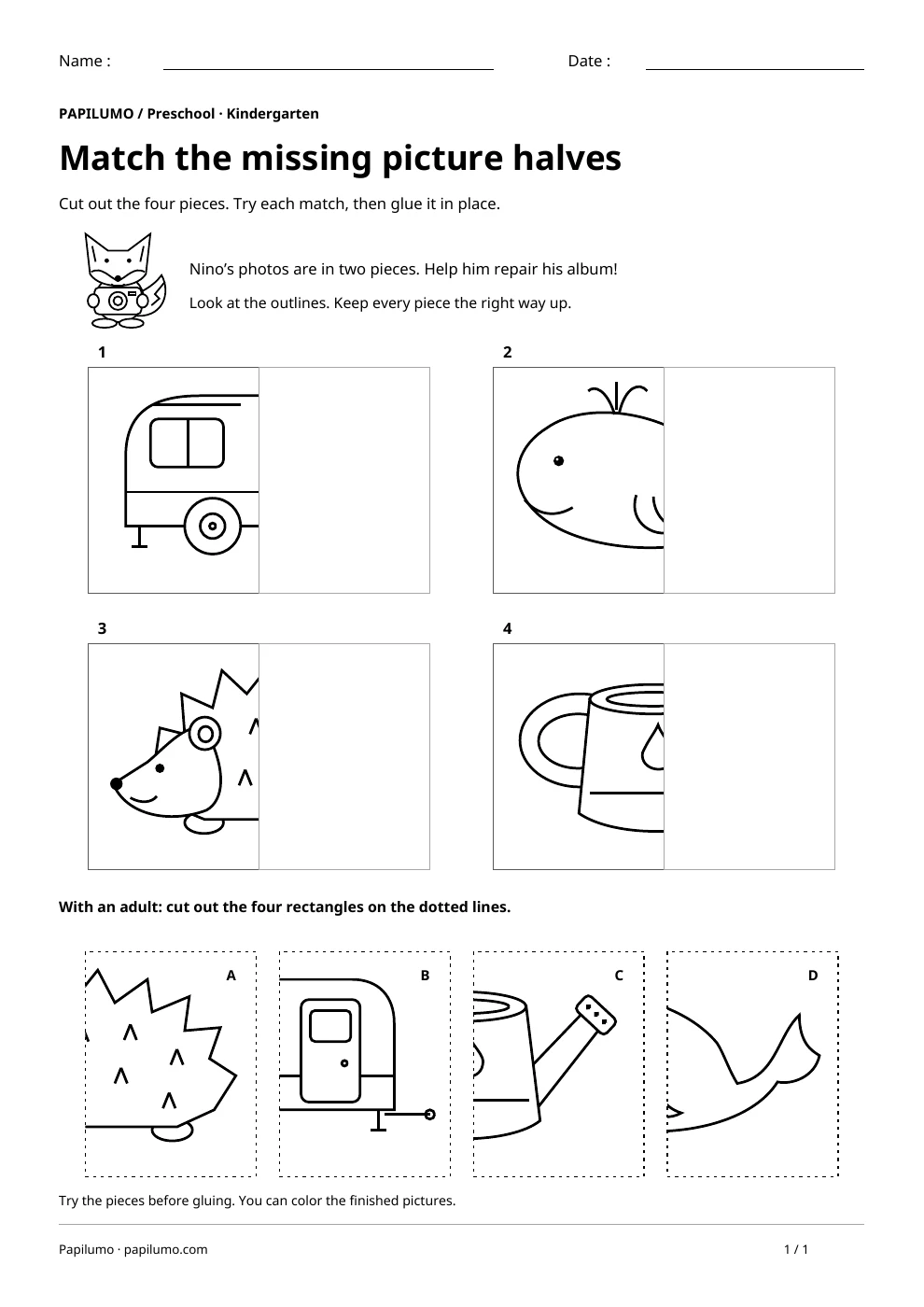
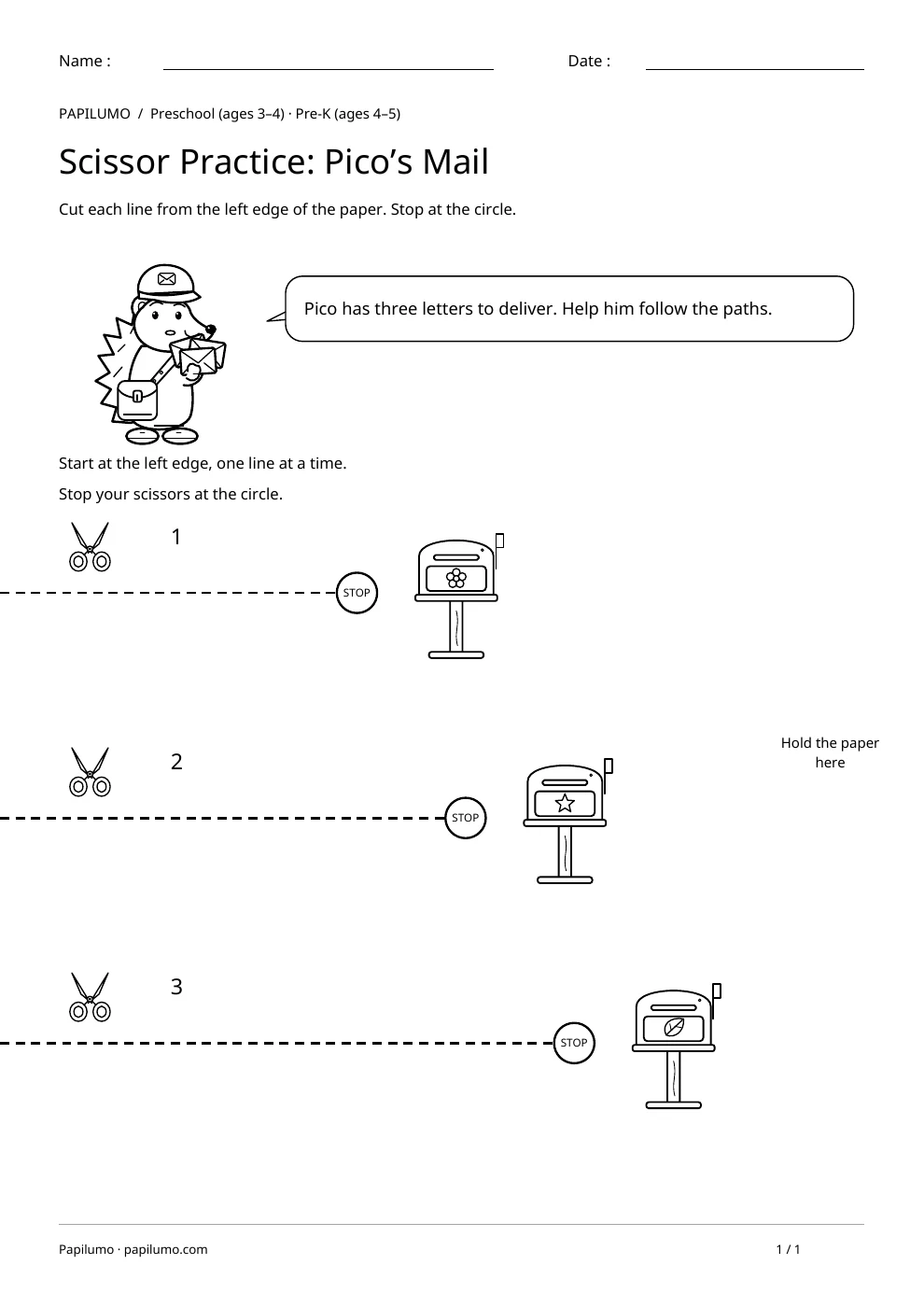
The activity practices visual matching, attention to details and careful placement. Each drawing is a simple two-piece picture puzzle. Children look for the missing part of an object rather than a mirror image. The camper trailer has different details on its two sides, so reflecting the visible half would not complete it. The small letter labels support checking by an adult; reading them is not needed to solve the puzzle. For a related skill, use Scissor Practice: Pico’s Mail: Cut each line from the left edge of the paper. Stop at the circle.
Preparing a short session
Set out child-appropriate scissors, a glue stick and coloring pencils. Print at actual size so that each cutout fits its space. An adult can first separate the strip at the bottom and help cut the four rectangles apart. Keep the upper part of the worksheet intact. Name the objects and animals together, then place the loose pieces beside the page with the drawings facing up.
A concrete example to get started
Begin with the camper trailer in the upper-left frame. Look at where the roof and body stop along the middle edge. Find a piece that continues those lines and place it in the empty right half. If a whale’s tail appears instead, lift the piece and try another. Waiting to use glue makes it easy to change a choice and compare the outlines.
Supporting the activity
Repair one photo at a time. Keep the pieces upright in their printed orientation; none needs to be turned over or rotated. Slide the matching rectangle against the printed half until the picture joins. Check all four pictures together before gluing. Children can then color their repaired album. They only cut straight rectangular borders, with no need to follow the animals’ detailed outlines. To vary the practice, try Cut and Paste Shapes: Circle, Square and Triangle: Cut out the six cards and stick them in the right family.
What to notice and how to check
The correct matches are picture 1 with B, picture 2 with D, picture 3 with A and picture 4 with C. Use those labels as an adult reference while the child checks the actual pictures. Look for continuous roof, back, spines and watering-can lines. A correct piece placed a little too high needs a positioning adjustment, not a different match.
Making the task easier
Offer only the camper trailer and whale with their two pieces. Add the hedgehog and watering can after the first matches are secure.
Keep the learning aim, but reduce how much the child has to handle at once. Cover part of the page with another sheet and reveal one task at a time. Demonstrate a separate example, then leave a real opportunity to work something out. An answer reached with support is still a useful attempt; it does not yet show that the same task can be completed independently.
Taking the idea beyond the worksheet
Ask which detail helped identify each piece before putting it down. Mix the four pieces and rebuild the pictures, or make up a title for Nino’s album.
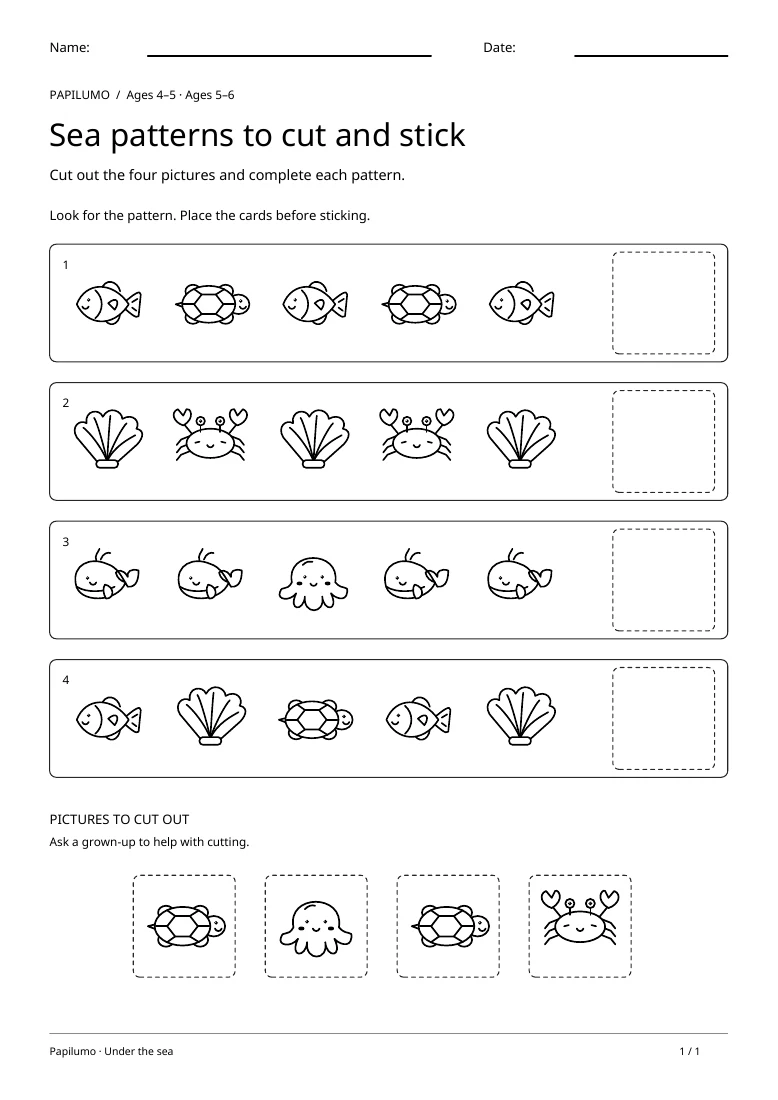
Use the follow-up to meet the same idea in a different setting. Offer it once the first task makes sense, without insisting that the whole page must be perfect. The child might explain a strategy, make an example or set a challenge for an adult. Return to the worksheet only when it helps connect the two situations. A short conversation or a practical activity can be enough to finish the session. To continue exploring, use Cut and Paste Patterns Worksheet: Sea Animals: Cut out the four pictures and complete each pattern.
Downloading and printing the PDF
This free PDF contains one worksheet designed for A4 paper. Download the file using the button on this page and open it in your PDF reader. Choose actual size or a 100% scale, check the orientation in the print preview and turn off any browser headers or footers. The illustrations use vector lines, so their outlines stay sharp when printed. Check the margins on one copy before preparing several sheets for a group. The level shown on the page is a guide, rather than a requirement to complete the activity at a particular age.