

What this worksheet helps children practise
Say the matching rule between the first two pictures out loud before picking your answer!
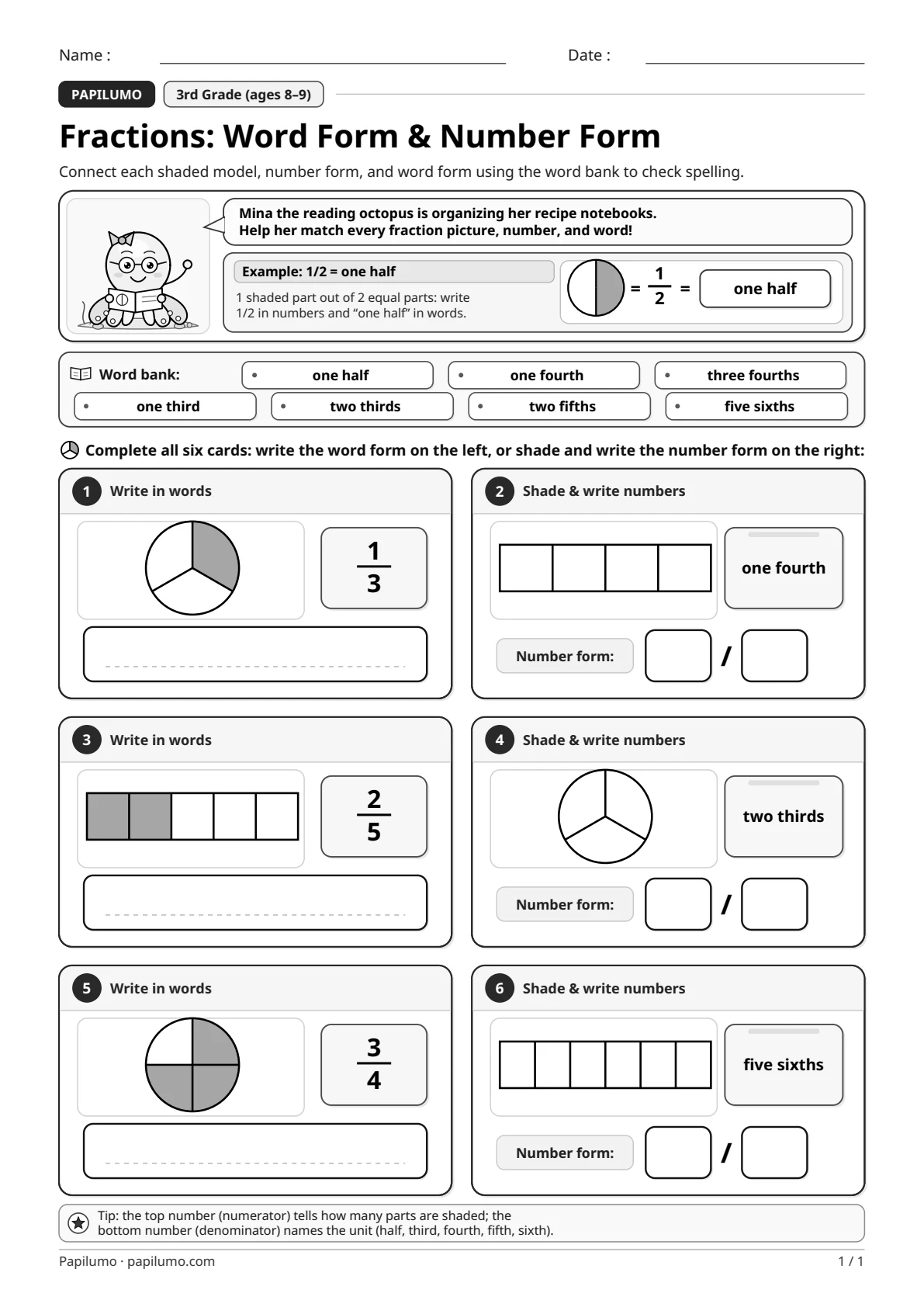
Completing visual analogies builds verbal reasoning, everyday category vocabulary, and careful reading comprehension at the 1st Grade level. To choose the right answer out of three detailed pictures, children must first discover the exact relationship linking the opening pair—such as clothing to body part, sky cue to time of day, animal to home, utensil to food, or cleaning tool to target surface. Reading each tiny printed word label beneath the crisp illustrations connects real-world logic directly to early literacy and spoken explanation. For a related skill, use Fractions in Word Form and Number Form with Mina the Octopus: Connect each shaded model, number form, and word form using the word bank to check spelling.
Preparing a short session
Print the student worksheet at actual size (100%) on plain white letter or A4 paper without shrinking the margins, and set out a sharpened pencil and a clean soft eraser so your child can neatly circle one framed picture per row. Before tackling row 1, spend a moment looking closely at Zelie the logic ferret in the top banner, read her speech bubble aloud together, and trace the worked raincloud-to-sunglasses example carefully with one finger. Keep the separate one-page answer key PDF out of sight during independent work.
A concrete example to get started
Inside the worked example box right beside Zelie the logic ferret, four mini picture frames clearly display the complete pattern: raincloud points to umbrella, followed by the double-colon link showing sun pointing to sunglasses. A bold hand-style loop circles the sunglasses frame to demonstrate the exact pencil mark expected across all five rows below. Walking through this visual model teaches young readers to state the hidden rule in plain words before scanning the three picture options.
Supporting the activity
Rows 1 through 5 explore five concrete everyday themes with correct answers evenly varied across positions A, B, and C: in row 1, glove goes with hand just as sock goes with foot (choice B, alongside hat and ball); in row 2, sun goes with day just as moon goes with night sky (choice A); in row 3, bird goes with nest just as fish goes with water bowl (choice C); in row 4, spoon goes with soup just as fork goes with pasta plate (choice B); and in row 5, broom goes with floor just as toothbrush goes with teeth (choice C). To vary the practice, try Read Short Sentences and Match to Pictures with Milo: Read each sentence on the left carefully, then draw a line to the matching picture on the right.
What to notice and how to check
When reviewing finished work against the separate one-page answer key PDF, invite your student to read each row aloud as a full sentence—such as "a broom cleans the floor, just like a toothbrush cleans teeth"—while pointing directly to the circled picture frame. Confirm all five exact answers together: foot (B) on row 1, night sky (A) on row 2, water bowl (C) on row 3, pasta plate (B) on row 4, and teeth (C) on row 5. If any row was tricky, discuss why the two distractors do not fit the rule.
Making the task easier
Read each tiny label aloud and test each of the three choices in a short sentence to hear which one fits best.
Keep the learning aim, but reduce how much the child has to handle at once. Cover part of the page with another sheet and reveal one task at a time. Demonstrate a separate example, then leave a real opportunity to work something out. An answer reached with support is still a useful attempt; it does not yet show that the same task can be completed independently.
Taking the idea beyond the worksheet
Draw your own 4-picture analogy on the back of the sheet, such as key and door just like pencil and notebook.
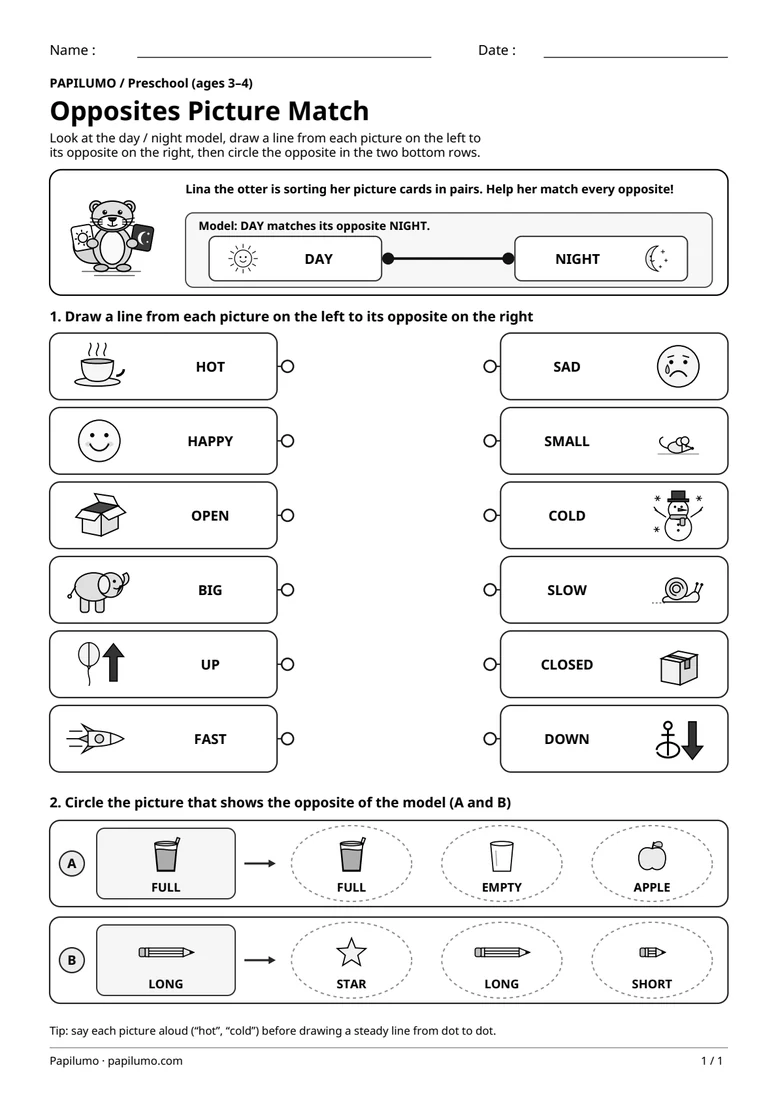
Use the follow-up to meet the same idea in a different setting. Offer it once the first task makes sense, without insisting that the whole page must be perfect. The child might explain a strategy, make an example or set a challenge for an adult. Return to the worksheet only when it helps connect the two situations. A short conversation or a practical activity can be enough to finish the session. To continue exploring, use Opposites Picture Matching with Lina the Otter: Look at the day / night model, draw a line from each picture on the left to its opposite on the right, then circle the opposite in the two bottom rows.
Downloading and printing the PDF
This free PDF contains one worksheet designed for A4 paper. Download the file using the button on this page and open it in your PDF reader. Choose actual size or a 100% scale, check the orientation in the print preview and turn off any browser headers or footers. The illustrations use vector lines, so their outlines stay sharp when printed. Check the margins on one copy before preparing several sheets for a group. The level shown on the page is a guide, rather than a requirement to complete the activity at a particular age.