

What this worksheet helps children practise
Have children read the story, point to the two picture groups, and count on from the first number to find the total.
Solving addition word problems in 1st grade requires connecting three representations at once: the written story, the visual model, and the symbolic equation with + and = signs. When young learners see only text, they may grab numbers without picturing the situation; when they only count pictures without reading a story or writing the addends, they miss the structure of an addition sentence. By placing a short narrative beside two clearly separated subgroups, this worksheet teaches children to model both 'add to' stories ('2 more butterflies fly in', '3 more ladybugs join them', '3 more stars light up') and 'put together' stories ('5 red apples and 3 green apples'). Writing both addends and the total cements the link between question words like 'in all' and the addition operation. For a related skill, use Picture Addition Within 5 with Lumi the Foraging Hedgehog: Count each group of pictures, write both numbers in the boxes, then find the total within 5.
Preparing a short session
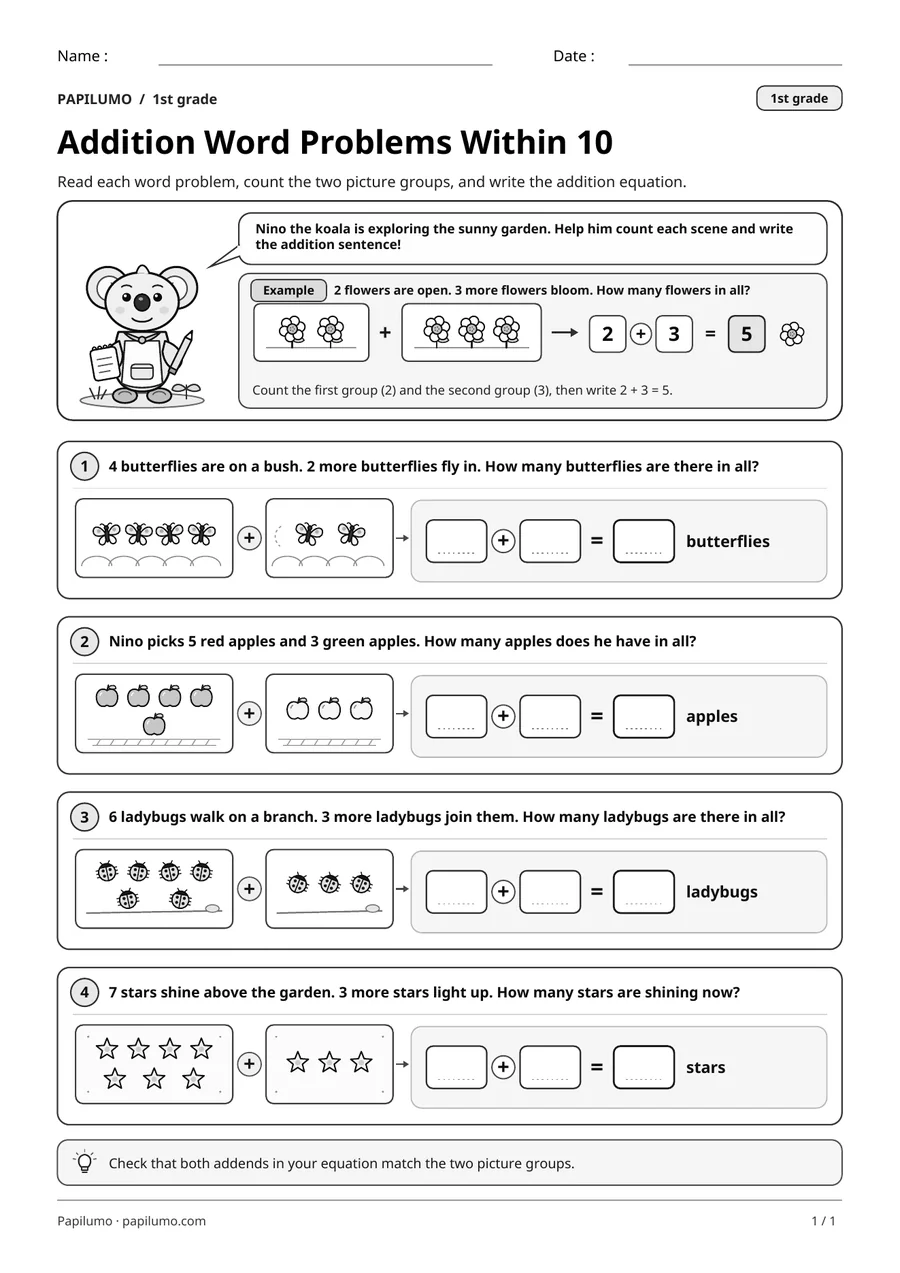
Print the student worksheet at 100% scale on standard paper and provide a pencil and eraser. Before starting Problem 1, introduce Nino the koala and review the worked example at the top together. Ask the child to point to the group of 2 flowers on the left and the group of 3 flowers on the right, noticing how those two counts become the addends 2 and 3 in 2 + 3 = 5. Encourage a steady three-step habit for every card: read the short story aloud (offering support with any unfamiliar words), point to each drawn group to confirm it matches the number in the text, and fill in the three boxes to complete the addition equation.
A concrete example to get started
In the top example box, the story says 2 flowers are open and 3 more bloom. The illustration shows 2 flowers on the left, a plus sign, and 3 flowers on the right, leading to the completed equation 2 + 3 = 5. In Problem 1, the prompt reads: '4 butterflies are on a bush. 2 more butterflies fly in. How many butterflies are there in all?' The student counts the 4 butterflies in the first group and writes 4 in the first box, counts the 2 arriving butterflies and writes 2 in the second box, and then adds them to write 6 in the final box before 'butterflies' (4 + 2 = 6).
Supporting the activity
Children complete four graded word problems from top to bottom, filling in 12 number boxes in total. Problem 1 (4 butterflies + 2 butterflies = 6 butterflies) begins with small numbers that are easy to subitize or count on. Problem 2 (5 apples + 3 apples = 8 apples) uses the five-benchmark so learners can start at 5 and count on three more. Problem 3 (6 ladybugs + 3 ladybugs = 9 ladybugs) practices adding 3 to a number greater than five. Finally, Problem 4 (7 stars + 3 stars = 10 stars) finishes with a key make-ten combination, helping 1st graders recognize that 7 and 3 make a full ten. To vary the practice, try Picture Addition and Subtraction: Write Number Sentences: Count and write three numbers. Crossed-out objects are included in the starting amount.
What to notice and how to check
After all four equations are written, review each card together before checking the separate answer key PDF. First, verify that the two addends written in the first two boxes match the two groups in the story and drawing in order (such as 5 + 3 rather than 5 + 8). Second, check each sum by practicing 'counting on' from the larger addend: for 6 + 3, start at 6 and count three steps ('seven, eight, nine') instead of recounting all six ladybugs from one. If a child writes only the final total in the first box, point back to the 2 + 3 = 5 model so they see how the two parts combine to form the whole after the equals sign.
Making the task easier
Touch and lightly check off each picture while counting aloud to verify the sum after writing the two starting numbers.
Keep the learning aim, but reduce how much the child has to handle at once. Cover part of the page with another sheet and reveal one task at a time. Demonstrate a separate example, then leave a real opportunity to work something out. An answer reached with support is still a useful attempt; it does not yet show that the same task can be completed independently.
Taking the idea beyond the worksheet
Make up a new spoken word problem with Nino for the equation 6 + 4 = 10 and name the objects being counted.
Use the follow-up to meet the same idea in a different setting. Offer it once the first task makes sense, without insisting that the whole page must be perfect. The child might explain a strategy, make an example or set a challenge for an adult. Return to the worksheet only when it helps connect the two situations. A short conversation or a practical activity can be enough to finish the session. To continue exploring, use Mixed Addition & Subtraction Word Problems to 20 with Nino: Read each story carefully, circle + or −, fill in the equation boxes, and write the final answer with its unit.
Downloading and printing the PDF
This free PDF contains one worksheet designed for A4 paper. Download the file using the button on this page and open it in your PDF reader. Choose actual size or a 100% scale, check the orientation in the print preview and turn off any browser headers or footers. The illustrations use vector lines, so their outlines stay sharp when printed. Check the margins on one copy before preparing several sheets for a group. The level shown on the page is a guide, rather than a requirement to complete the activity at a particular age.