


What this worksheet helps children practise
Picture the story like a short movie: if the group grows, circle +; if part of it goes away, circle −!
Deciding independently whether a story calls for addition or subtraction is one of the cornerstone reasoning skills of 2nd grade mathematics. Instead of blindly applying the same operation to every question on a page, students must picture the real action in the text: is a group growing larger as more items join in, or shrinking smaller as some items leave? Alternating both operations up to 20 deepens number sense, careful reading comprehension, bridging across ten, and translating everyday English sentences into clean number equations. For a related skill, use Two-Step Addition & Subtraction Word Problems with Nino: Read each post office story, solve Step 1 first, carry that result into Step 2, and complete the final unit sentence.
Preparing a short session
Print the student worksheet at actual size (100%) on plain white A4 or letter paper without shrinking margins, and provide a sharpened pencil with an eraser. Keep the separate one-page PDF answer key out of sight while your child works. Before tackling problem 1, read the top banner beside Nino the reading panda aloud together and invite your child to act out with both hands what happens when birds fly onto a branch versus when items are used up or leave.
A concrete example to get started
In the top example panel, Nino the reading panda models every step cleanly on a bird story: nine birds sit on a branch and five more arrive. Because extra birds join the group, the (+) choice pill is circled first, then the four-box equation is completed as 9 + 5 = 14, and the answer line shows 14 birds. Having all three steps visible side by side gives learners a crystal-clear blueprint before they move on to the four independent problems below.
Supporting the activity
The main sheet presents four illustrated story-problem cards alternating addition and subtraction up to 20. On Card 1, Lina starts with 12 stickers and gets 7 more: students circle (+), write 12 + 7 = 19, and record 19 stickers. On Card 2, 6 out of 18 apples are baked into a pie: students circle (−) and compute 18 − 6 = 12 apples. On Card 3, 8 new books join 9 books on a shelf: students circle (+) for 9 + 8 = 17 books. On Card 4, 9 of 16 balloons pop: students circle (−) and solve 16 − 9 = 7 balloons. To vary the practice, try Picture Subtraction Word Problems Within 10 with Coco: Read each word problem, cross out the items taken away, then write the subtraction equation and short answer.
What to notice and how to check
When reviewing with the separate PDF answer key, check all three parts on every card: the circled operation pill, the order of numbers inside the equation boxes, and the final unit answer. On subtraction cards, make sure the starting total always comes first before the minus sign (18 − 6 = 12 and 16 − 9 = 7), never reversed. If 9 + 8 or 16 − 9 feels tricky, encourage making ten as a quick mental bridge.
Making the task easier
Underline the two numbers in the story and sketch a tiny up arrow (+) or down arrow (−) before filling the boxes.
Keep the learning aim, but reduce how much the child has to handle at once. Cover part of the page with another sheet and reveal one task at a time. Demonstrate a separate example, then leave a real opportunity to work something out. An answer reached with support is still a useful attempt; it does not yet show that the same task can be completed independently.
Taking the idea beyond the worksheet
Make up two short stories up to 20—one addition and one subtraction—and quiz someone at home on which sign fits.
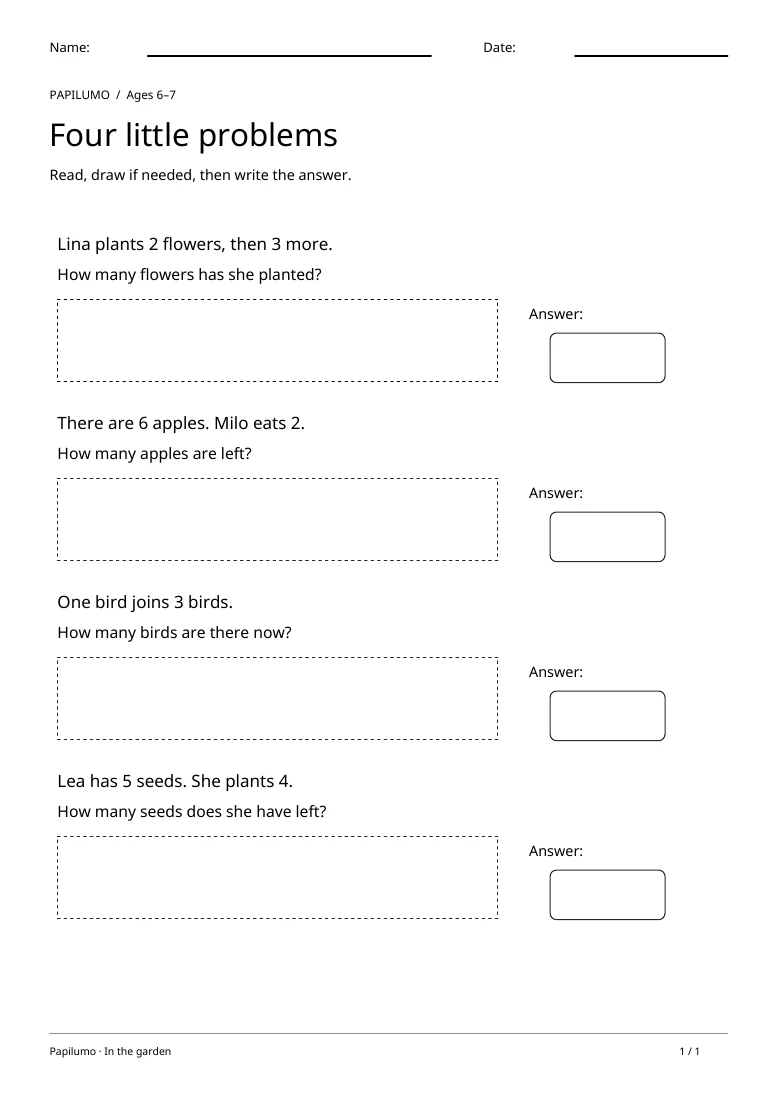
Use the follow-up to meet the same idea in a different setting. Offer it once the first task makes sense, without insisting that the whole page must be perfect. The child might explain a strategy, make an example or set a challenge for an adult. Return to the worksheet only when it helps connect the two situations. A short conversation or a practical activity can be enough to finish the session. To continue exploring, use First Grade Maths Word Problems: Add or Subtract: Read, draw if needed, then write the answer.
Downloading and printing the PDF
This free PDF contains one worksheet designed for A4 paper. Download the file using the button on this page and open it in your PDF reader. Choose actual size or a 100% scale, check the orientation in the print preview and turn off any browser headers or footers. The illustrations use vector lines, so their outlines stay sharp when printed. Check the margins on one copy before preparing several sheets for a group. The level shown on the page is a guide, rather than a requirement to complete the activity at a particular age.