

What this worksheet helps children practise
Mark your starting corner with a dot and tick every 1 cm outer edge once as you travel clockwise around each shape!
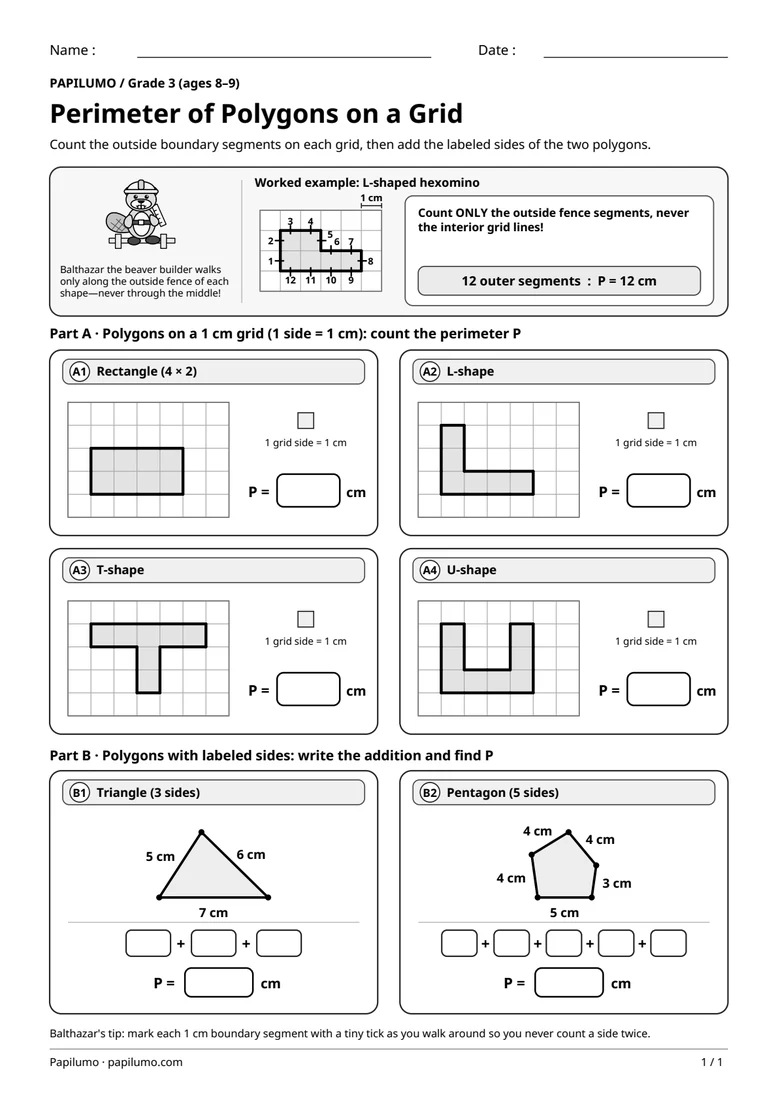
Finding perimeter means measuring the complete outer boundary around a closed figure, just like laying wooden fencing around a garden plot. Third graders often confuse perimeter with counting inside squares or accidentally include interior grid edges. By contrasting an eight-square 4 × 2 rectangle (P = 12 cm) against a six-square L-shape (P = 14 cm), a seven-square T-shape (P = 16 cm), and an eight-square U-shape (P = 18 cm), pupils discover through clear visual structure that shapes with similar areas can have very different perimeters. For a related skill, use Perimeter of Rectangles and Squares (Formula) with Gaspard: Use P = 2 × (l + w) for rectangles and P = 4 × s for squares with the labeled side lengths in cm (and find the missing width on F).
Preparing a short session
Print the student worksheet at 100% scale on crisp white A4 paper so every 1 cm grid line prints clearly, and provide a sharpened pencil and eraser. Keep the separate answer key PDF aside during independent work. Before starting Part A, trace a finger around the thick outer fence of the top L-shaped hexomino together, reading the twelve tick marks aloud and highlighting the core reminder to count only outer boundary segments.
A concrete example to get started
In the top banner beside Balthazar the beaver, the worked example features an L-shaped hexomino made of six unit squares on a 1 cm grid. Twelve crisp tick marks numbered 1 to 12 sit along the thick dark perimeter while internal grid segments stay thin and light. Students see at once why the total is P = 12 cm rather than 6 or 14: each tick represents one 1 cm step along the outer wall, skipping every shared inside edge.
Supporting the activity
In Part A, students walk carefully around four grid figures, ticking off each 1 cm outer segment in pencil: the 4 × 2 rectangle gives P = 12 cm, the L-shape gives P = 14 cm, the T-shape gives P = 16 cm, and the U-shape gives P = 18 cm. In Part B, they switch to side lengths without a grid: for the triangle with sides 5 cm, 6 cm, and 7 cm, they fill in 5 + 6 + 7 and write P = 18 cm; for the pentagon with sides 4 cm, 4 cm, 5 cm, 3 cm, and 4 cm, they complete 4 + 4 + 5 + 3 + 4 and write P = 20 cm. To vary the practice, try Area of Rectangles and Squares (l × w) with Gaspard: Use the formula A = l × w with the labeled dimensions on each floorplan to find the area in cm² (and the missing width on F).
What to notice and how to check
When reviewing with the answer key PDF, verify all four grid perimeters in Part A (12 cm, 14 cm, 16 cm, and 18 cm) along with both full addition expressions and totals in Part B (18 cm and 20 cm). If a student misses by two on the L-shape, T-shape, or U-shape, walk through the inside corners together—every inward turn still exposes two outer segments that must be fenced. Also confirm all five pentagon sides were copied cleanly.
Making the task easier
Trace the thick black border with a colored pencil first, then count your ticks side by side along each straight edge.
Keep the learning aim, but reduce how much the child has to handle at once. Cover part of the page with another sheet and reveal one task at a time. Demonstrate a separate example, then leave a real opportunity to work something out. An answer reached with support is still a useful attempt; it does not yet show that the same task can be completed independently.
Taking the idea beyond the worksheet
Draw a new polygon on scrap grid paper whose perimeter equals exactly 16 cm and check how many squares fit inside it.
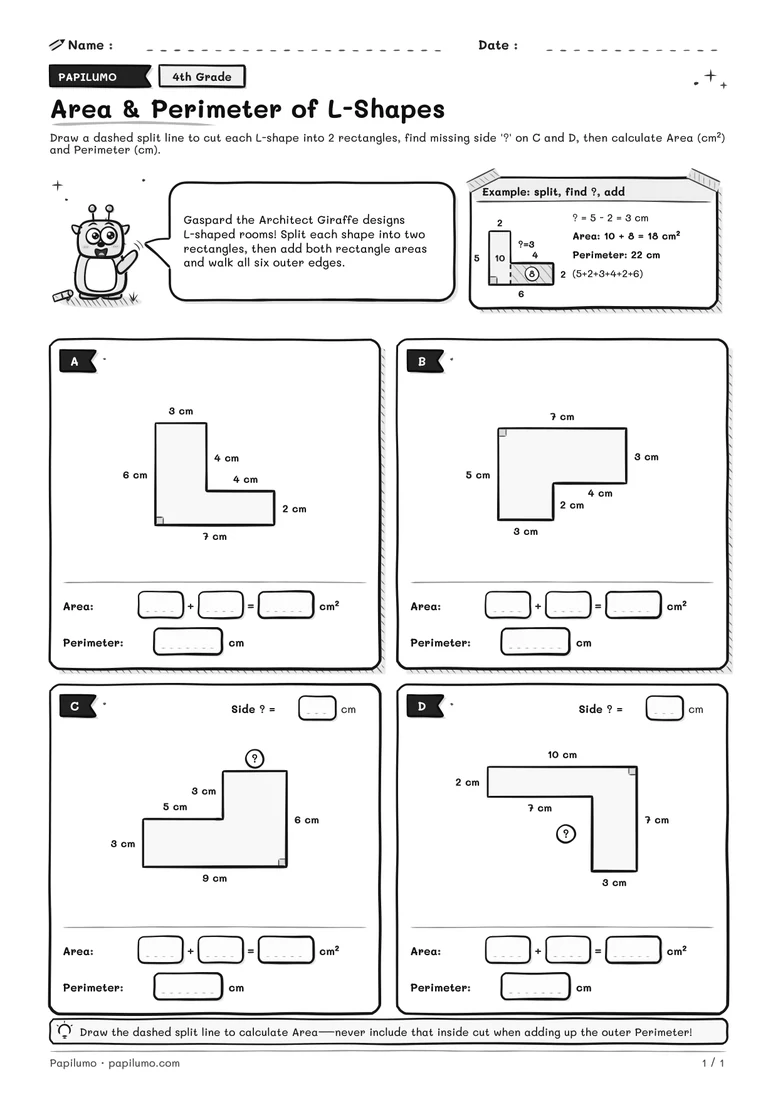
Use the follow-up to meet the same idea in a different setting. Offer it once the first task makes sense, without insisting that the whole page must be perfect. The child might explain a strategy, make an example or set a challenge for an adult. Return to the worksheet only when it helps connect the two situations. A short conversation or a practical activity can be enough to finish the session. To continue exploring, use Area and Perimeter of Composite L-Shapes with Gaspard (4th Grade): Draw a dashed split line to cut each L-shape into 2 rectangles, find missing side '?' on C and D, then calculate Area (cm²) and Perimeter (cm).
Downloading and printing the PDF
This free PDF contains one worksheet designed for A4 paper. Download the file using the button on this page and open it in your PDF reader. Choose actual size or a 100% scale, check the orientation in the print preview and turn off any browser headers or footers. The illustrations use vector lines, so their outlines stay sharp when printed. Check the margins on one copy before preparing several sheets for a group. The level shown on the page is a guide, rather than a requirement to complete the activity at a particular age.