

What this worksheet helps children practise
Multiply length times width to find the area in cm², and double-check every unit label!
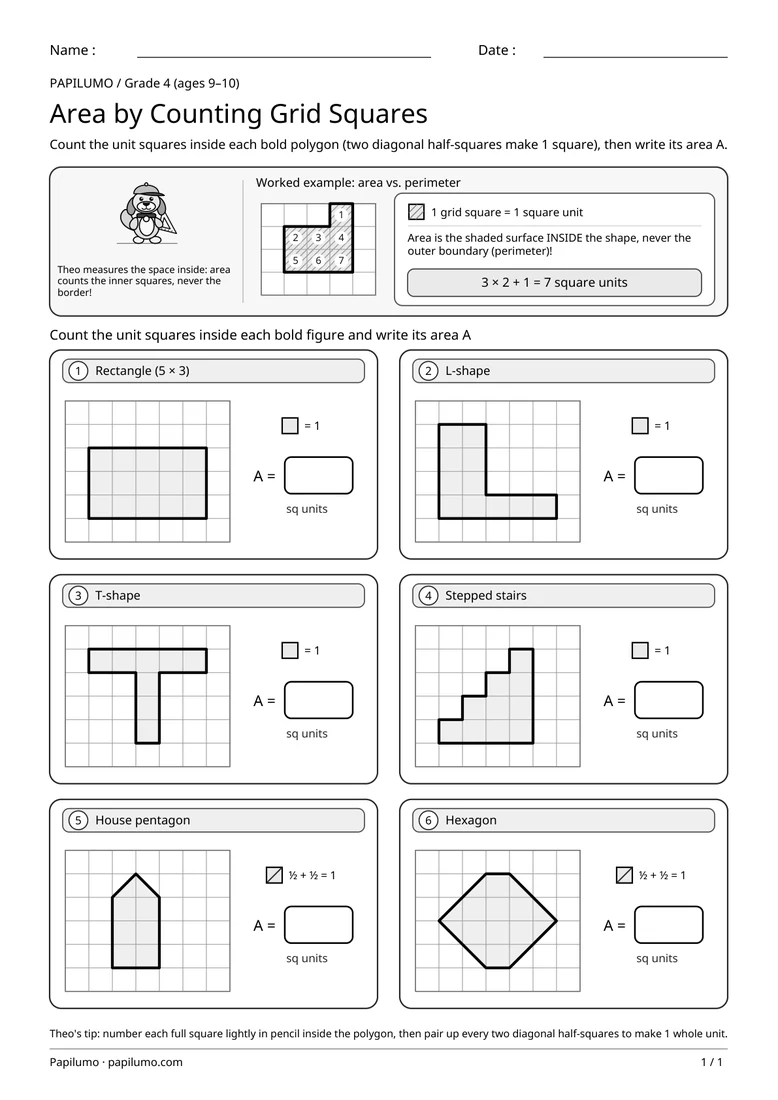
Finding the area of a rectangle with A = l × w means multiplying its length by its width when both sides share the same unit. In 4th Grade, this essential step connects spatial geometry to multiplication fluency and moves students beyond counting individual unit squares, which becomes impractical on real architectural plans. Including a square on card C highlights that equal sides multiply together, while the missing-side problem on card F builds algebraic reasoning by reversing the area formula from a known product. For a related skill, use Area by Counting Grid Squares with Theo the Surveyor Dog: Count the unit squares inside each bold polygon (two diagonal half-squares make 1 square), then write its area A.
Preparing a short session
Print the student worksheet at actual size (100%) on plain white letter or A4 paper without shrinking the margins, and provide a sharpened pencil, eraser, and scratch paper for checking two-digit products. Before solving the six cards, look closely at Gaspard’s top banner together, read the formula A = l × w aloud, and talk through why area uses square centimeters (cm²) rather than plain centimeters. Keep the separate one-page answer key PDF out of sight while your child completes all six cards independently.
A concrete example to get started
In the worked example box beside Gaspard the architect giraffe, a clean architectural rectangle displays only its outer measurements—6 cm across the top and 4 cm down the side—with no inner unit grid lines. A crisp arrow leads directly to the formula A = l × w and the completed calculation A = 6 × 4 = 24 cm². This clear visual model helps students immediately connect two perpendicular edge labels on a scale drawing to a single multiplication product.
Supporting the activity
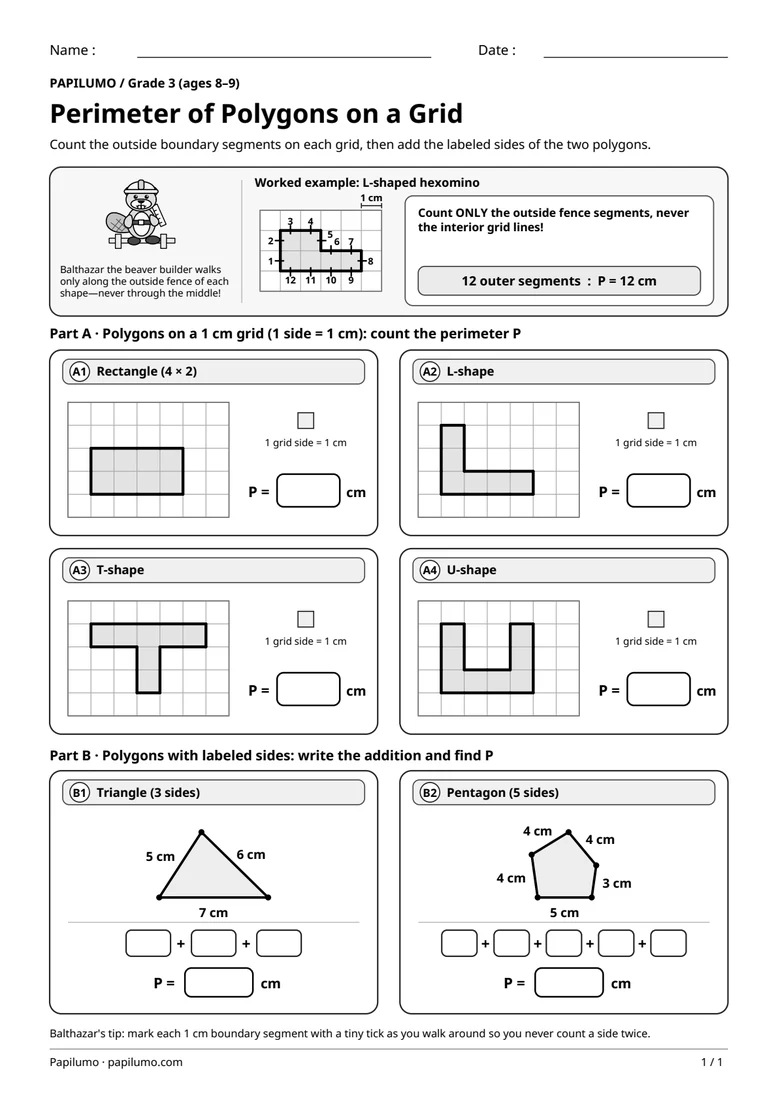
Floorplan cards A through F progress smoothly through practical dimensions: 8 cm × 5 cm = 40 cm² for room A, 9 cm × 3 cm = 27 cm² for hallway B, a 7 cm × 7 cm = 49 cm² square studio on C, a 12 cm × 4 cm = 48 cm² deck on D, and an 11 cm × 6 cm = 66 cm² library on E. On challenge card F, the total area of 45 cm² and length of 9 cm are given, so students solve 9 × 5 = 45 to uncover the missing width w = 5 cm. To vary the practice, try Perimeter of Polygons on a Grid with Balthazar the Beaver: Count the outside boundary segments on each grid, then add the labeled sides of the two polygons.
What to notice and how to check
When reviewing the finished sheet against the separate answer key PDF, check first that your student multiplied length by width instead of adding sides or computing perimeter. Confirm the two-digit mental products 12 × 4 = 48 on card D and 11 × 6 = 66 on card E, and verify that both equal 7 cm edges appear on square C. On challenge card F, check both the missing-factor equation 9 × 5 = 45 and the final side label w = 5 cm, written in plain cm because it measures length.
Making the task easier
Start with cards A, B, and C using your 5s, 3s, and 7s facts, and keep the 6 × 4 = 24 cm² model close by.
Keep the learning aim, but reduce how much the child has to handle at once. Cover part of the page with another sheet and reveal one task at a time. Demonstrate a separate example, then leave a real opportunity to work something out. An answer reached with support is still a useful attempt; it does not yet show that the same task can be completed independently.
Taking the idea beyond the worksheet
Design two different rectangles that each have an area of 36 cm², then check which one has the larger perimeter.
Use the follow-up to meet the same idea in a different setting. Offer it once the first task makes sense, without insisting that the whole page must be perfect. The child might explain a strategy, make an example or set a challenge for an adult. Return to the worksheet only when it helps connect the two situations. A short conversation or a practical activity can be enough to finish the session. To continue exploring, use Perimeter of Rectangles and Squares (Formula) with Gaspard: Use P = 2 × (l + w) for rectangles and P = 4 × s for squares with the labeled side lengths in cm (and find the missing width on F).
Downloading and printing the PDF
This free PDF contains one worksheet designed for A4 paper. Download the file using the button on this page and open it in your PDF reader. Choose actual size or a 100% scale, check the orientation in the print preview and turn off any browser headers or footers. The illustrations use vector lines, so their outlines stay sharp when printed. Check the margins on one copy before preparing several sheets for a group. The level shown on the page is a guide, rather than a requirement to complete the activity at a particular age.