What this worksheet helps children practise
Count full rows of 10 squares first (10, 20, 30…), then add the single squares—the top number over 100 is the exact same number as the percent!
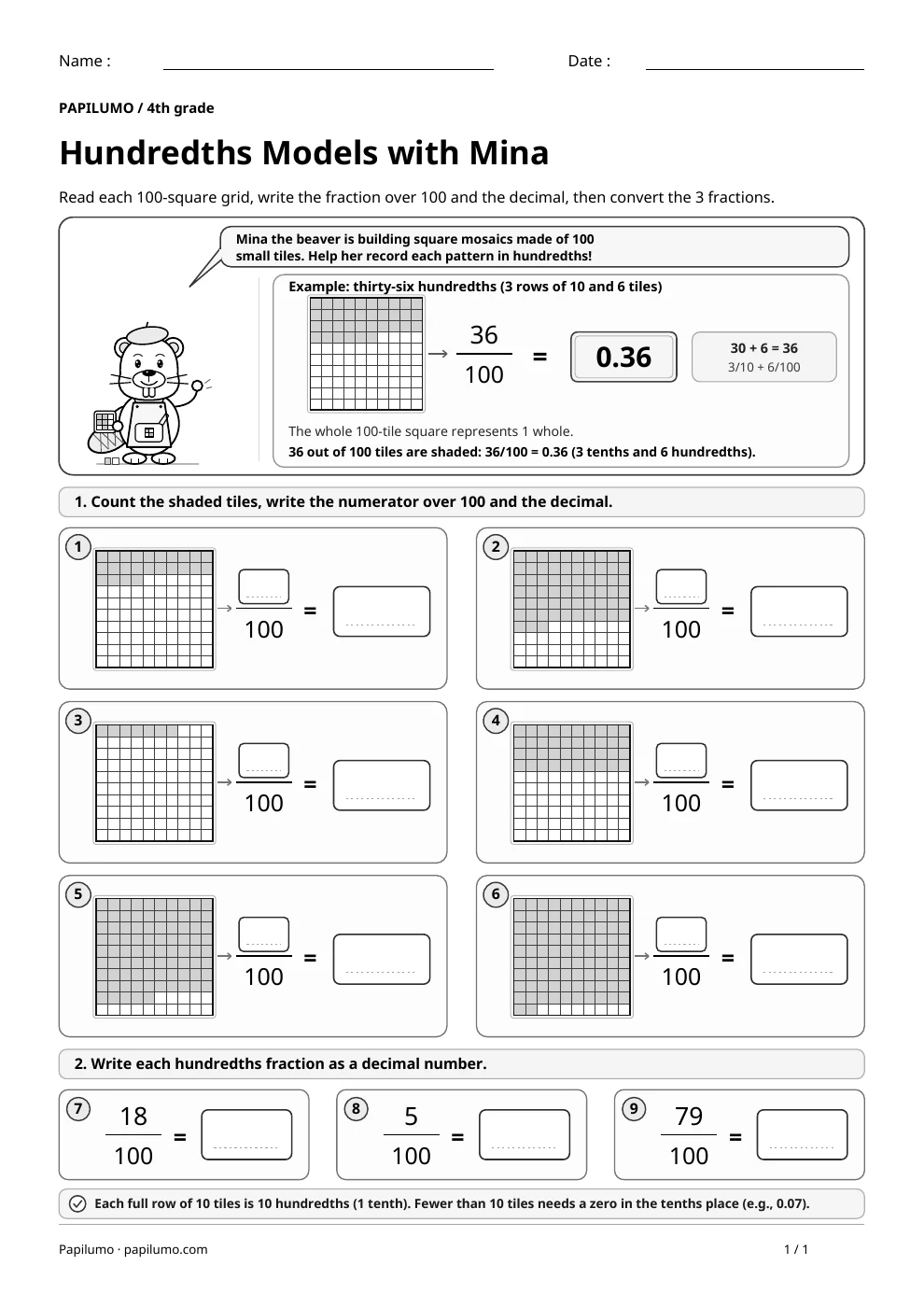
Exploring percentages on hundred grids grounds the meaning of "percent"—literally "out of one hundred equal parts"—in concrete area models. Fourth graders already comfortable with basic fractions discover that percentages such as 25%, 50%, 75%, 10%, 40%, and 80% are simply fractions with a fixed denominator of 100. Counting full rows by tens speeds up mental fluency while building essential benchmark intuition: half of the grid equals 50%, one quarter equals 25%, three quarters equals 75%, and one single row equals 10%. For a related skill, use Hundredths Models: 100-Grids, Fractions and Decimals: Read each 100-square grid, write the fraction over 100 and the decimal, then convert the 3 fractions.
Preparing a short session
Print the student worksheet at actual size (100%) on plain white letter or A4 paper without shrinking page margins, and prepare a sharp pencil, a clean eraser, and optionally a light grey or colored pencil for Part 2 shading. Keep the separate answer key PDF tucked out of sight while your child works. Before filling in the first box, inspect Mina the beaver’s example grid together to verify ten rows of ten equal one hundred squares in all, so every single small square stands for 1%.
A concrete example to get started
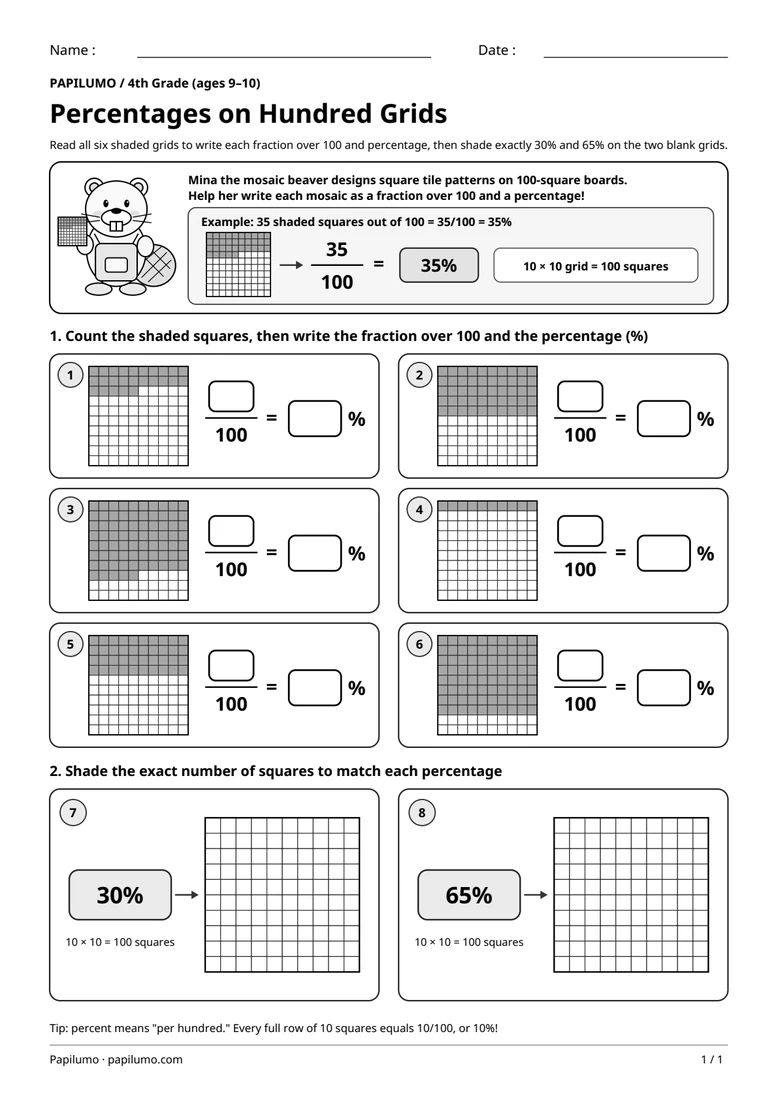
In the top example panel beside Mina the beaver, the 10×10 grid displays three full shaded rows of ten squares plus five extra squares, making thirty-five shaded squares out of one hundred. Right beside it sits the full match: 35/100 = 35%. Pointing out this solved guide teaches the exact shortcut used throughout Part 1: count full rows by tens first (10, 20, 30…), add any leftover single squares, and write that exact same total both above 100 and before the percent sign.
Supporting the activity
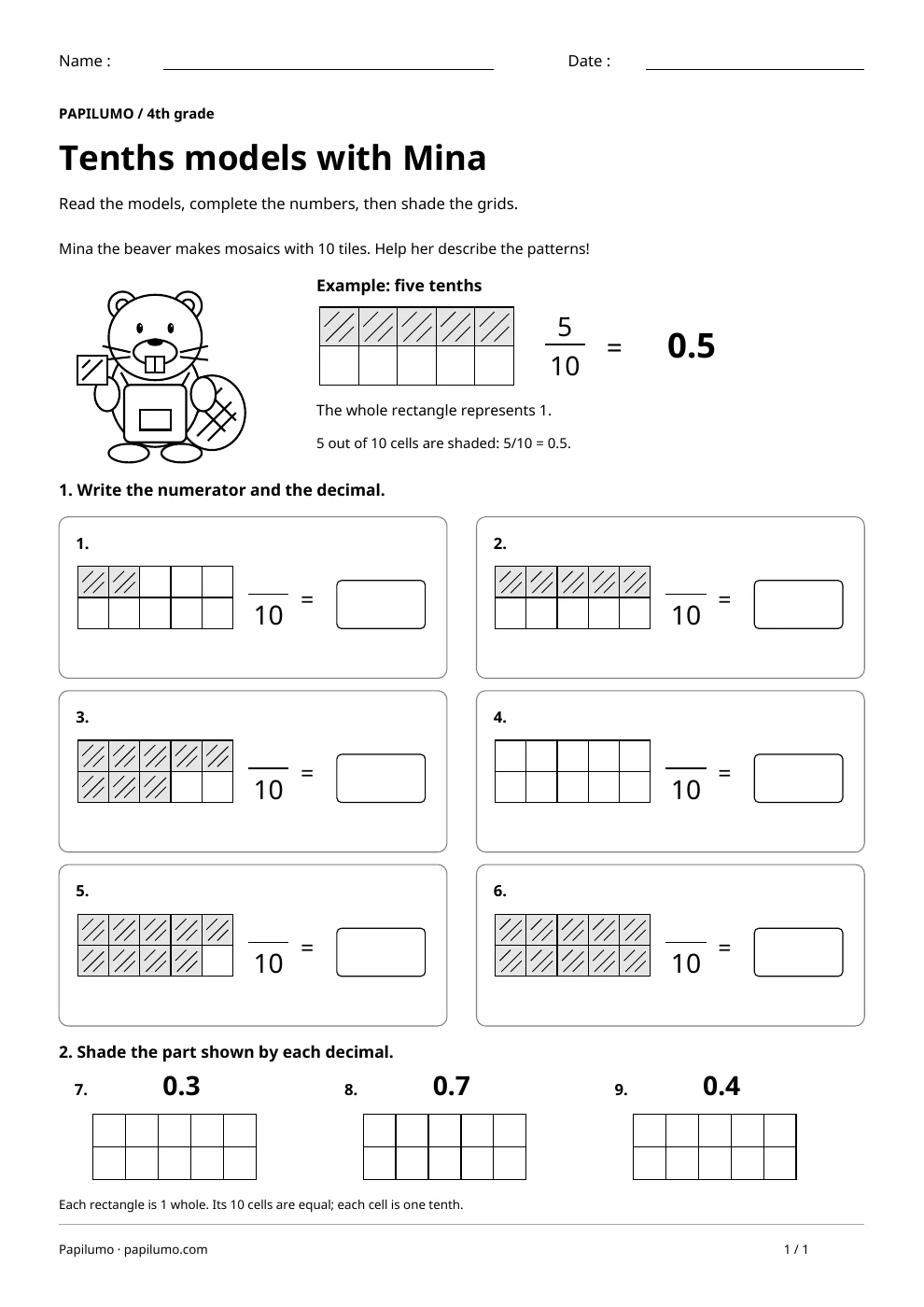
In Part 1, students read six shaded grids and fill twelve clear writing boxes: #1 with 25 squares (25/100 = 25%), #2 with 50 squares showing exactly half (50/100 = 50%), #3 with 75 squares showing three quarters (75/100 = 75%), #4 with one full row of 10 squares (10/100 = 10%), #5 with four full rows of 40 squares (40/100 = 40%), and #6 with eight full rows of 80 squares (80/100 = 80%). In Part 2, learners switch from reading to creating by neatly shading 30 squares (3 full rows) for 30% and 65 squares (6 full rows plus 5 squares) for 65%. To vary the practice, try Tenths models: fractions and decimals: Read the models, complete the numbers, then shade the grids.
What to notice and how to check
When checking work against the separate one-page PDF answer key, verify all six pairs in Part 1 first: 25/100 = 25%, 50/100 = 50%, 75/100 = 75%, 10/100 = 10%, 40/100 = 40%, and 80/100 = 80%. Make sure each numerator matches its percent value. Next, check the two grids in Part 2 by counting full shaded rows by tens: three full rows for 30%, and six full rows plus five extra squares for 65%. If a student miscounted a row, count aloud together by tens from the top row before adjusting.
Making the task easier
Lightly write 10, 20, 30… beside each full shaded row before filling in the numerator over 100 and the percentage box.
Keep the learning aim, but reduce how much the child has to handle at once. Cover part of the page with another sheet and reveal one task at a time. Demonstrate a separate example, then leave a real opportunity to work something out. An answer reached with support is still a useful attempt; it does not yet show that the same task can be completed independently.
Taking the idea beyond the worksheet
For every grid on the page, find the percentage of unshaded white squares and check that shaded plus white always equals 100%.
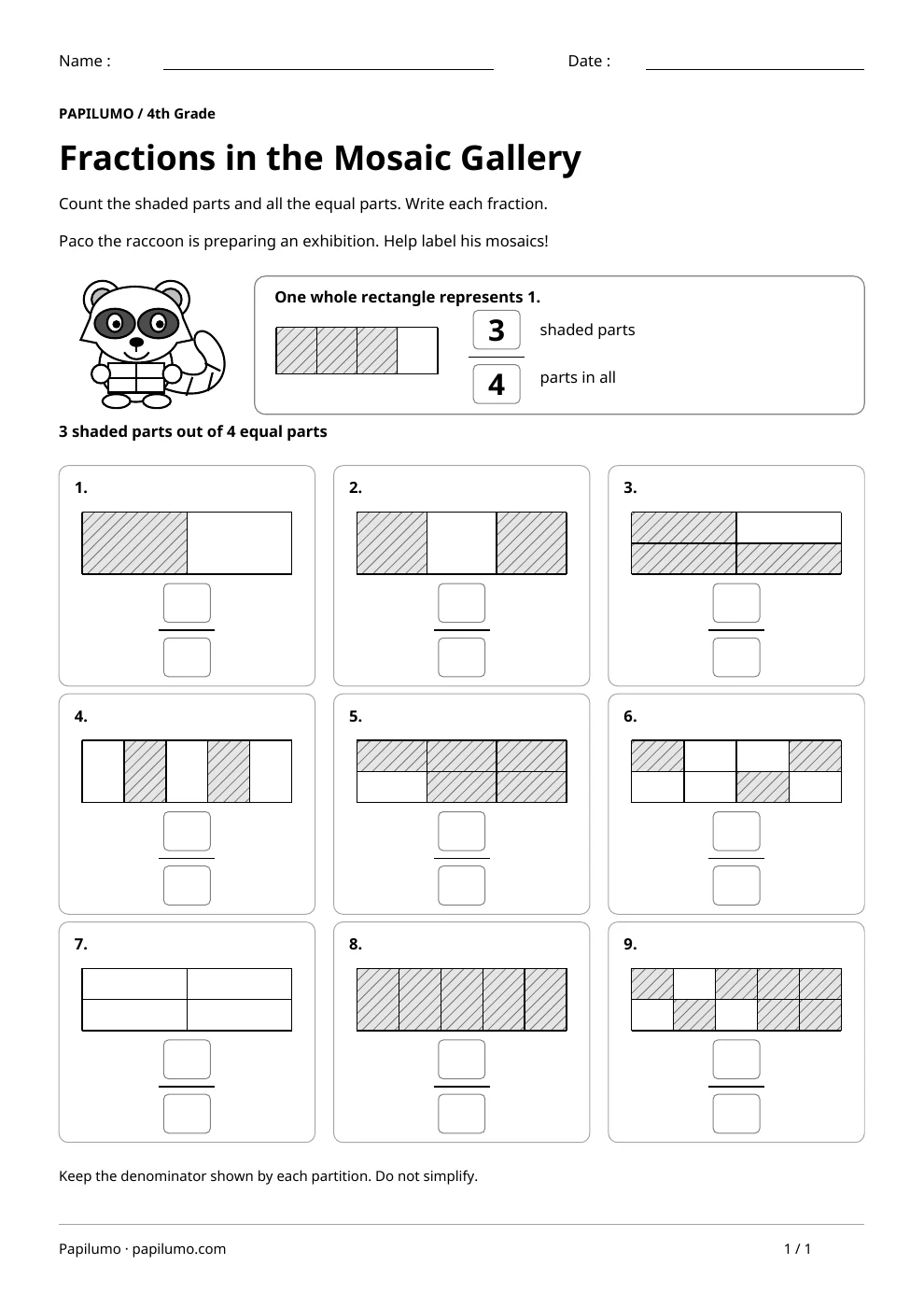
Use the follow-up to meet the same idea in a different setting. Offer it once the first task makes sense, without insisting that the whole page must be perfect. The child might explain a strategy, make an example or set a challenge for an adult. Return to the worksheet only when it helps connect the two situations. A short conversation or a practical activity can be enough to finish the session. To continue exploring, use Write Fractions for Shaded Shapes: Count the shaded parts and all the equal parts. Write each fraction.
Downloading and printing the PDF
This free PDF contains one worksheet designed for A4 paper. Download the file using the button on this page and open it in your PDF reader. Choose actual size or a 100% scale, check the orientation in the print preview and turn off any browser headers or footers. The illustrations use vector lines, so their outlines stay sharp when printed. Check the margins on one copy before preparing several sheets for a group. The level shown on the page is a guide, rather than a requirement to complete the activity at a particular age.