
What this worksheet helps children practise
If a child writes 5.0 for five cells, return to the whole rectangle: five wholes would require five complete rectangles. If unshaded cells are counted, point to the printed hatching. If the full grid is called 0.10, show that ten tenths make one whole. The number 0.10 is one tenth, not one whole, so it does not describe the full model.
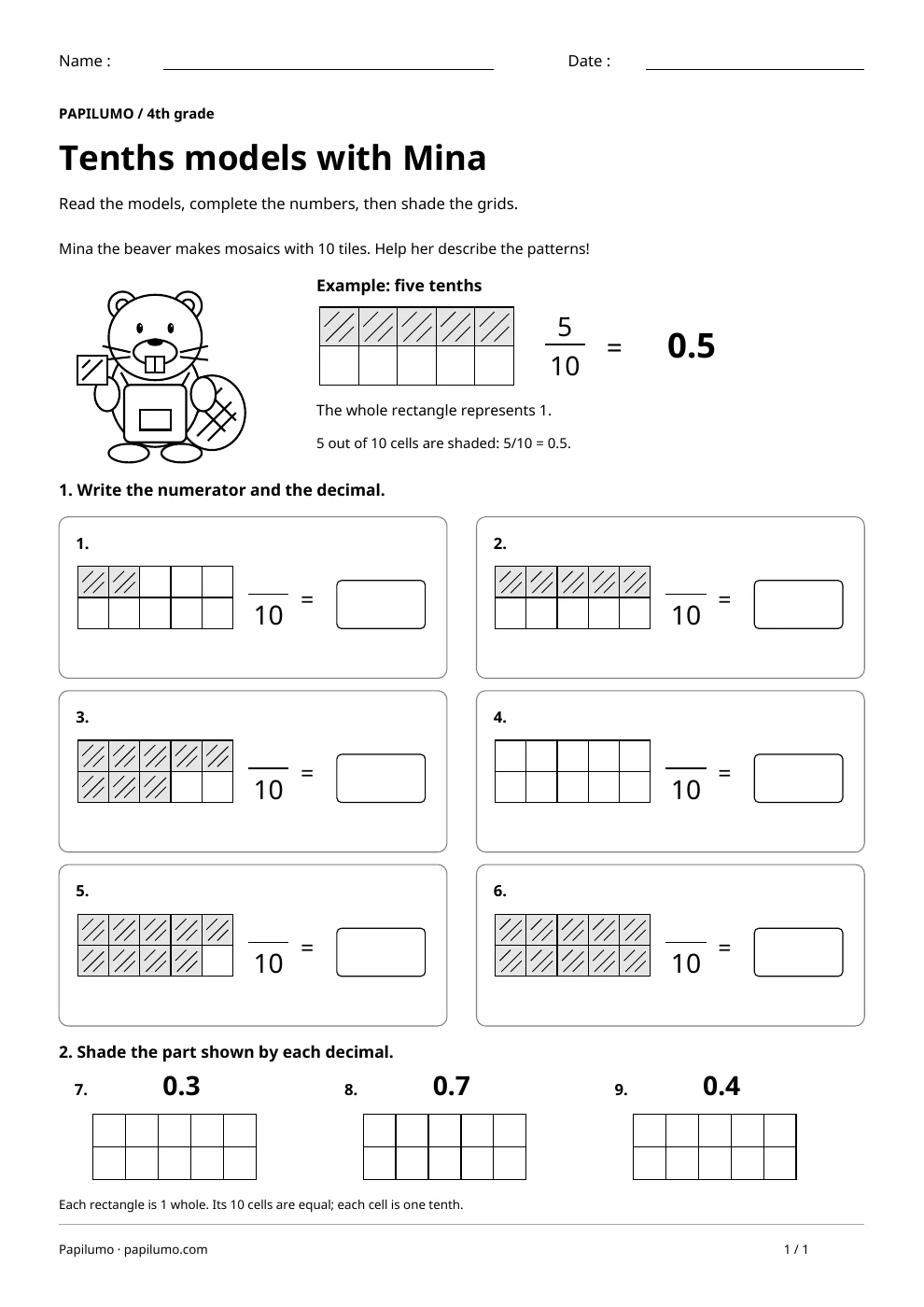
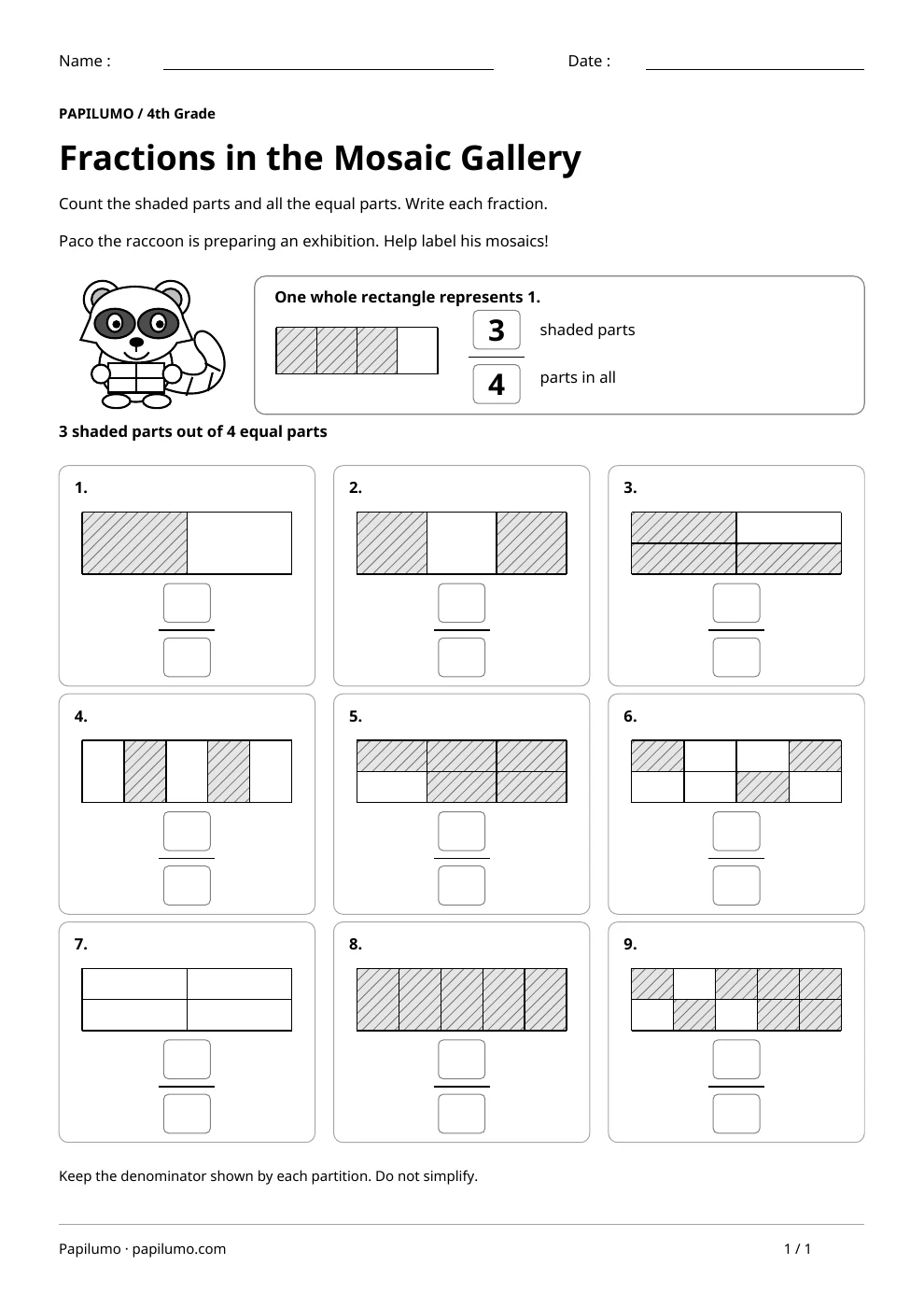
Children learn that one tenth is one of ten equal parts of a whole. The numerator counts shaded cells, while the denominator ten describes how the entire rectangle is partitioned. The five in 0.5 represents five tenths, not five whole units. This is fourth-grade practice for learners who have met fractions with a denominator of ten. It focuses on reading and building decimal models, without introducing hundredths, percentages or written decimal calculations. For a related skill, use Write Fractions for Shaded Shapes: Count the shaded parts and all the equal parts. Write each fraction.
Preparing a short session
Print at actual size and provide a pencil and a colored pencil. Keep the answer key out of sight. Trace the outside of one rectangle and count all ten cells together: both rows belong to the same whole. One row alone is not the whole unit. The printed hatching makes the selected cells visible in black and white. No cutting or extra equipment is required. Cover later questions if the full page distracts the child.
A concrete example to get started
The worked example has five shaded cells out of ten. Write 5 above the denominator 10 and read the equivalent decimal as 0.5. Ask the child to say « five tenths » and point to the complete whole. Five cells also make half of the rectangle, but the fraction stays in tenths to show its connection with decimal notation. The zero before the decimal point tells us that this selected part contains no complete whole unit.
Supporting the activity
For each model, count the shaded cells once, write the numerator and complete the decimal. The six models are mixed, so children must read each picture rather than continue a number pattern. The fourth grid has no shading, and the sixth grid is completely shaded. In the lower section, work in the opposite direction: read the decimal and shade three, seven and four cells. Any arrangement is correct when the number of shaded cells matches. To vary the practice, try Adding decimals: tenths without regrouping: Add the lengths. Write one digit in each answer box.
What to notice and how to check
The six answers are 2/10 = 0.2, 5/10 = 0.5, 8/10 = 0.8, 0/10 = 0.0, 9/10 = 0.9 and 10/10 = 1.0. Accept 0 and 1 for the empty and full models as well. The final three grids need three, seven and four shaded cells, respectively. The answer key gives one possible arrangement; children do not need to copy that exact pattern.
Making the task easier
Start with the example and the first two models. An adult may record the answers while the child points to the cells and explains the count. Use the phrase « ... out of ten equal parts ». Introduce the empty and full grids after the child understands the partially shaded examples.
Keep the learning aim, but reduce how much the child has to handle at once. Cover part of the page with another sheet and reveal one task at a time. Demonstrate a separate example, then leave a real opportunity to work something out. An answer reached with support is still a useful attempt; it does not yet show that the same task can be completed independently.
Taking the idea beyond the worksheet
Draw a fresh ten-cell grid and ask the child to show six tenths. Compare two different arrangements that both represent 0.6. Ask which is larger, four tenths or seven tenths, using whole rectangles of the same size to support the explanation.
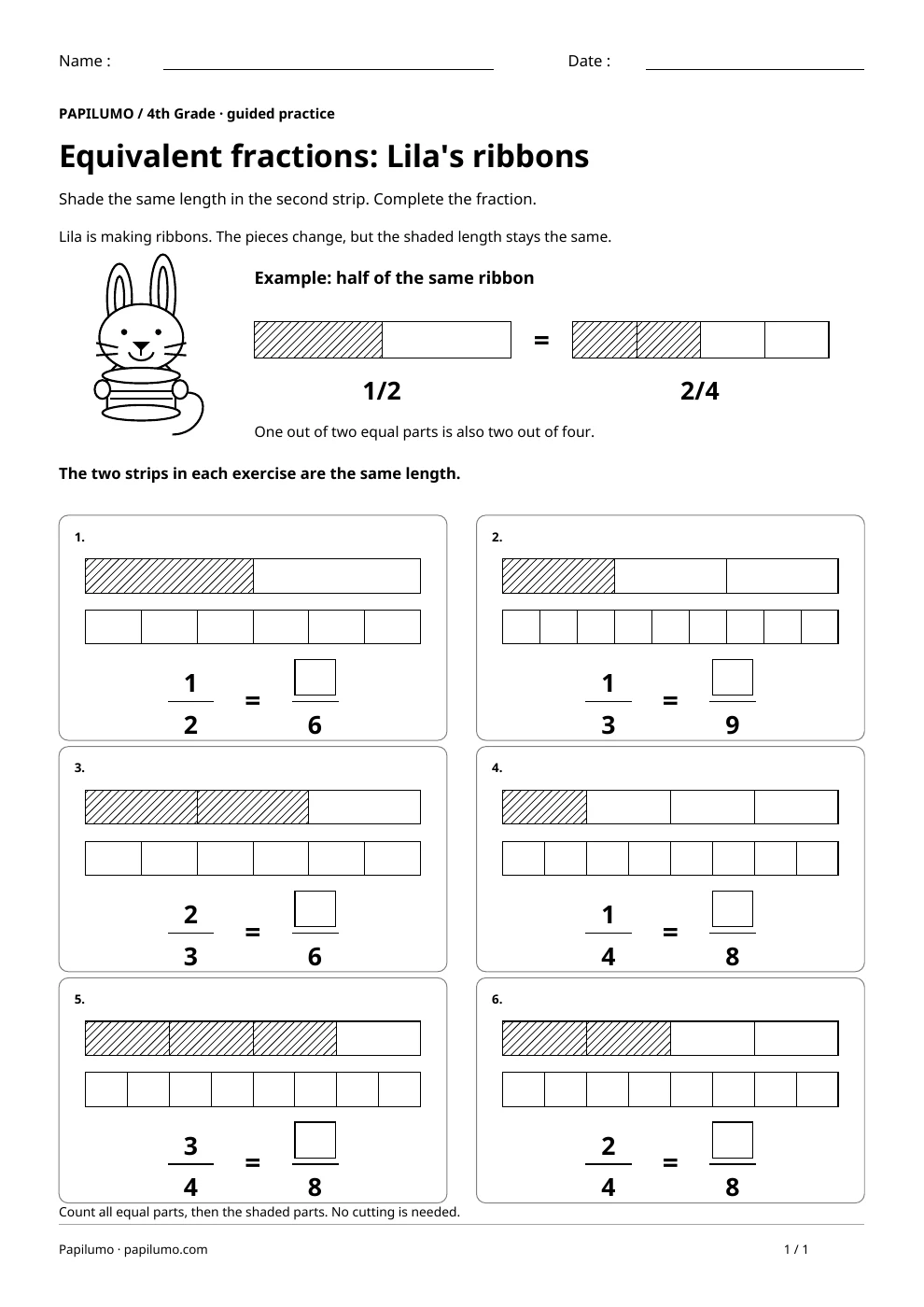
Use the follow-up to meet the same idea in a different setting. Offer it once the first task makes sense, without insisting that the whole page must be perfect. The child might explain a strategy, make an example or set a challenge for an adult. Return to the worksheet only when it helps connect the two situations. A short conversation or a practical activity can be enough to finish the session. To continue exploring, use Equivalent fractions with shaded strips: Shade the same length in the second strip. Complete the fraction.
Downloading and printing the PDF
This free PDF contains one worksheet designed for A4 paper. Download the file using the button on this page and open it in your PDF reader. Choose actual size or a 100% scale, check the orientation in the print preview and turn off any browser headers or footers. The illustrations use vector lines, so their outlines stay sharp when printed. Check the margins on one copy before preparing several sheets for a group. The level shown on the page is a guide, rather than a requirement to complete the activity at a particular age.