
What this worksheet helps children practise
Ask yourself before solving each card: am I building the top whole bar or uncovering one of the two bottom parts?
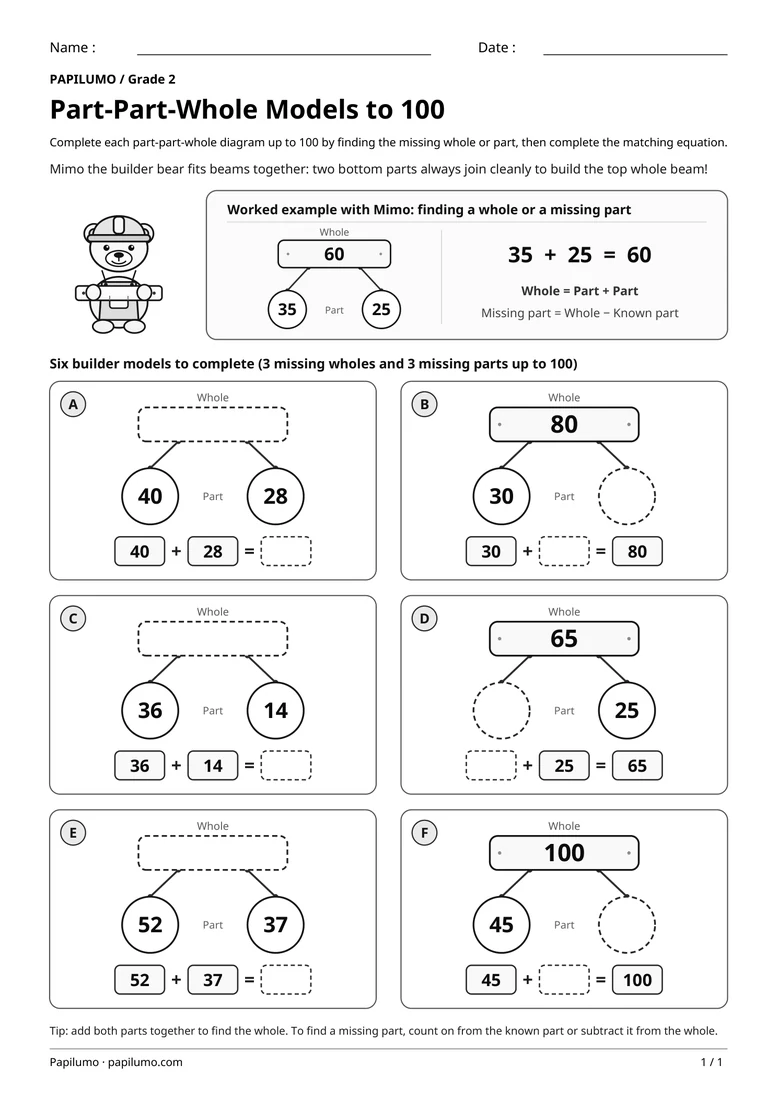
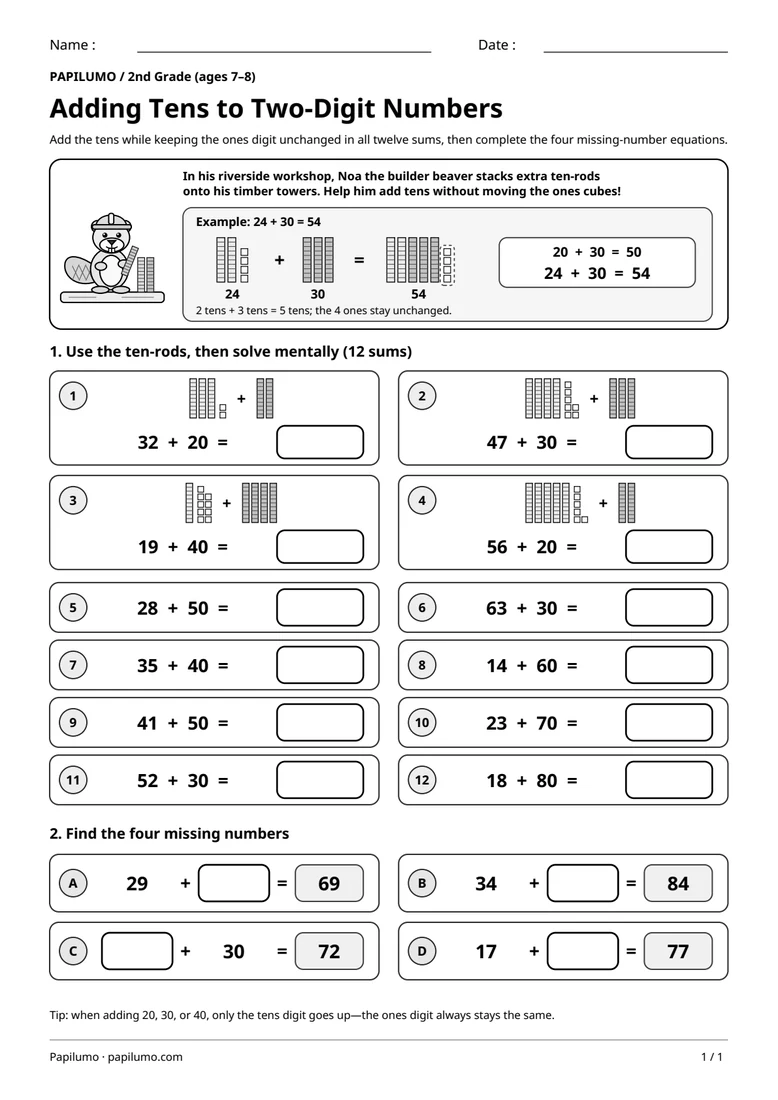
Part-part-whole diagrams give second graders a concrete bridge between addition and subtraction within 100. Instead of guessing which operation to apply, children see how one total bar splits into two connected parts: when both parts are given, joining them gives the whole; when the whole and one part are known, finding the missing part reinforces missing-addend thinking and inverse subtraction. These carefully chosen values practice adding tens, making a new ten, two-digit sums without regrouping, and building complements to 100. For a related skill, use Adding Tens to Two-Digit Numbers with Noa the Beaver: Add the tens while keeping the ones digit unchanged in all twelve sums, then complete the four missing-number equations.
Preparing a short session
Print the student worksheet at actual size (100%) on plain white A4 or letter paper without cropping margins, and provide a sharpened pencil and a soft eraser. Keep the separate one-page PDF answer key out of sight during independent work. Before starting card A, trace the two diagonal connector lines from the bottom part circles up to the top whole bar in Mimo’s example so your child immediately links the diagram structure to joining two parts into one total.
A concrete example to get started
In the top box beside Mimo, the worked example shows how every builder card works. The two bottom circles hold parts 35 and 25, connected upward to the whole bar showing 60. Combining 3 tens and 2 tens makes 50, and joining 5 ones and 5 ones makes another 10, giving 60 in total, written cleanly below as 35 + 25 = 60. That same picture shows the inverse link too: given whole 60 and part 35, the missing part must be 25.
Supporting the activity
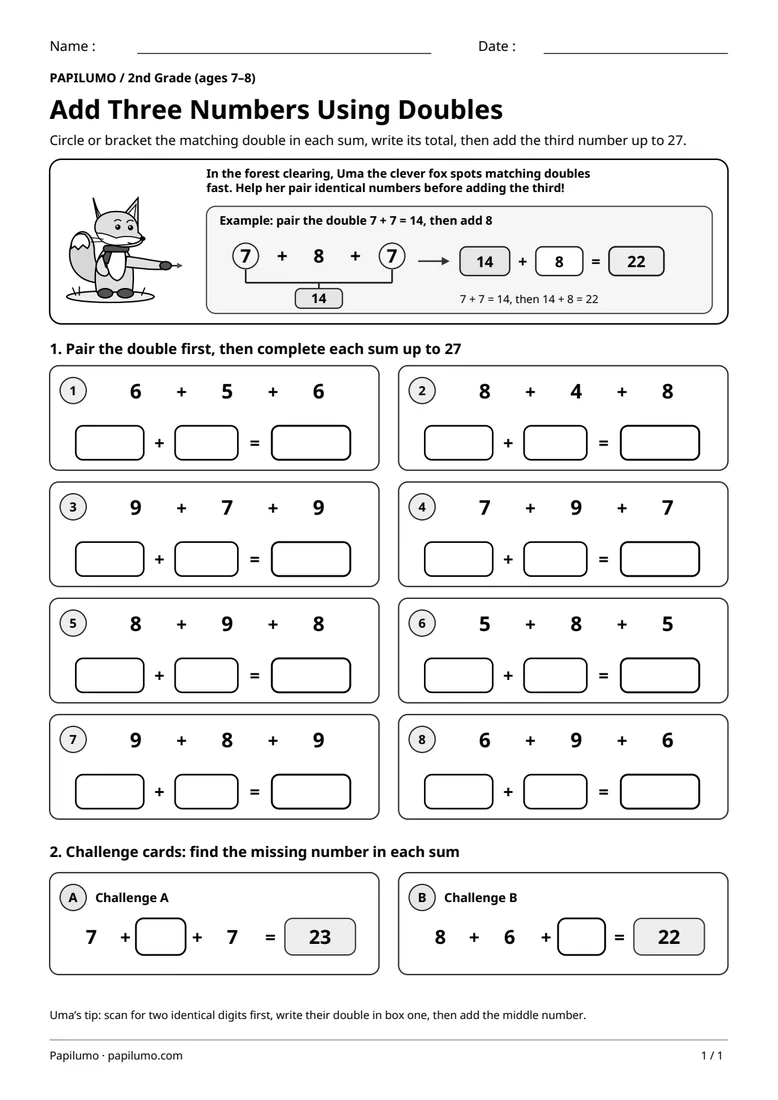
The six pupil cards alternate tasks so students think carefully on every problem rather than repeating one routine: card A provides parts 40 and 28 to find whole 68; card B gives whole 80 and left part 30 to find the missing right part; card C joins parts 36 and 14 across a ten boundary; card D shows whole 65 and right part 25 to find the missing left part; card E adds parts 52 and 37; and card F gives whole 100 and left part 45. On every card, children fill both the empty shape and the matching equation box. To vary the practice, try Add Three Single-Digit Numbers Using Doubles: Circle or bracket the matching double in each sum, write its total, then add the third number up to 27.
What to notice and how to check
When reviewing with the separate PDF answer key, check all six diagrams and matching equations together: A gives 40 + 28 = 68; B gives 30 + 50 = 80; C gives 36 + 14 = 50; D gives 40 + 25 = 65; E gives 52 + 37 = 89; and F gives 45 + 55 = 100. Look closely at cards C and F, where the ones digits add up to ten (6 + 4 = 10 and 5 + 5 = 10), because students sometimes forget to carry that extra ten and write 40 or 65 instead.
Making the task easier
When a part is missing, count up in tens first from the known part or draw quick ten-sticks beside the card until you reach the whole.
Keep the learning aim, but reduce how much the child has to handle at once. Cover part of the page with another sheet and reveal one task at a time. Demonstrate a separate example, then leave a real opportunity to work something out. An answer reached with support is still a useful attempt; it does not yet show that the same task can be completed independently.
Taking the idea beyond the worksheet
Draw two blank part-part-whole diagrams on the back with 100 as the whole and trade them with a partner to solve.
Use the follow-up to meet the same idea in a different setting. Offer it once the first task makes sense, without insisting that the whole page must be perfect. The child might explain a strategy, make an example or set a challenge for an adult. Return to the worksheet only when it helps connect the two situations. A short conversation or a practical activity can be enough to finish the session. To continue exploring, use Mental Addition Sums up to 30 with Toto the Toucan: Solve the twelve mental addition sums up to 30, then fill in each missing addend in the six equations below.
Downloading and printing the PDF
This free PDF contains one worksheet designed for A4 paper. Download the file using the button on this page and open it in your PDF reader. Choose actual size or a 100% scale, check the orientation in the print preview and turn off any browser headers or footers. The illustrations use vector lines, so their outlines stay sharp when printed. Check the margins on one copy before preparing several sheets for a group. The level shown on the page is a guide, rather than a requirement to complete the activity at a particular age.