What this worksheet helps children practise
Always scan the whole expression first, simplify the highest-priority step, and copy unused numbers neatly in place.
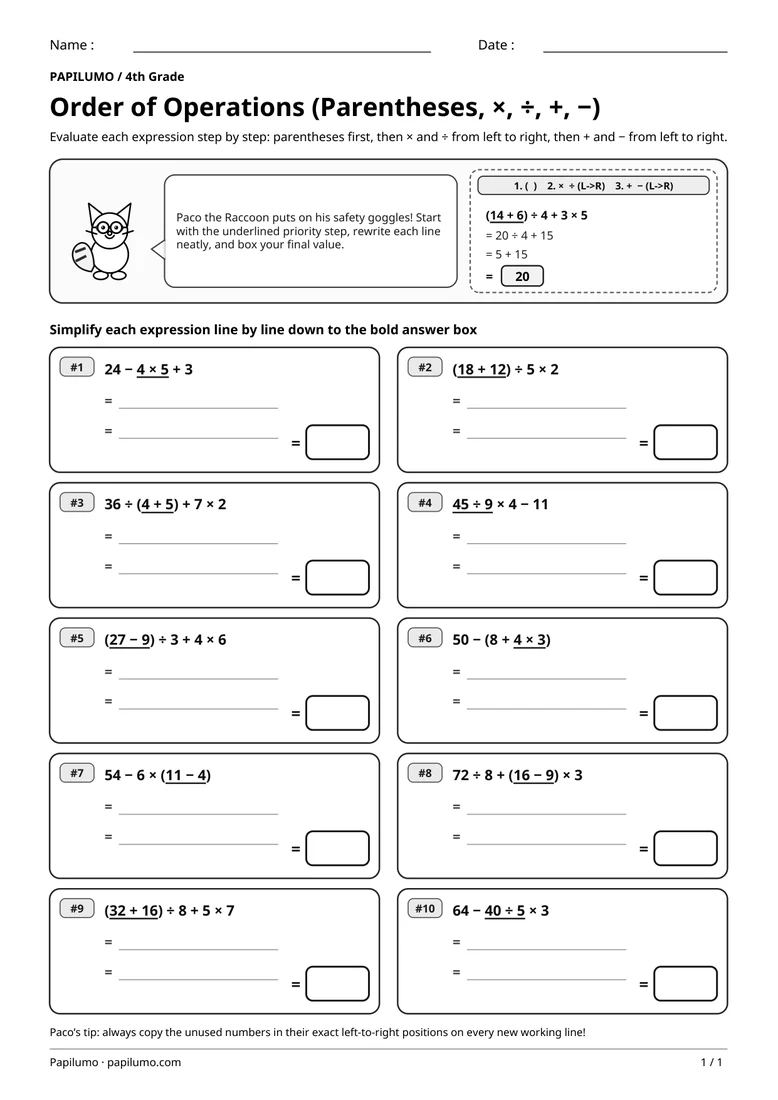
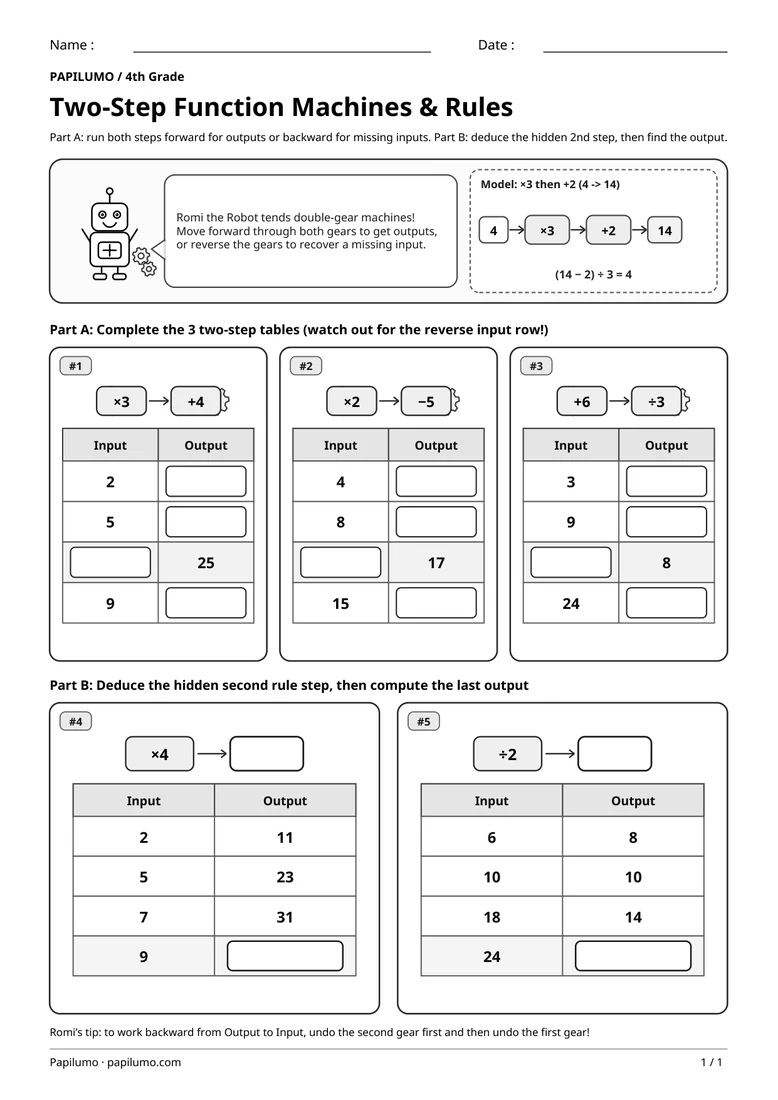
Applying full order-of-operations rules in 4th grade prevents the classic mistake of simply computing every symbol blindly from left to right. When students meet expressions like 24 − 4 × 5 + 3 or 64 − 40 ÷ 5 × 3, they learn to pause carefully, scan the whole expression for grouping parentheses and higher-priority × or ÷ steps, preserve left-to-right tie-breaking between × and ÷ or + and −, and keep unused terms anchored in place. Funnel-style line-by-line simplification builds clean algebraic discipline. For a related skill, use Two-Step Function Machines: Forward & Reverse Rules with Romi (4th Grade): Part A: run both steps forward for outputs or backward for missing inputs. Part B: deduce the hidden 2nd step, then find the output.
Preparing a short session
Print the student worksheet at actual size (100%) on plain white A4 paper so all ten funnel cards and intermediate writing lines have generous vertical room. Seat your child at a quiet, well-lit table with a sharpened pencil and clean eraser while keeping the separate answer key PDF hidden until every expression is finished. Before writing, read the compact three-step priority rule badge together and invite your child to name the exact underlined first step on the opening three cards.
A concrete example to get started
Inside the framed top banner beside Paco the Raccoon, a compact 3-step priority badge summarizes 1. ( ), 2. × ÷ (L->R), and 3. + − (L->R) right above a complete worked funnel example: (14 + 6) ÷ 4 + 3 × 5 simplifies first to 20 ÷ 4 + 15, then to 5 + 15, and finally to the boxed answer 20. Seeing each line align cleanly underneath trains 4th grade students to copy remaining terms accurately without losing signs.
Supporting the activity
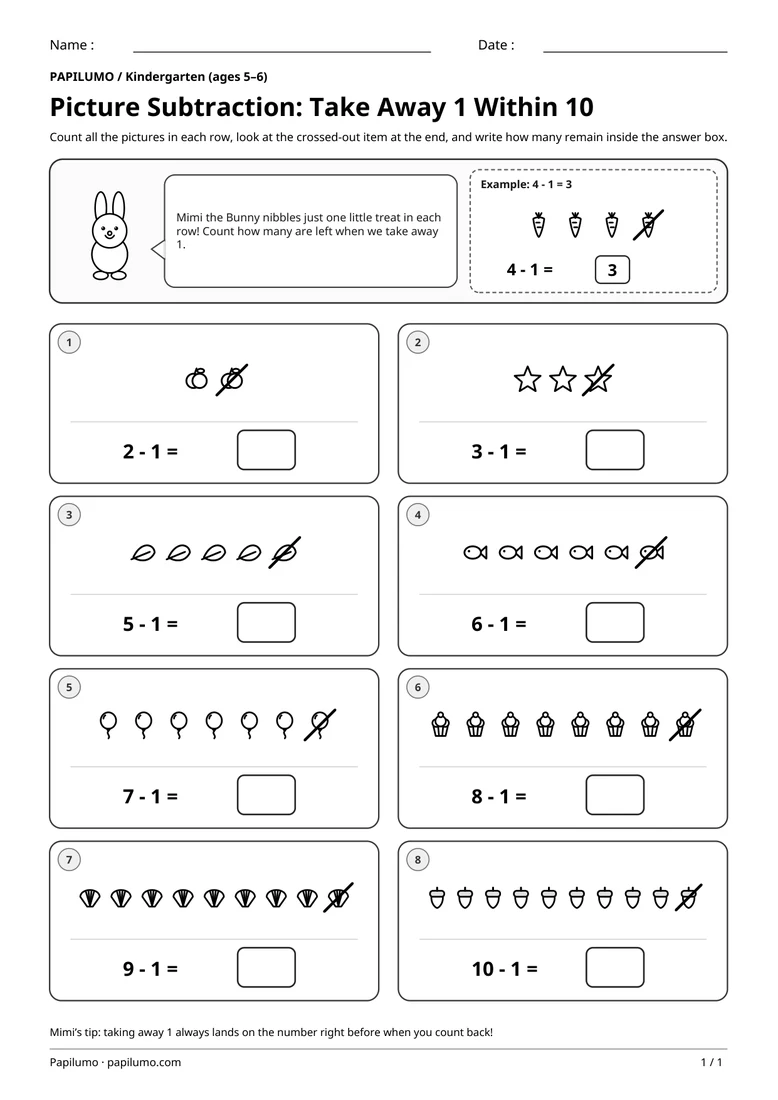
Below the banner, ten stepped-funnel expressions sit cleanly in two neat columns with the first priority group gently underlined to launch each calculation: 24 − 4 × 5 + 3, (18 + 12) ÷ 5 × 2, 36 ÷ (4 + 5) + 7 × 2, 45 ÷ 9 × 4 − 11, (27 − 9) ÷ 3 + 4 × 6, 50 − (8 + 4 × 3), 54 − 6 × (11 − 4), 72 ÷ 8 + (16 − 9) × 3, (32 + 16) ÷ 8 + 5 × 7, and 64 − 40 ÷ 5 × 3. Two roomy working lines guide each card down to its bold answer box. To vary the practice, try Picture Subtraction: Take Away 1 Within 10 with Mimi: Count all the pictures in each row, look at the crossed-out item at the end, and write how many remain inside the answer box.
What to notice and how to check
When all ten expressions are solved, place the separate one-page answer key PDF beside your child’s finished worksheet and check every intermediate working line together as well as the ten final answers: 7, 12, 18, 9, 30, 30, 12, 30, 41, and 40. Pay special attention to left-to-right traps in 45 ÷ 9 × 4 − 11 and 64 − 40 ÷ 5 × 3, plus multiplication inside parentheses in 50 − (8 + 4 × 3).
Making the task easier
Lightly box only the single operation you are solving on each step before rewriting the rest of the expression on the next line.
Keep the learning aim, but reduce how much the child has to handle at once. Cover part of the page with another sheet and reveal one task at a time. Demonstrate a separate example, then leave a real opportunity to work something out. An answer reached with support is still a useful attempt; it does not yet show that the same task can be completed independently.
Taking the idea beyond the worksheet
Write two different expressions using parentheses and at least three operations that both evaluate to 24, then test them step by step.
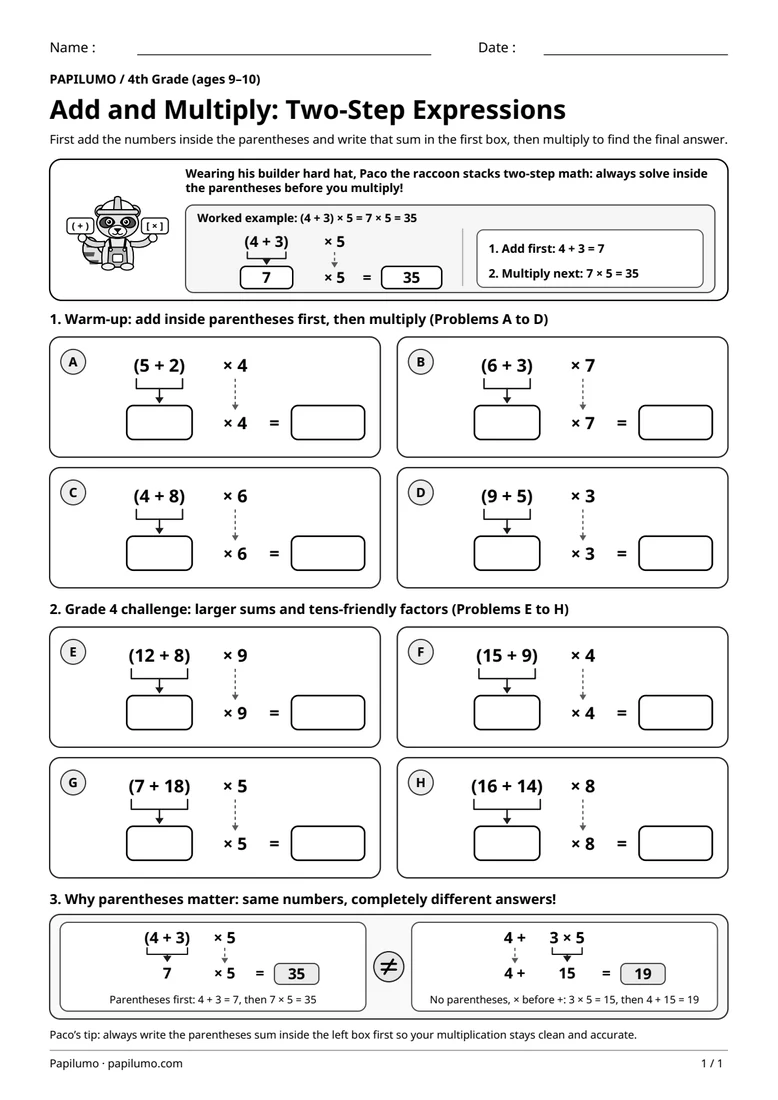
Use the follow-up to meet the same idea in a different setting. Offer it once the first task makes sense, without insisting that the whole page must be perfect. The child might explain a strategy, make an example or set a challenge for an adult. Return to the worksheet only when it helps connect the two situations. A short conversation or a practical activity can be enough to finish the session. To continue exploring, use Add and Multiply Two-Step Expressions with Paco the Raccoon: First add the numbers inside the parentheses and write that sum in the first box, then multiply to find the final answer.
Downloading and printing the PDF
This free PDF contains one worksheet designed for A4 paper. Download the file using the button on this page and open it in your PDF reader. Choose actual size or a 100% scale, check the orientation in the print preview and turn off any browser headers or footers. The illustrations use vector lines, so their outlines stay sharp when printed. Check the margins on one copy before preparing several sheets for a group. The level shown on the page is a guide, rather than a requirement to complete the activity at a particular age.