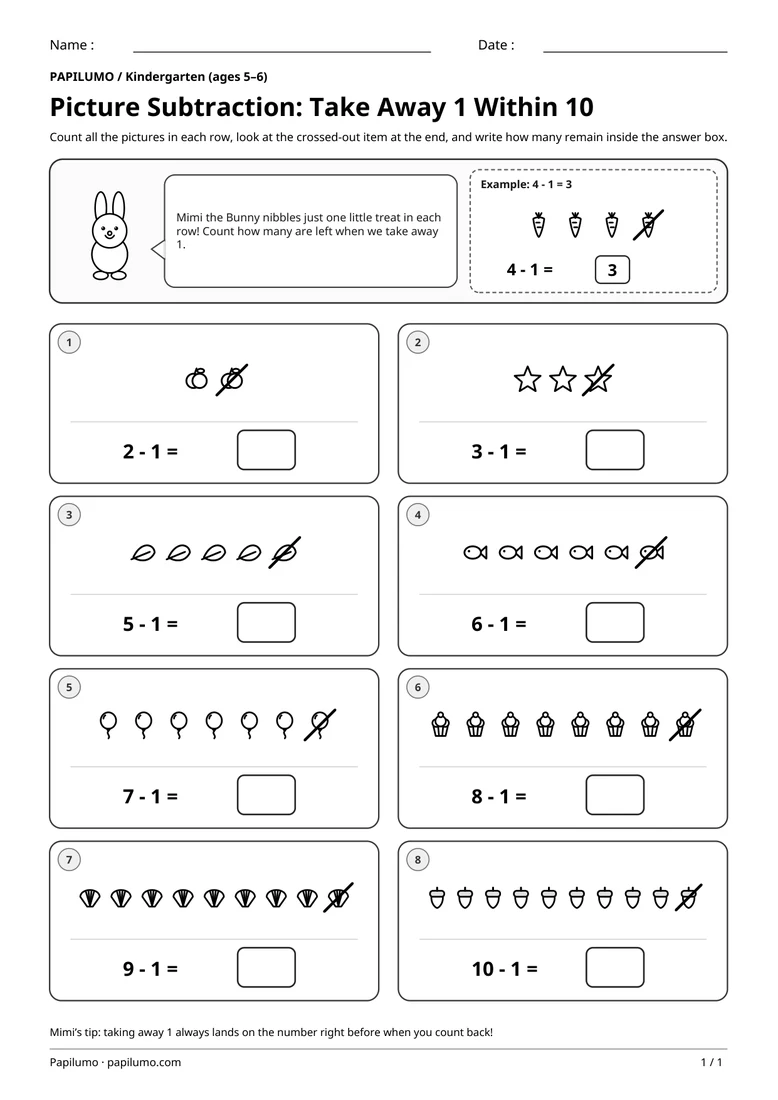


What this worksheet helps children practise
Count back one step from the starting number to find the number right before it!
Practicing take-away-one picture subtraction in Kindergarten strengthens accurate one-to-one counting up to 10, builds concrete understanding of the minus sign, and links subtracting 1 directly to naming the preceding number on the number sequence. By seeing the full starting group with the final item crossed out, young learners realize that the first digit names the whole set before removal and that the remaining drawings match one step backward. This visual bridge prepares students smoothly for first-grade symbolic subtraction while fostering careful pencil habits, steady number sense, and quiet confidence with early math. For a related skill, use Ways to Make 6 and 8: Two-Part Pictures with Lumi: Count the shaded pictures first, then count the white outline pictures, and write both parts to make 6 or 8.
Preparing a short session
Print the student worksheet at actual size (100%) on plain white A4 paper and keep the separate one-page answer key PDF tucked aside during practice. Seat your child comfortably at a clear table with a sharpened pencil and a soft eraser. Before writing in the first box, encourage your child to touch each drawing from left to right to confirm the starting total printed before the minus sign, then point to the crossed-out item and say aloud that one is taken away.
A concrete example to get started
Inside the rounded top banner next to smiling Mimi the Bunny and her speech bubble, a worked example demonstrates the exact routine. Four crunchy carrots sit in a tidy row and the fourth carrot is clearly crossed out with a bold diagonal slash. Directly beneath the row, the completed equation reads 4 - 1 = 3 with the solution digit 3 written neatly inside its rounded box. Beginners see right away how crossing out one picture turns four into three.
Supporting the activity
Below the banner, eight spacious horizontal cards arranged in a clean two-by-four grid cover take-away-one facts across 2 through 10 with fresh, countable sets: two apples (2 - 1), three stars (3 - 1), five leaves (5 - 1), six fish (6 - 1), seven balloons (7 - 1), eight cupcakes (8 - 1), nine seashells (9 - 1), and ten acorns (10 - 1). Every card pairs the clear crossed-out row with a roomy write-in box after the equals sign. To vary the practice, try Missing Addends Within 20 with Pico the Fox: Count on along the 20-dot strip up to the target sum, count how many dots you added, and write the missing addend in the box.
What to notice and how to check
Once all eight boxes are filled in, place the separate one-page answer key PDF beside your child’s sheet to review each equation calmly together. The answer key mirrors the exact two-by-four layout with bold black solution digits inside every box and highlighted count-back totals shown directly beneath each crossed-out object. Celebrate careful counting and, if a larger set like 8 - 1 or 10 - 1 needs a second look, cover the crossed-out item with a finger and recount only the remaining drawings.
Making the task easier
Cover the crossed-out picture with one finger and recount the remaining pictures slowly from left to right.
Keep the learning aim, but reduce how much the child has to handle at once. Cover part of the page with another sheet and reveal one task at a time. Demonstrate a separate example, then leave a real opportunity to work something out. An answer reached with support is still a useful attempt; it does not yet show that the same task can be completed independently.
Taking the idea beyond the worksheet
Say the countdown from 10 to 1 aloud, then act out two extra take-away-one stories using small blocks or snacks.
Use the follow-up to meet the same idea in a different setting. Offer it once the first task makes sense, without insisting that the whole page must be perfect. The child might explain a strategy, make an example or set a challenge for an adult. Return to the worksheet only when it helps connect the two situations. A short conversation or a practical activity can be enough to finish the session. To continue exploring, use Picture Subtraction Within 5 with Mimi the Gardening Bear: Count the items left after the crossed-out ones to finish the first 6 equations, then cross out and write the answer below.
Downloading and printing the PDF
This free PDF contains one worksheet designed for A4 paper. Download the file using the button on this page and open it in your PDF reader. Choose actual size or a 100% scale, check the orientation in the print preview and turn off any browser headers or footers. The illustrations use vector lines, so their outlines stay sharp when printed. Check the margins on one copy before preparing several sheets for a group. The level shown on the page is a guide, rather than a requirement to complete the activity at a particular age.