What this worksheet helps children practise
Check the tens digit on the left first (6, 7, 8, or 9), say the full number out loud, and connect compound words with a hyphen.
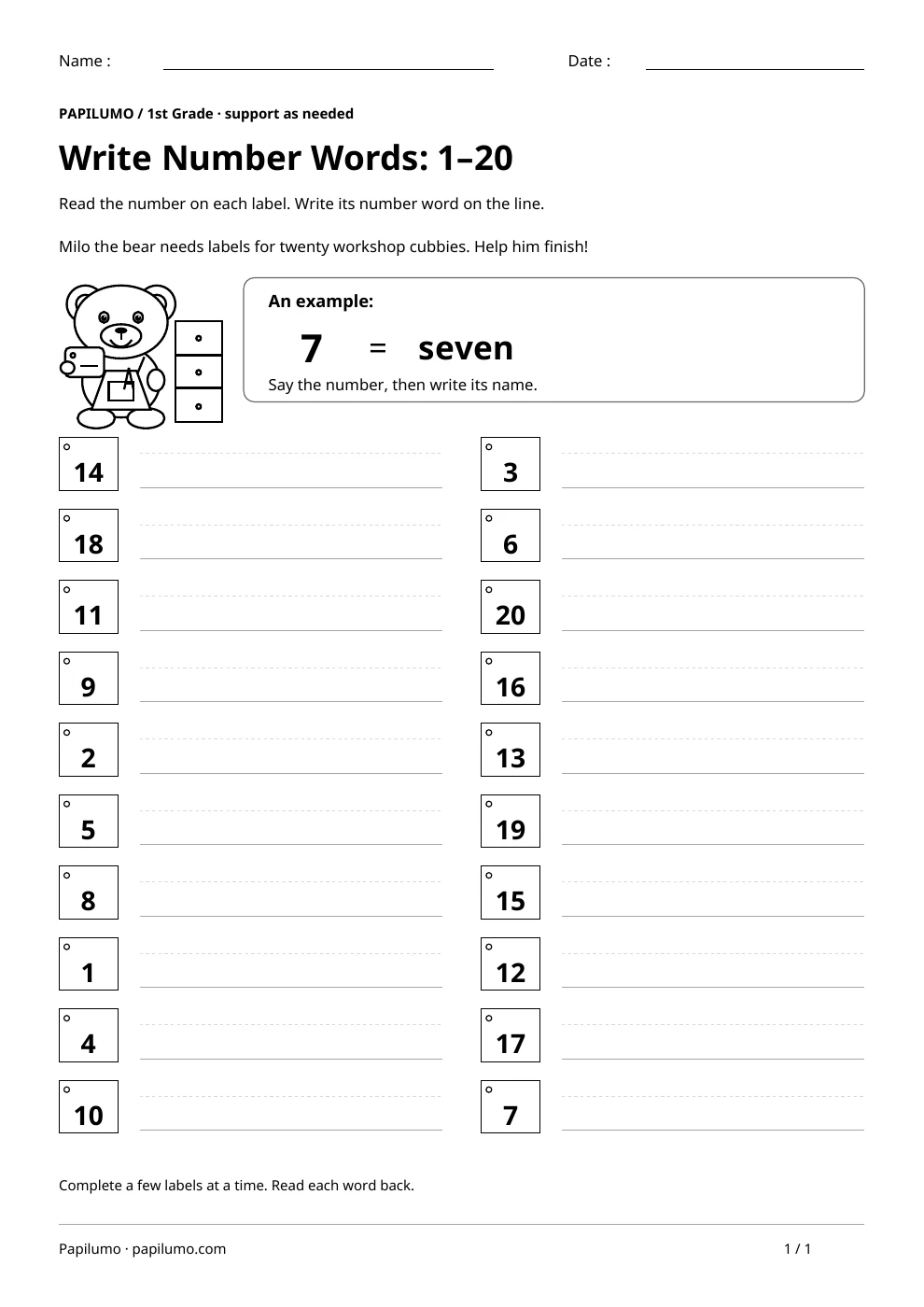
Writing number words from 61 through 100 connects place-value understanding with accurate spelling and punctuation. Grade 2 students practice recognizing the tens digit first (6 for sixty, 7 for seventy, 8 for eighty, 9 for ninety) before joining the ones digit with a hyphen, while noticing that whole tens like eighty and the landmark one hundred stand without hyphens. Keeping the numbers out of counting order prevents rote guessing and checks true decoding of two-digit and three-digit numerals without any timer, speed drill, or arithmetic distraction. For a related skill, use Mastering Tricky Teen Spellings Alongside Milo: Read the number on each label. Write its number word on the line.
Preparing a short session
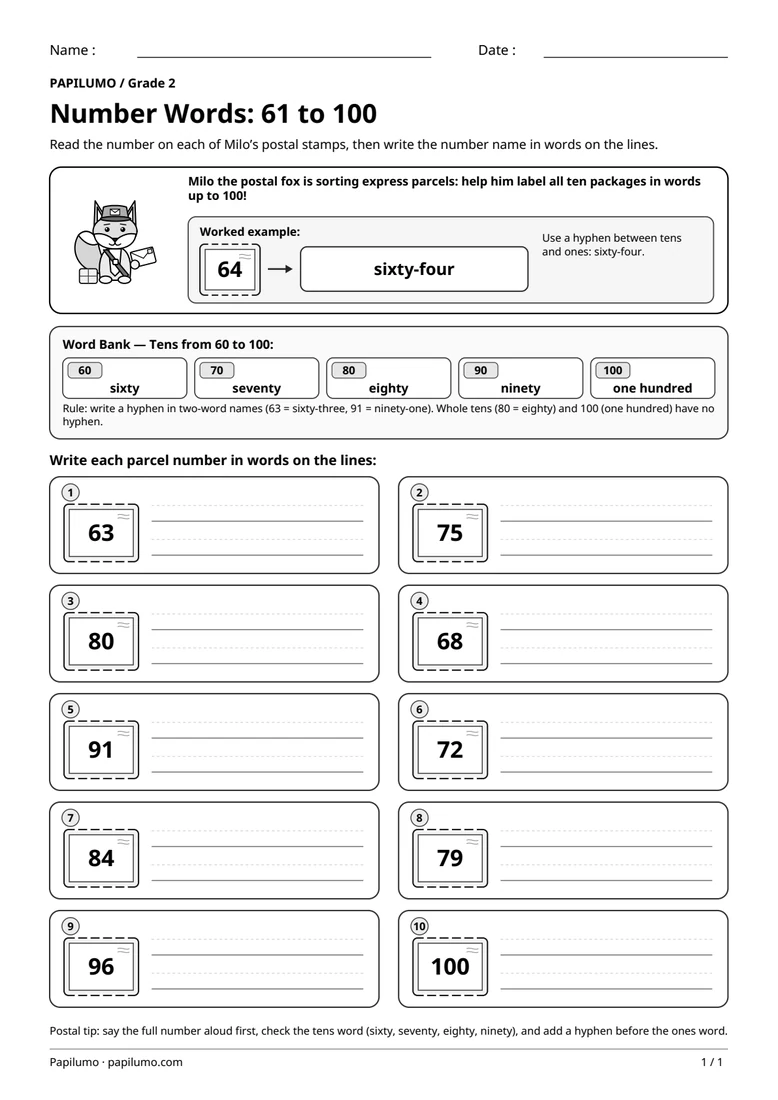
Print the student worksheet at actual size (100%) on plain white paper without shrinking the margins, and provide a sharpened pencil and soft eraser for clean work. Keep the separate one-page answer key hidden until the child completes an independent attempt. Before starting card 1, read the five reference words in the top word bank together (sixty, seventy, eighty, ninety, one hundred) and review Milo’s worked example for 64. Remind your learner to whisper each parcel number aloud before writing on the double lines.
A concrete example to get started
In the top example panel beside Milo the postal fox, parcel 64 becomes sixty-four. Point out how the tens word sixty keeps its spelling, followed immediately by a hyphen and the ones word four. Contrast that structure with eighty (a single word for 80, noticing the single t in eighty) and one hundred (two words with a space and no hyphen for 100). A quick look at ninety also helps children keep the silent e in nine before adding -ty, avoiding common second-grade misspellings like ninty.
Supporting the activity
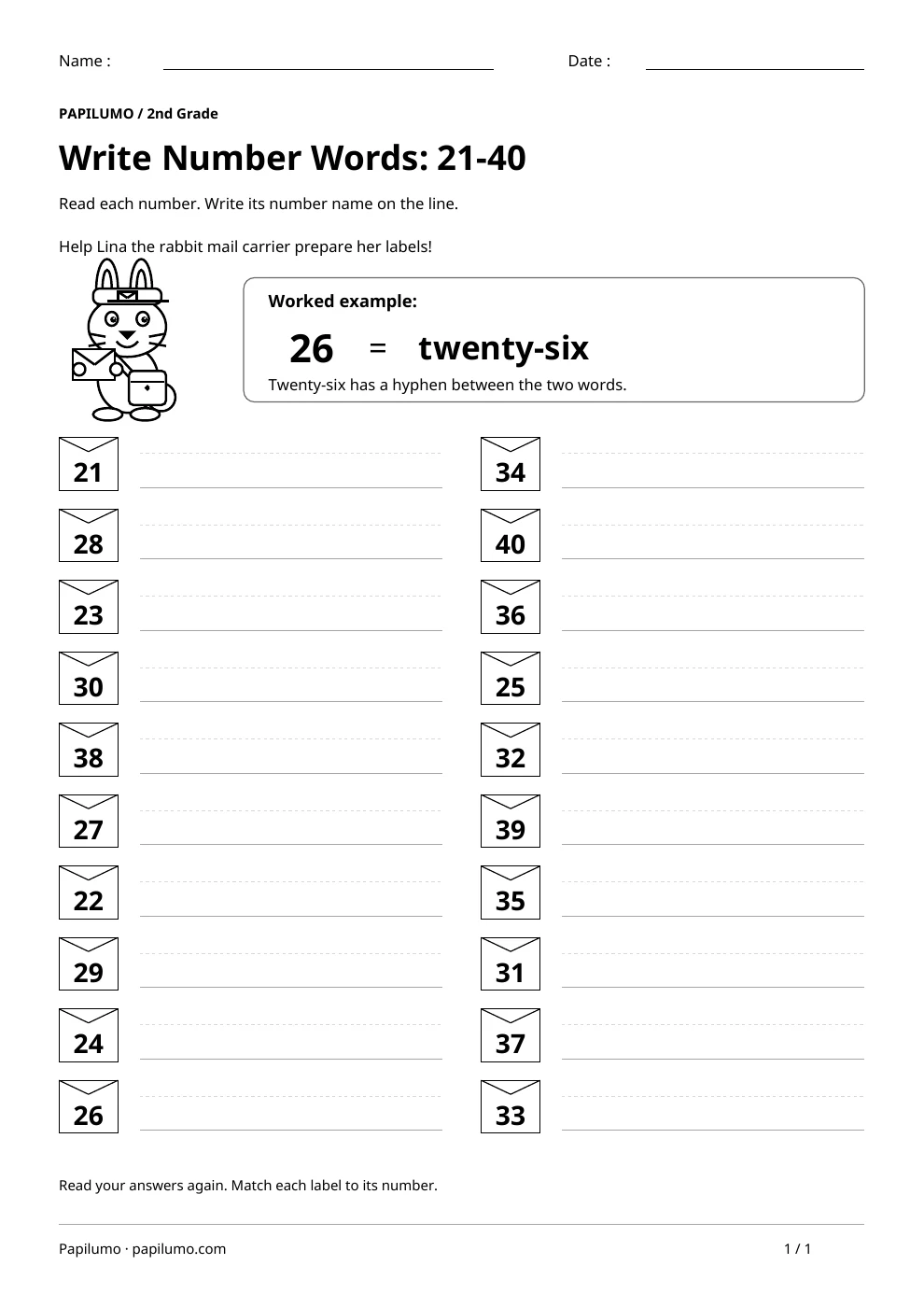
The ten parcel cards mix families intentionally from top to bottom so learners read each stamp fresh: 1. 63 (sixty-three), 2. 75 (seventy-five), 3. 80 (eighty), 4. 68 (sixty-eight), 5. 91 (ninety-one), 6. 72 (seventy-two), 7. 84 (eighty-four), 8. 79 (seventy-nine), 9. 96 (ninety-six), and 10. 100 (one hundred). If a learner reverses digits such as reading 68 as eighty-six, pause and identify tens and ones together before checking spelling. Each card supplies generous vertical space and two ruled lines so young writers never feel cramped on longer compound words. To vary the practice, try Writing numbers 21 to 40 in words: Read each number. Write its number name on the line.
What to notice and how to check
When reviewing with the separate one-page answer key, check all ten parcel labels in numerical box order from 1 to 10. Confirm first that the correct tens family was chosen (especially distinguishing sixty from seventy and eighty from ninety), then inspect tricky spots: the hyphen in all compound numbers from 63 to 96, the silent e in ninety-one and ninety-six, the spelling of eighty without a double t, and two separate words for one hundred. Let the child circle any missing hyphen with a colored pencil before neatly fixing it.
Making the task easier
Highlight the tens digit in each parcel stamp and match it to the word bank row before spelling the ones part.
Keep the learning aim, but reduce how much the child has to handle at once. Cover part of the page with another sheet and reveal one task at a time. Demonstrate a separate example, then leave a real opportunity to work something out. An answer reached with support is still a useful attempt; it does not yet show that the same task can be completed independently.
Taking the idea beyond the worksheet
Write four extra delivery slips for Milo on the back of the page—61, 77, 89, and 94—and quiz a partner aloud.
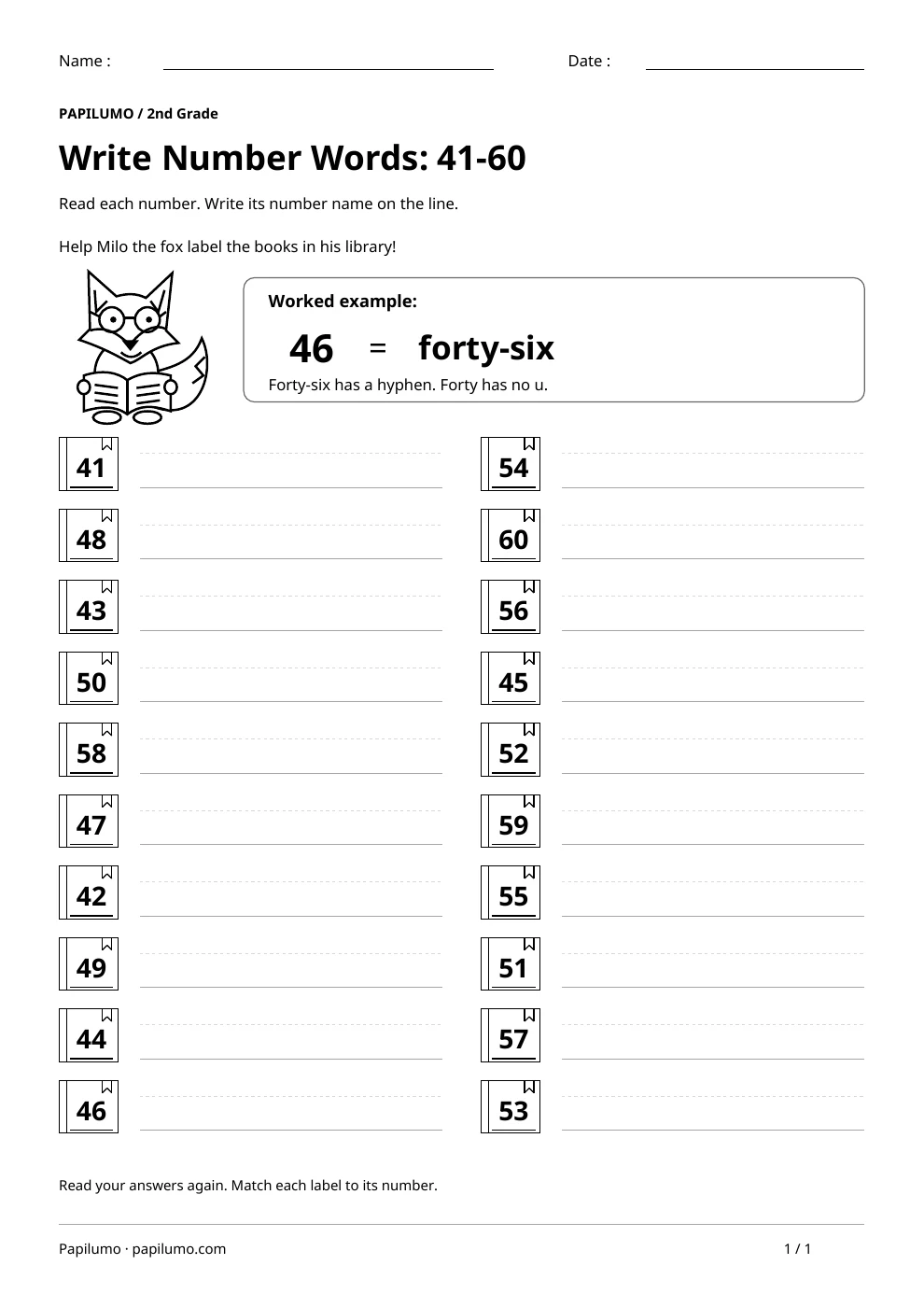
Use the follow-up to meet the same idea in a different setting. Offer it once the first task makes sense, without insisting that the whole page must be perfect. The child might explain a strategy, make an example or set a challenge for an adult. Return to the worksheet only when it helps connect the two situations. A short conversation or a practical activity can be enough to finish the session. To continue exploring, use Spelling Number Words from 41 to 60 Without the Classic Traps: Read each number. Write its number name on the line.
Downloading and printing the PDF
This free PDF contains one worksheet designed for A4 paper. Download the file using the button on this page and open it in your PDF reader. Choose actual size or a 100% scale, check the orientation in the print preview and turn off any browser headers or footers. The illustrations use vector lines, so their outlines stay sharp when printed. Check the margins on one copy before preparing several sheets for a group. The level shown on the page is a guide, rather than a requirement to complete the activity at a particular age.