

What this worksheet helps children practise
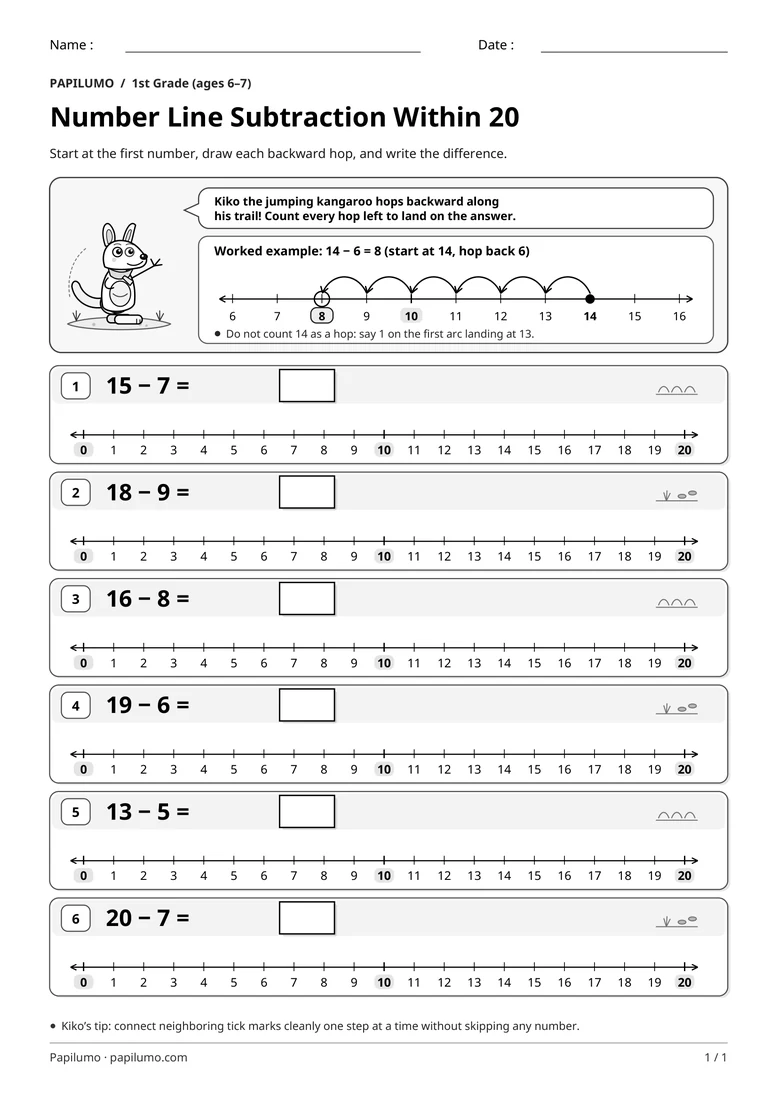
Say the starting number, count each backward arc aloud as you draw it, then circle the landing tick.
Subtracting on a number line turns takeaway into a clear leftward journey from mark to mark. Every whole number from 0 to 20 sits evenly spaced underneath the line, with stronger ticks and shaded pills highlighting benchmark numbers 0, 10, and 20. Counting unit hops backward builds reliable counting-back fluency past ten and deepens understanding of bridging across ten without confusing children with mixed signs. Focusing purely on subtraction lets young learners lock in direction, steady spacing, and accurate one-to-one hop counting before tackling mixed operations. For a related skill, use Number Line Subtraction Within 10: Start at the black dot. Draw jumps to the left, then write the answer.
Preparing a short session
Print the pupil sheet at actual size (100%) on plain white letter or A4 paper so the 0–20 ticks stay crisp and wide enough for clear pencil arcs. Provide a sharpened pencil, a clean eraser, and optionally a small counter or token for hands-on movement before drawing. Before starting exercise 1, locate 0, 10, and 20 together on a line and walk calmly through Kiko’s speech bubble and worked banner. Keep the separate answer key PDF tucked out of sight while your child completes all six cards.
A concrete example to get started
Inside Kiko’s worked-example panel, the equation 14 − 6 = 8 is modeled clearly step by step on a zoomed line. A starting dot marks 14, and six curved backward hop arcs step left one tick at a time through 13, 12, 11, 10, 9, and finally 8. A neat circle highlights 8 as the landing target, matching the completed difference in the equation. Seeing all six arcs clearly shows why the starting mark 14 never counts as hop one: the first hop only finishes upon touching 13.
Supporting the activity
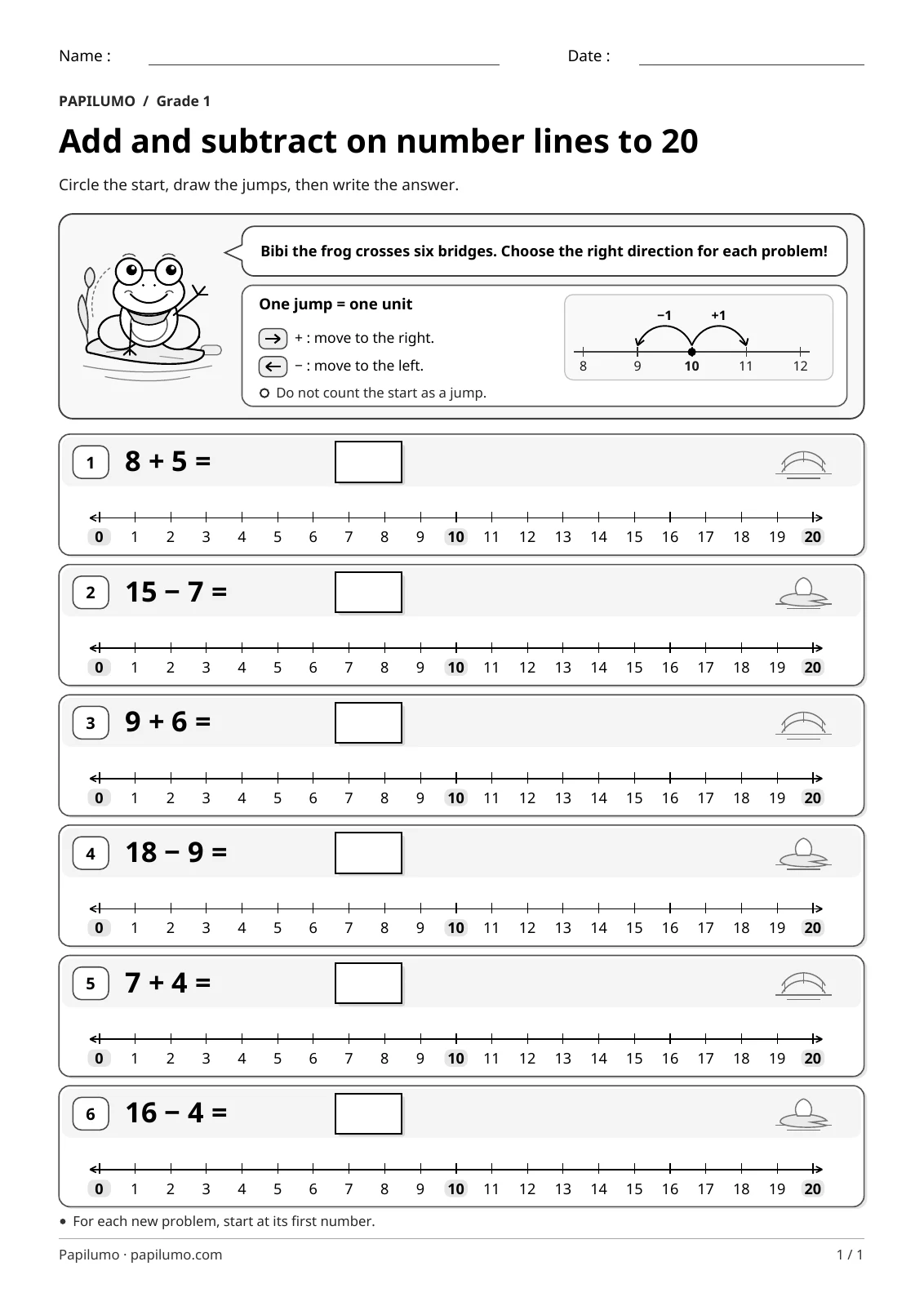
The six numbered cards present these subtractions in progressive order: 15 − 7, 18 − 9, 16 − 8, 19 − 6, 13 − 5, and 20 − 7. For each card, learners read the equation at the top left, place their pencil on the starting number along the 0–20 line, draw the exact number of leftward hop arcs, circle the target tick, and write the difference inside the bold answer box. Notice how 19 − 6 stays comfortably above ten while the other five bridge cleanly through ten. To vary the practice, try Mixed addition and subtraction on number lines to 20: Circle the start, draw the jumps, then write the answer.
What to notice and how to check
When reviewing with the separate answer key PDF, check both the written differences—8, 9, 8, 13, 8, and 13—and the drawn hop arcs underneath each equation. Every single line should show a clear dot on the minuend, backward arcs matching the subtrahend, and a circled landing tick. If an answer is off by one, check carefully whether the student counted the starting tick as the first hop or miscounted while crossing 10, especially on 15 − 7, 13 − 5, and 20 − 7.
Making the task easier
Slide a small counter backward one tick per count from the start number before drawing the pencil arcs.
Keep the learning aim, but reduce how much the child has to handle at once. Cover part of the page with another sheet and reveal one task at a time. Demonstrate a separate example, then leave a real opportunity to work something out. An answer reached with support is still a useful attempt; it does not yet show that the same task can be completed independently.
Taking the idea beyond the worksheet
Check 15 − 7 = 8 by hopping 7 steps forward from 8 on the same line: do you land back on 15?
Use the follow-up to meet the same idea in a different setting. Offer it once the first task makes sense, without insisting that the whole page must be perfect. The child might explain a strategy, make an example or set a challenge for an adult. Return to the worksheet only when it helps connect the two situations. A short conversation or a practical activity can be enough to finish the session. To continue exploring, use Subtraction Within 20 with Ten-Frames: Cross Out Berries with Mimi: Cross out the berries being taken away (clear the second frame first to get back to 10), then write the answer.
Downloading and printing the PDF
This free PDF contains one worksheet designed for A4 paper. Download the file using the button on this page and open it in your PDF reader. Choose actual size or a 100% scale, check the orientation in the print preview and turn off any browser headers or footers. The illustrations use vector lines, so their outlines stay sharp when printed. Check the margins on one copy before preparing several sheets for a group. The level shown on the page is a guide, rather than a requirement to complete the activity at a particular age.