


What this worksheet helps children practise
Find the closest 5, 10, 15, or 20 mark first, then count unit ticks carefully forward or backward to the flag.
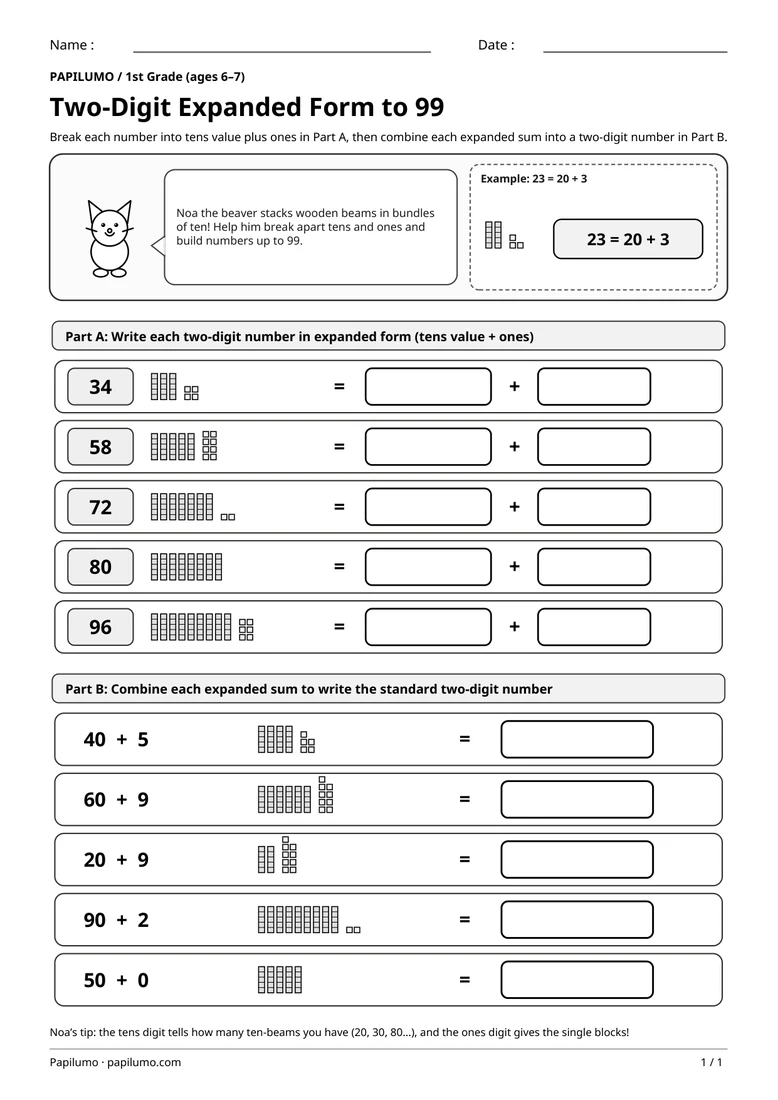
Locating values on a graduated number line builds proportional number sense, sequencing fluency, and flexible use of benchmark numbers like 5, 10, 15, and 20. Instead of always starting back at zero and counting every single tick mark from the beginning, first graders practice starting mid-line at 5 or 10 on zoomed segments and counting forward or backward by ones from the nearest five-step milestone—recognizing 14 as one step before 15, or 19 as one step before 20. These clear visual benchmarks directly support confident mental addition and subtraction jumps. For a related skill, use Two-Digit Expanded Form to 99 with Noa the Beaver (1st Grade): Break each number into tens value plus ones in Part A, then combine each expanded sum into a two-digit number in Part B.
Preparing a short session
Print the student worksheet at actual size (100%) on plain white A4 paper and keep the separate answer key PDF neatly aside until your child finishes every number line. Provide a sharpened pencil and a soft eraser for crisp digit writing inside the small square boxes and flag banners at a quiet table. Before beginning, trace along the 0–10 and 0–20 lines by finger together from left to right, pointing out how taller tick marks highlight every multiple of 5 so students spot benchmarks at a glance.
A concrete example to get started
Inside the framed top banner next to Bibi the frog, a clear worked example shows a mini 0–10 number line with every single tick neatly spaced and numbered. A little frog marker and pointer flag sit directly above tick 6, showing how one unit step past the 5 benchmark lands squarely on 6. Seeing the frog resting right at 6 helps 1st Grade students grasp how tick spacing and pointer arrows pinpoint exact positions before they begin Part A and Part B.
Supporting the activity
Part A gives three crisp ten-step graduated lines—0 to 10, 5 to 15, and 10 to 20—with four missing tick labels per line replaced by clean square boxes underneath so children fill in twelve steady counting gaps. Part B shifts to four full 0–20 number lines labeled only at 0, 5, 10, 15, and 20; two crisp pointer flags on each line point directly to target unit ticks (3 and 8, 6 and 12, 9 and 14, and 17 and 19) for students to identify. To vary the practice, try Two-Digit Number Riddles to 99 with Pico the Detective Fox (1st Grade): Read the clues on each riddle card, circle the single matching number from the three choices, and write it in the answer box.
What to notice and how to check
Once all twelve Part A tick boxes and all eight Part B pointer flags are filled in, place the separate one-page answer key beside your child’s worksheet to verify each mark calmly together. Check the 0–10, 5–15, and 10–20 sequences for smooth counting without skipped ticks or reversed teen digits such as 14 and 41. On the 0–20 lines, invite your child to explain which benchmark—0, 5, 10, 15, or 20—helped them locate each flag quickly and accurately, reinforcing steady number-line confidence.
Making the task easier
Rest your pencil tip on the nearest printed benchmark number and touch each tick mark softly as you count up or down by ones.
Keep the learning aim, but reduce how much the child has to handle at once. Cover part of the page with another sheet and reveal one task at a time. Demonstrate a separate example, then leave a real opportunity to work something out. An answer reached with support is still a useful attempt; it does not yet show that the same task can be completed independently.
Taking the idea beyond the worksheet
Draw your own 0 to 20 number line on scrap paper and place pointer flags at 4, 11, and 18 for a partner to solve.
Use the follow-up to meet the same idea in a different setting. Offer it once the first task makes sense, without insisting that the whole page must be perfect. The child might explain a strategy, make an example or set a challenge for an adult. Return to the worksheet only when it helps connect the two situations. A short conversation or a practical activity can be enough to finish the session. To continue exploring, use Before, Between, and After to 20 with Bibi the Frog: Use the 10–20 number bar to write the number just before, just after, or right between two lily pads.
Downloading and printing the PDF
This free PDF contains one worksheet designed for A4 paper. Download the file using the button on this page and open it in your PDF reader. Choose actual size or a 100% scale, check the orientation in the print preview and turn off any browser headers or footers. The illustrations use vector lines, so their outlines stay sharp when printed. Check the margins on one copy before preparing several sheets for a group. The level shown on the page is a guide, rather than a requirement to complete the activity at a particular age.