What this worksheet helps children practise
Rest your pencil on the black dot and only count “one” when you land on the very next number!
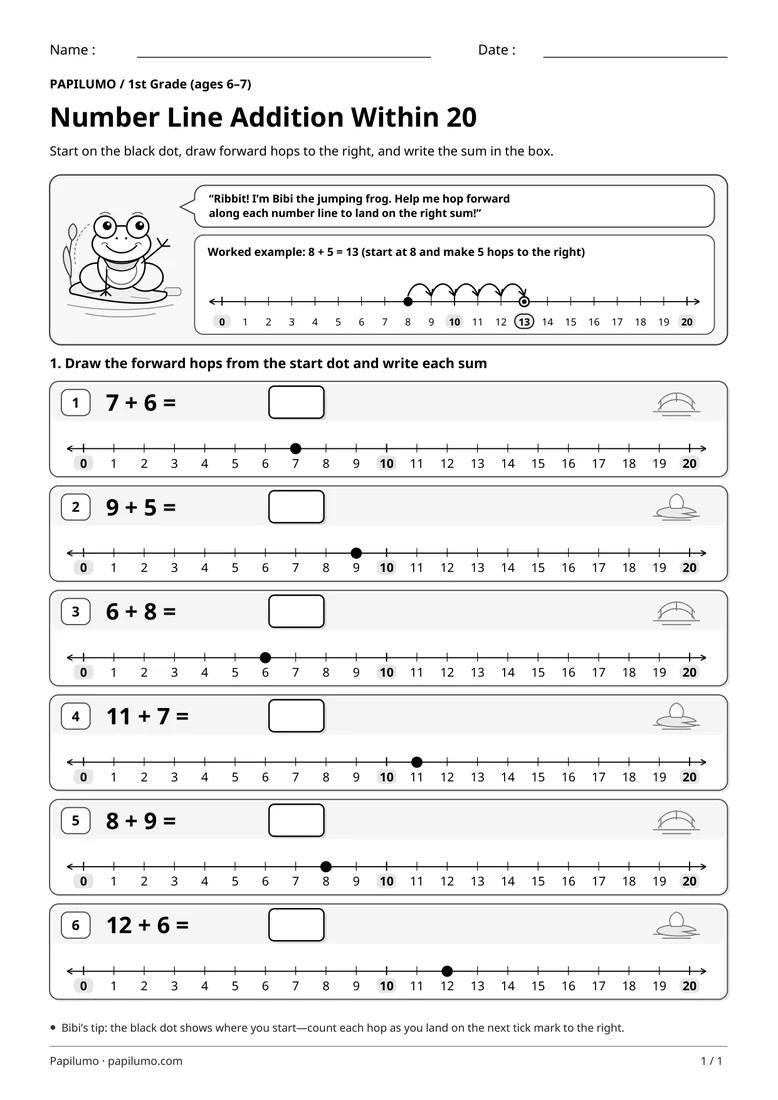
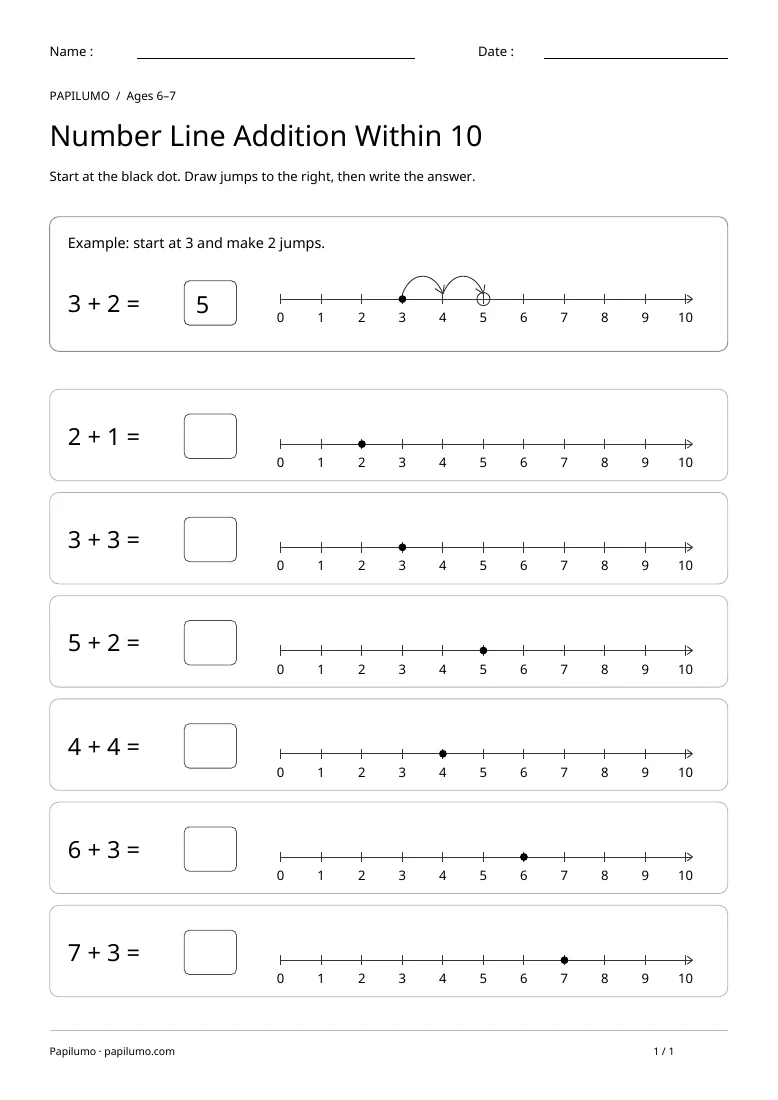
Adding on a number line turns abstract arithmetic into visible forward movement from left to right. Every curved hop between adjacent tick marks represents adding one, helping 1st Graders move smoothly beyond finger counting while strengthening number order from 0 to 20. Highlighted benchmark pills on 0, 10, and 20 make bridging across ten easy to notice and understand. Students build lasting accuracy with addition facts up to 18, learn to distinguish the starting position from the hops counted, and develop mental-math fluency with teen sums. For a related skill, use Number Line Addition Within 10: Start at the black dot. Draw jumps to the right, then write the answer.
Preparing a short session
Print the student worksheet at actual size (100%) on plain white A4 or letter paper so every tick mark from 0 to 20 stays crisp and readable. Set out a sharpened pencil, an eraser, and optionally a small counter or bean for children who benefit from acting out jumps before drawing arcs. Look through Bibi’s worked example together at the top of the page, pointing out 0, 10, and 20 on the axis. Keep the separate answer key PDF out of sight while your child completes all six cards independently.
A concrete example to get started
Inside the top banner next to Bibi the jumping frog, the worked example illustrates 8 + 5 = 13 on its own 0-to-20 number line. A solid black dot marks 8 as the starting spot, showing students where to rest their pencil without counting 8 as a jump. Five neat curved arcs then hop forward one unit at a time—landing on 9, 10, 11, 12, and finally 13. The final arrowhead lands right on 13, which is circled on the axis and written in the model equation, clearly highlighting the bridge past ten.
Supporting the activity
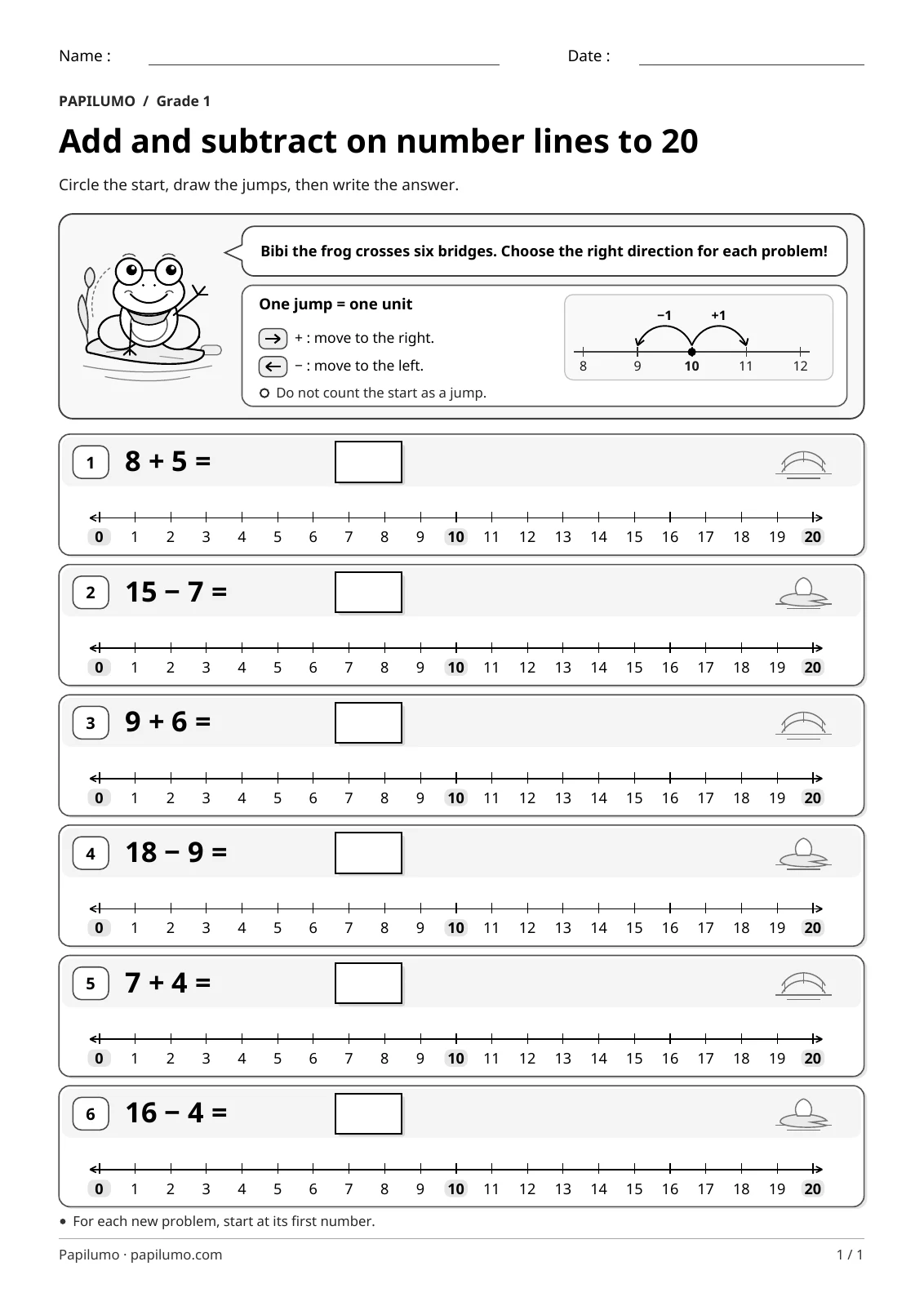
The six numbered cards guide learners through six carefully chosen sums between 13 and 18: 7 + 6, 9 + 5, 6 + 8, 11 + 7, 8 + 9, and 12 + 6. Each card already displays the solid start dot on the first addend so children can begin immediately without hunting for the starting mark. Pupils draw the matching number of single-unit forward hops to the right, circle or note where they land, and write the total inside the large answer box. Four problems cross ten, while 11 + 7 and 12 + 6 extend adding past ten. To vary the practice, try Mixed addition and subtraction on number lines to 20: Circle the start, draw the jumps, then write the answer.
What to notice and how to check
When reviewing finished work against the separate answer key PDF, inspect both the written sums and the drawn hop arcs above every number line. The correct answers are 13, 14, 14, 18, 17, and 18, produced by 6, 5, 8, 7, 9, and 6 forward hops respectively. If an answer is off by one, check whether the student counted the start dot itself as hop number one or accidentally skipped a tick mark. Confirm that every arc connects consecutive whole numbers cleanly right up to the circled landing tick.
Making the task easier
Move a small counter one tick at a time to the right before drawing the curved pencil hops.
Keep the learning aim, but reduce how much the child has to handle at once. Cover part of the page with another sheet and reveal one task at a time. Demonstrate a separate example, then leave a real opportunity to work something out. An answer reached with support is still a useful attempt; it does not yet show that the same task can be completed independently.
Taking the idea beyond the worksheet
Look at card 3 (6 + 8 = 14): how many hops get Bibi from 6 to 10, and how many hops are left?
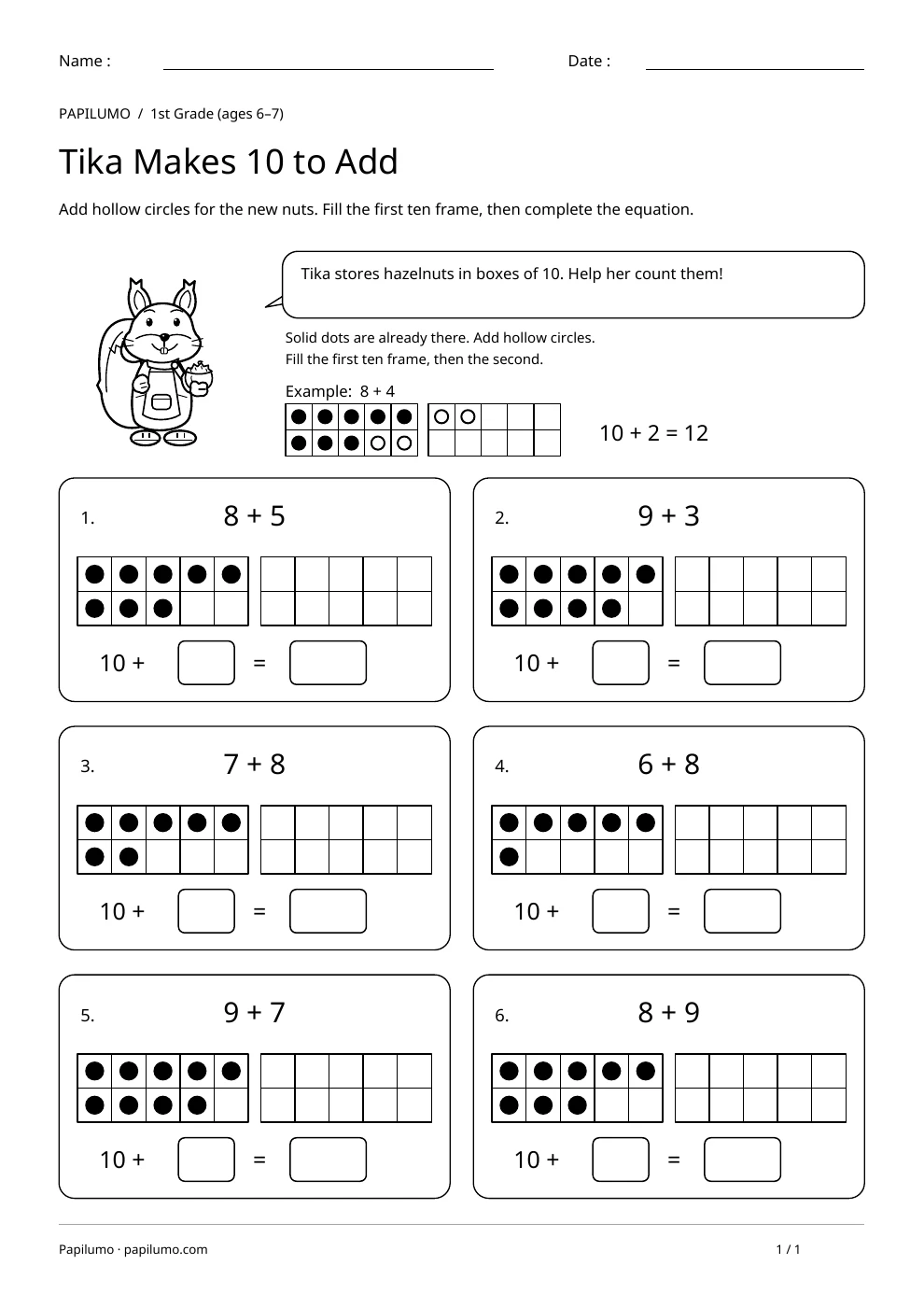
Use the follow-up to meet the same idea in a different setting. Offer it once the first task makes sense, without insisting that the whole page must be perfect. The child might explain a strategy, make an example or set a challenge for an adult. Return to the worksheet only when it helps connect the two situations. A short conversation or a practical activity can be enough to finish the session. To continue exploring, use Addition Within 20: Make 10 with Tika: Add hollow circles for the new nuts. Fill the first ten frame, then complete the equation.
Downloading and printing the PDF
This free PDF contains one worksheet designed for A4 paper. Download the file using the button on this page and open it in your PDF reader. Choose actual size or a 100% scale, check the orientation in the print preview and turn off any browser headers or footers. The illustrations use vector lines, so their outlines stay sharp when printed. Check the margins on one copy before preparing several sheets for a group. The level shown on the page is a guide, rather than a requirement to complete the activity at a particular age.