

What this worksheet helps children practise
Place one finger above an empty box and drop straight down one row to add 10 in an instant!
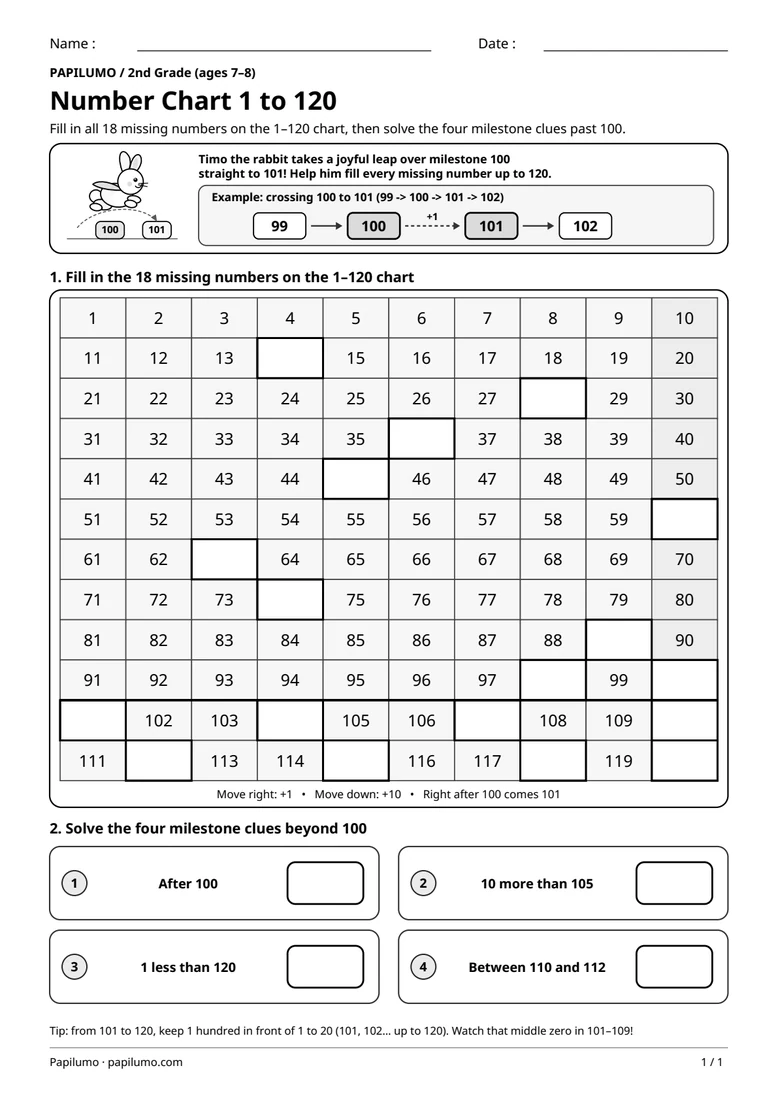
Extending a hundreds chart up to 120 builds deep place-value fluency during second grade. Many young learners count smoothly up to 99 yet stumble when crossing into three-digit numbers, sometimes writing 1001 instead of 101 or losing track at the end of row ten. Working inside a structured ten-column grid proves visually that 101 follows 100 in the exact same way 11 follows 10, while every vertical step down adds one full ten: 104 sits directly below 94, and 115 sits directly beneath 105. For a related skill, use Number Chart 1–100: Read the chart, then complete the small challenges below it.
Preparing a short session
Print the student worksheet at actual size (100%) on plain white letter or A4 paper without shrinking the margins, and provide a sharpened pencil with a soft eraser. Keep the separate answer key completely out of sight while your child works. Before writing the first digit, trace one finger slowly across row ten from 91 to 100 and sweep smoothly down to the start of row eleven at 101. Read the short story and worked example banner beside Timo the rabbit aloud together so the hundred crossing feels natural.
A concrete example to get started
In the top example panel, Timo the rabbit clears the 100 milestone in one springy hop onto 101. Four linked number tiles display 99, 100, 101, and 102 side by side so students immediately see how ninety-nine transitions into one hundred, then one hundred one, and finally one hundred two. Pointing out the zero placeholder in the tens column for every number from 101 through 109 prevents common three-digit writing slips before children begin filling in the missing boxes across the full grid.
Supporting the activity
In Part 1, students fill eighteen open boxes spaced evenly down the chart: 14, 28, 36, 45, 60, 63, 74, and 89 warm up tens and ones patterns, followed by focused milestone practice at 98, 100, 101, 104, 107, 110, 112, 115, 118, and 120. Learners can verify each entry horizontally (+1 or -1) and vertically (+10). In Part 2, four concise bridge clues reinforce numbers past 100: after 100 (101), 10 more than 105 (115), 1 less than 120 (119), and between 110 and 112 (111). To vary the practice, try Missing numbers 51 to 100: complete the chart: Write the missing numbers. Count on by 1 across each row.
What to notice and how to check
When reviewing with the separate one-page answer key, where every filled number stands out clearly on a shaded tile with bold print, check the bottom three rows from 98 to 120 first. Confirm that zero placeholders appear cleanly in 101, 104, and 107, and verify that the right-hand tens column aligns 60, 100, 110, and 120 cleanly from top to bottom. Next, check all four Part 2 answers (101, 115, 119, and 111) while having your child point back to each spot on the chart and read the number aloud.
Making the task easier
Lightly circle the given tens down the right edge (10, 20, 30, 40, 50, 70, 80, 90) before filling the blanks.
Keep the learning aim, but reduce how much the child has to handle at once. Cover part of the page with another sheet and reveal one task at a time. Demonstrate a separate example, then leave a real opportunity to work something out. An answer reached with support is still a useful attempt; it does not yet show that the same task can be completed independently.
Taking the idea beyond the worksheet
Pick three numbers between 101 and 120 and write new “10 more” or “1 less” clues for a partner.
Use the follow-up to meet the same idea in a different setting. Offer it once the first task makes sense, without insisting that the whole page must be perfect. The child might explain a strategy, make an example or set a challenge for an adult. Return to the worksheet only when it helps connect the two situations. A short conversation or a practical activity can be enough to finish the session. To continue exploring, use Counting Across 100 (95 to 120) with Timo: Write the missing numbers on each train car, then count the hundred flats, ten-rods, and unit cubes to write each number.
Downloading and printing the PDF
This free PDF contains one worksheet designed for A4 paper. Download the file using the button on this page and open it in your PDF reader. Choose actual size or a 100% scale, check the orientation in the print preview and turn off any browser headers or footers. The illustrations use vector lines, so their outlines stay sharp when printed. Check the margins on one copy before preparing several sheets for a group. The level shown on the page is a guide, rather than a requirement to complete the activity at a particular age.