

What this worksheet helps children practise
A child may put the result in the box or ignore the number after =. Remind them what is missing, then point to the result they need to reach. If + is unclear, distinguish its two crossing strokes from the single stroke of −. Listen to the explanation before correcting the writing: choosing an operation and forming its sign are separate skills to notice.
The activity asks children to choose an operation from an incomplete equation. The + sign means adding the second amount to the first; the − sign means taking it away. The number after = is the result that must be reached. Children need to consider all three numbers, rather than simply recognize the signs. Every second amount is greater than zero, so adding makes the starting amount larger and taking away makes it smaller. Each card has one valid sign, with no negative result or calculation beyond 10 required. For a related skill, use Picture Addition and Subtraction: Write Number Sentences: Count and write three numbers. Crossed-out objects are included in the starting amount.
Preparing a short session
Print at actual size and keep the key aside. Provide a pencil and, if useful, ten small objects for working beside the worksheet. Introduce Bao's problem and point to the box between the numbers. Find both signs in the legend: add and take away. Read one card aloud, pausing at the box. Point out the printed result after the equals sign, which tells the child what the chosen action needs to produce.
A concrete example to get started
The model shows 3 + 2 = 5. Begin with three objects, add two, and count the five objects together. That is why + fills the box. Choosing − would mean taking two away from three, leaving one instead of the printed 5. Read the completed equation. This example connects the sign with a change in amount before asking for a choice on the eight cards. Let the child describe the action in everyday words.
Supporting the activity
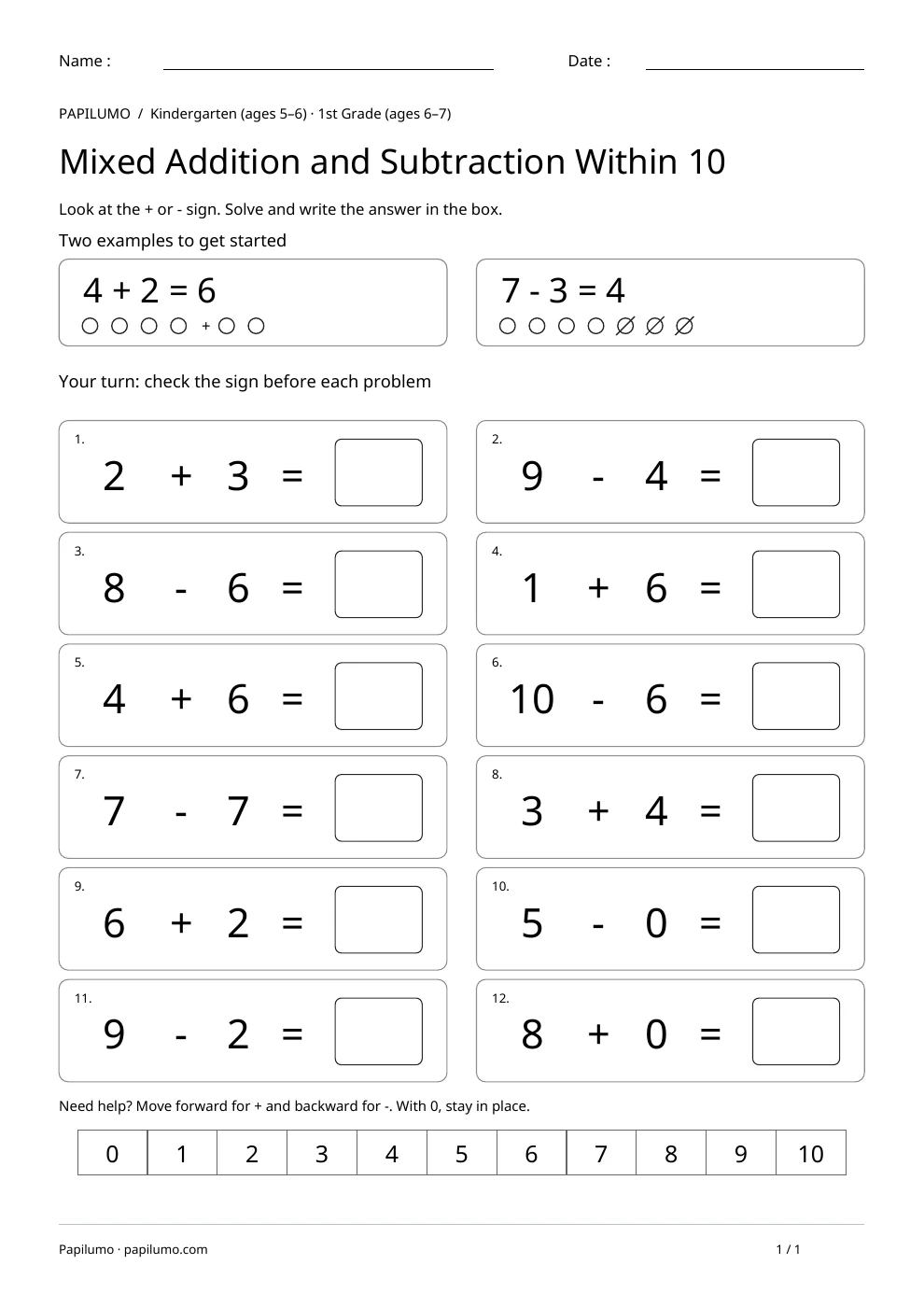
Work through one card at a time in worksheet order. First look at the starting number and expected result: should the amount become larger or smaller? Try that action using the second amount, then check the result. For 3 box 4 = 7, combining three and four makes seven, so write +. Place the sign in the middle of the box. Begin the reasoning again for every card, even when identical signs occur consecutively. The worksheet does not ask children to continue an alternating sign pattern. To vary the practice, try Mixed Addition and Subtraction Within 10: Look at the + or - sign. Solve and write the answer in the box.
What to notice and how to check
In order, the signs are +, −, +, −, −, +, −, and +. The completed cards show 3+4=7, 8−3=5, 6+2=8, 9−4=5, 7−2=5, 4+5=9, 10−6=4, and 2+6=8. Compare choices with the key and reread several equations. If a sign is wrong, compare the starting number with the expected result, then check the suitable action. Do not require negative numbers: for 2 box 6 = 8, six can be added, but six objects cannot be taken from a collection of two.
Making the task easier
Begin with one addition card and one subtraction card, using objects. The adult reads the numbers while the child chooses the action and writes its sign. Cover the remaining cards if they distract. Return to two new cards with less support, without requiring mental calculation.
Keep the learning aim, but reduce how much the child has to handle at once. Cover part of the page with another sheet and reveal one task at a time. Demonstrate a separate example, then leave a real opportunity to work something out. An answer reached with support is still a useful attempt; it does not yet show that the same task can be completed independently.
Taking the idea beyond the worksheet
Choose a completed card and ask why the other sign would not work. Use a card where both actions can be shown with objects, such as 7−2=5. The child can compare the two results aloud and explain which one makes the equation true, without adding another written answer.
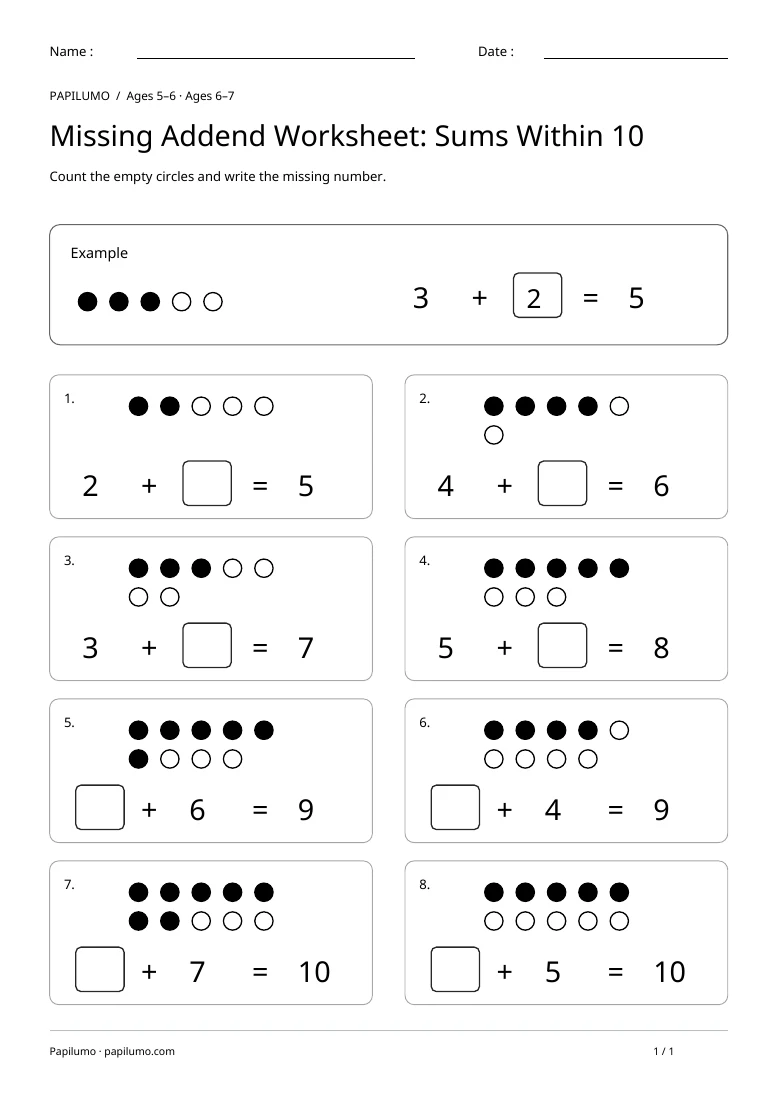
Use the follow-up to meet the same idea in a different setting. Offer it once the first task makes sense, without insisting that the whole page must be perfect. The child might explain a strategy, make an example or set a challenge for an adult. Return to the worksheet only when it helps connect the two situations. A short conversation or a practical activity can be enough to finish the session. To continue exploring, use Missing Addend Worksheet: Sums Within 10: Count the empty circles and write the missing number.
Downloading and printing the PDF
This free PDF contains one worksheet designed for A4 paper. Download the file using the button on this page and open it in your PDF reader. Choose actual size or a 100% scale, check the orientation in the print preview and turn off any browser headers or footers. The illustrations use vector lines, so their outlines stay sharp when printed. Check the margins on one copy before preparing several sheets for a group. The level shown on the page is a guide, rather than a requirement to complete the activity at a particular age.