What this worksheet helps children practise
Ask your child to say aloud whether each column totals 10 or more before moving left so carried tens and hundreds are never skipped.
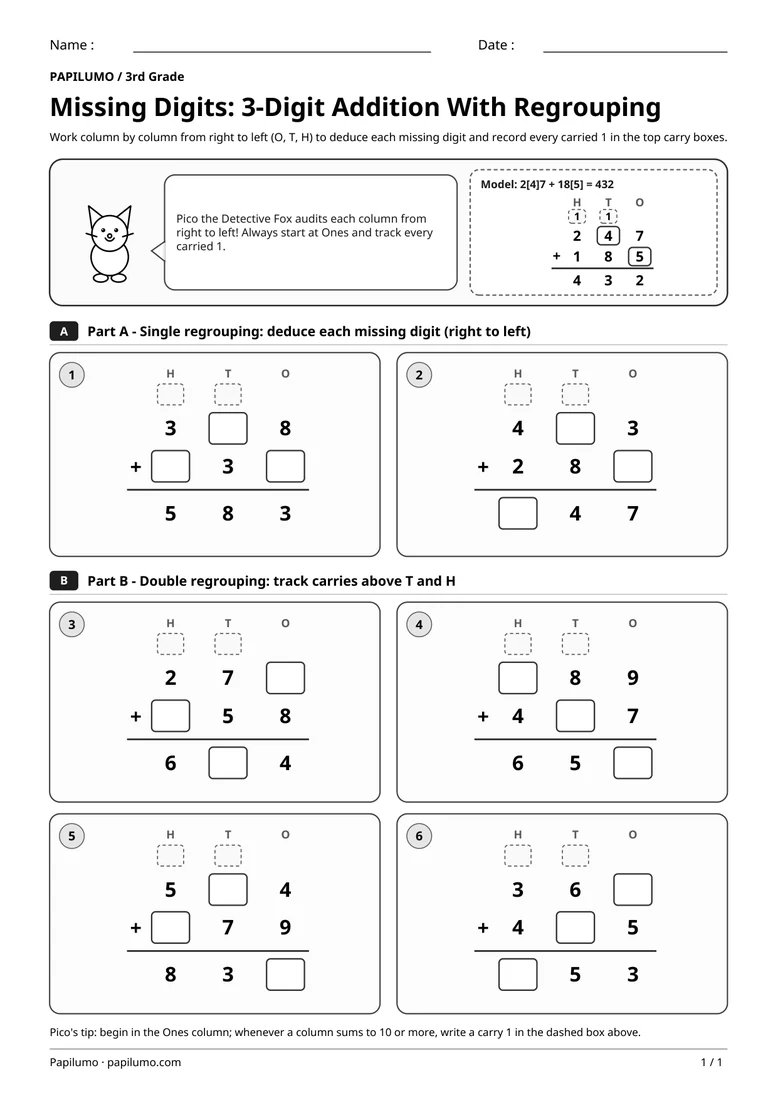
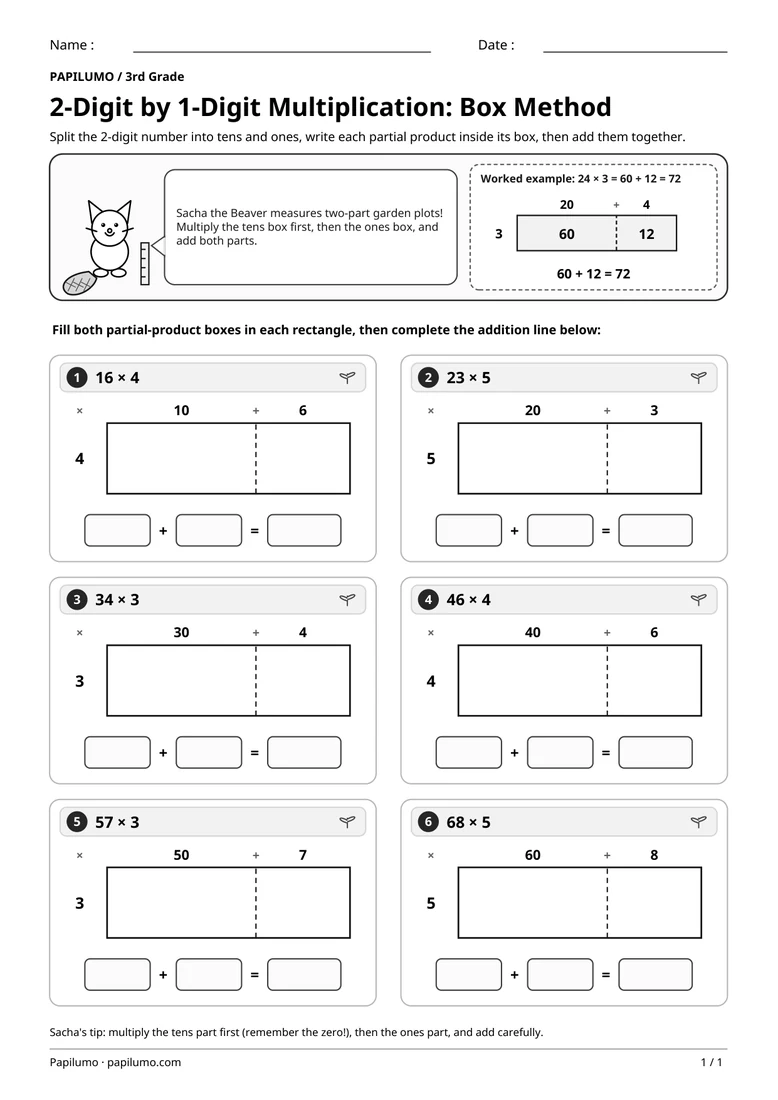
Across six spacious detective puzzles, learners connect three essential 3rd grade arithmetic competencies: reasoning backward to find an unknown addend or sum digit, recognizing when a bottom sum digit smaller than a given top digit signals a two-digit column total requiring regrouping, and carrying that exact 1 across from Ones into Tens and from Tens into Hundreds. Dedicated dashed carry boxes train tidy place-value habits and prevent off-by-one column errors across multi-digit vertical calculations. For a related skill, use 2-Digit by 1-Digit Multiplication: Area Model / Box Method with Sacha: Split the 2-digit number into tens and ones, write each partial product inside its box, then add them together.
Preparing a short session
Print the student worksheet on a single plain white A4 page in sharp black and white and provide a sharpened pencil and soft eraser. No cutting, folding, or extra cards are needed: six large H, T, O puzzle cards arranged in a clean 2-by-3 grid provide wide column spacing, dashed carry boxes at the top, and bold framed blanks for every missing digit. A focused 15-to-20-minute session fits homework, a math detective station, or guided classroom practice while keeping the one-page answer key separate.
A concrete example to get started
In the framed top banner beside Pico the Detective Fox, the worked model clearly solves 2[4]7 + 18[5] = 432 step by step. In the Ones column, 7 plus an unknown digit ends in 2, so 7 + 5 = 12 puts 5 neatly inside the bottom blank and carries 1 above Tens. Next, 1 + [ ] + 8 ends in 3, yielding 4 inside the top Tens blank and carrying 1 above Hundreds so 1 + 2 + 1 = 4 checks out cleanly.
Supporting the activity
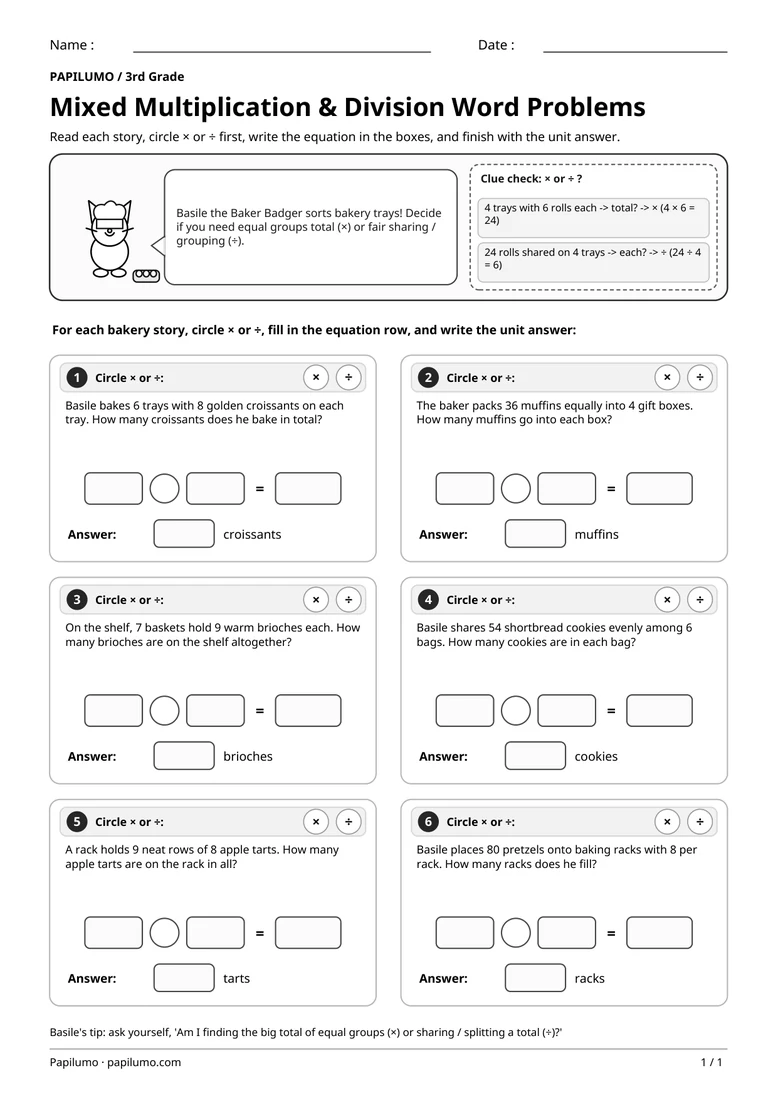
Six roomy vertical puzzles progress thoughtfully from single carries into full double regrouping. Cards 1 and 2 each isolate one regrouping step (3[4]8 + [2]3[5] = 583 carrying neatly into Tens, and 4[6]3 + 28[4] = [7]47 carrying neatly into Hundreds). Cards 3 through 6 require two carries across both Ones and Tens columns: 27[6] + [3]58 = 6[3]4, [1]89 + 4[6]7 = 65[6], 5[5]4 + [2]79 = 83[3], and 36[8] + 4[8]5 = [8]53. To vary the practice, try Mixed Multiplication & Division Word Problems Within 100 with Basile: Read each story, circle × or ÷ first, write the equation in the boxes, and finish with the unit answer.
What to notice and how to check
When all six vertical grids are completely and neatly filled in, place the separate one-page answer key PDF right beside your child's completed worksheet for calm, thorough column-by-column verification together. Every solved card displays bold missing digits inside each framed box together with the exact carried 1 printed clearly inside the active top dashed carry boxes (T in Card 1, H in Card 2, and both T and H in Cards 3 through 6). Whenever a Tens or Hundreds digit misses by exactly one, first check carefully whether a small carried 1 was overlooked at the top before carefully recounting the full vertical column from top to bottom and confirming the final sum stays neatly below one thousand.
Making the task easier
Check the Ones column aloud first and lightly circle the dashed carry box above Tens whenever the sum reaches 10 or higher.
Keep the learning aim, but reduce how much the child has to handle at once. Cover part of the page with another sheet and reveal one task at a time. Demonstrate a separate example, then leave a real opportunity to work something out. An answer reached with support is still a useful attempt; it does not yet show that the same task can be completed independently.
Taking the idea beyond the worksheet
Invite your child to design one new 3-digit addition puzzle under 1,000 with two carries and three blank boxes on the back.
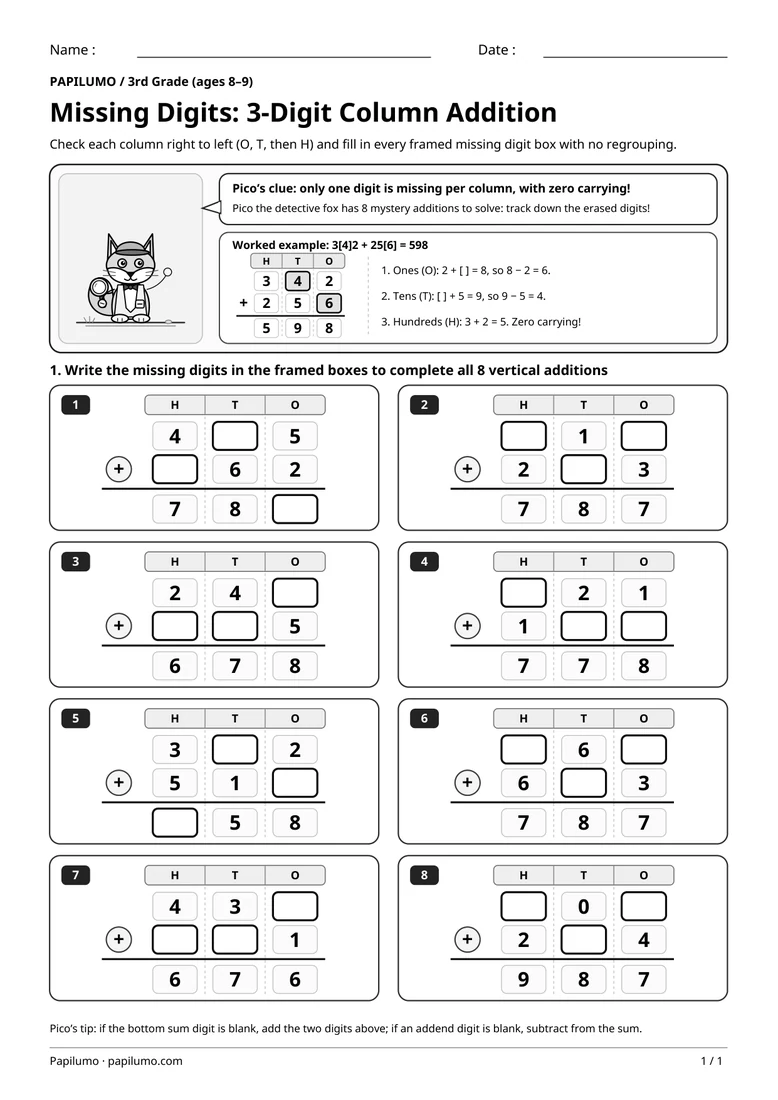
Use the follow-up to meet the same idea in a different setting. Offer it once the first task makes sense, without insisting that the whole page must be perfect. The child might explain a strategy, make an example or set a challenge for an adult. Return to the worksheet only when it helps connect the two situations. A short conversation or a practical activity can be enough to finish the session. To continue exploring, use Missing Digits in 3-Digit Vertical Addition (No Regrouping) with Pico: Check each column right to left (O, T, then H) and fill in every framed missing digit box with no regrouping.
Downloading and printing the PDF
This free PDF contains one worksheet designed for A4 paper. Download the file using the button on this page and open it in your PDF reader. Choose actual size or a 100% scale, check the orientation in the print preview and turn off any browser headers or footers. The illustrations use vector lines, so their outlines stay sharp when printed. Check the margins on one copy before preparing several sheets for a group. The level shown on the page is a guide, rather than a requirement to complete the activity at a particular age.